
凯哥的进击
402 Posts

凯哥的进击
预期收益1年4倍|定比跟单,用闲钱跟一年|跟单有风险,盈亏自负|进粉丝群获取多种实操资讯|粉丝超级VIP返佣邀请码:KAIGE838
High-Frequency Trader
8.2 Months
421 Following
29.4K+ Followers
14.0K+ Liked
Posts
All
Quotes
Live
PINNED
🎁🎁Reply today to claim your red envelope🎁🎁$SOL
🌹Thank you for your help in forwarding and sharing🌹
🌹Thank you for your help in forwarding and sharing🌹

go

Dream Spicer 梦想家
·
--
The Dusk consensus problem I didn’t notice at first.
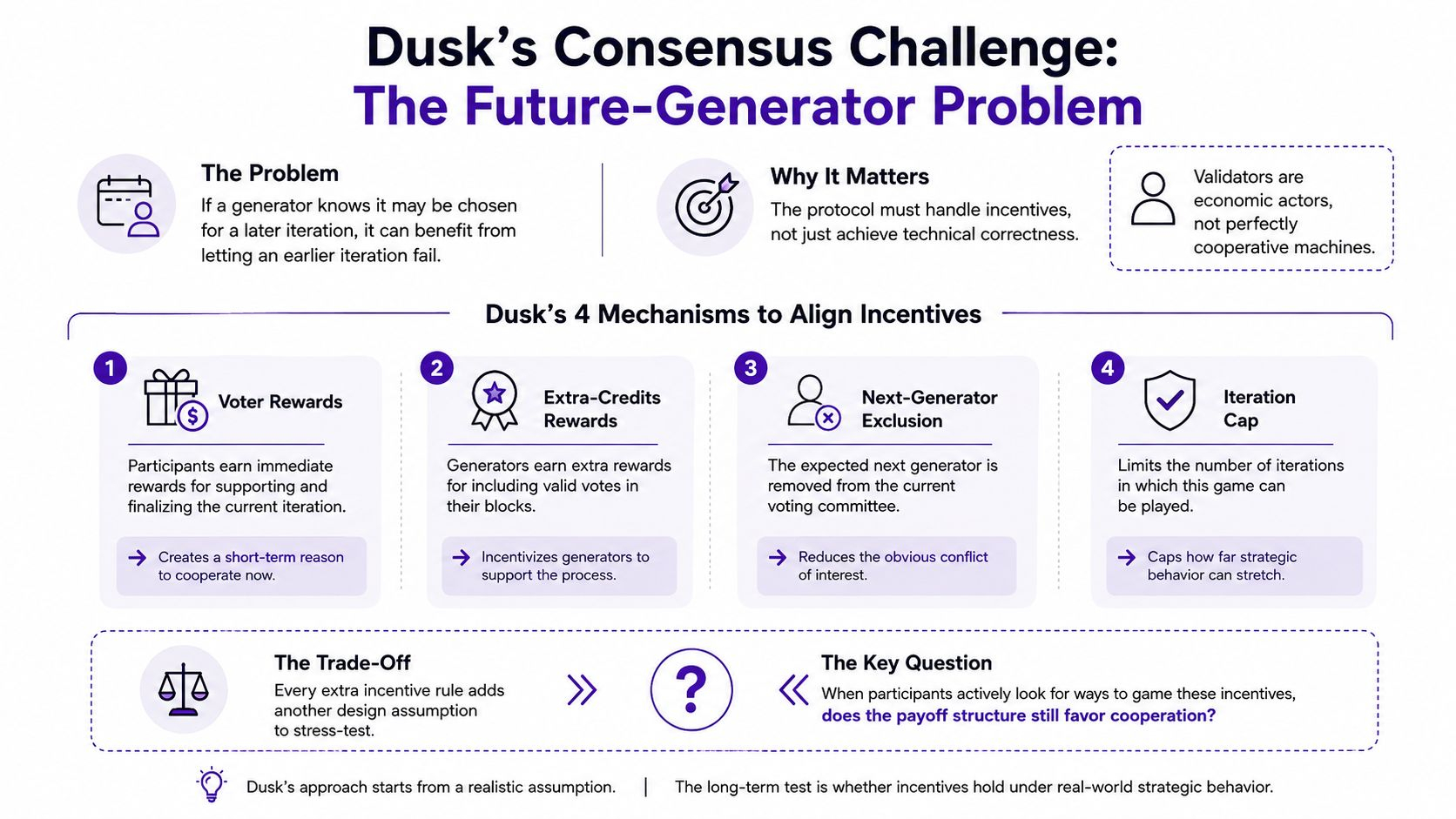
While going deeper into @Dusk , I found the future generator problem more interesting than the usual consensus discussion.
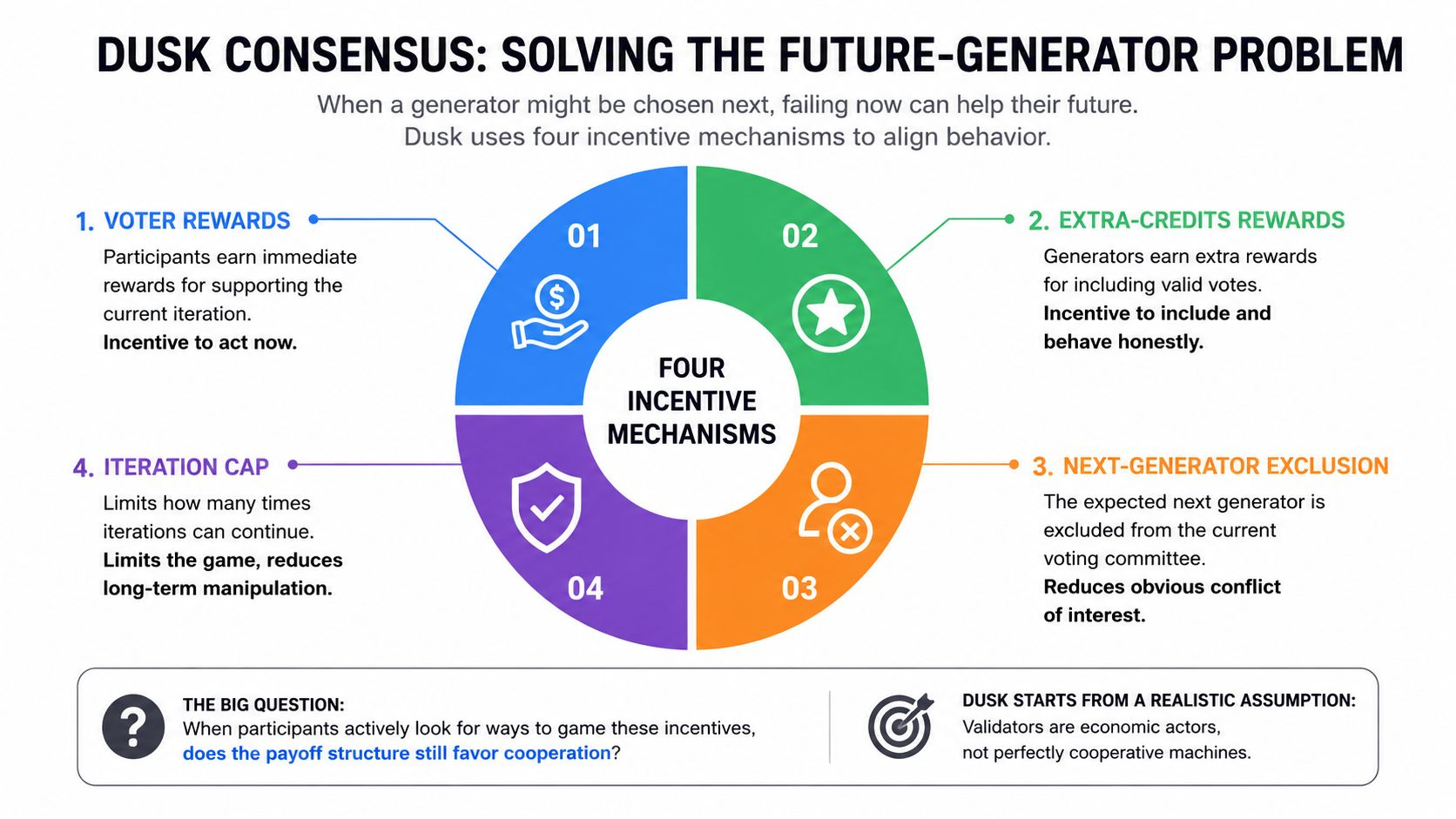
The basic issue is pretty simple. If a generator knows it may be chosen for a later iteration, there can be a reason to let an earlier iteration fail. That failure could improve its own chance to become the next useful generator. So the protocol has to deal with incentives, not just technical correctness.
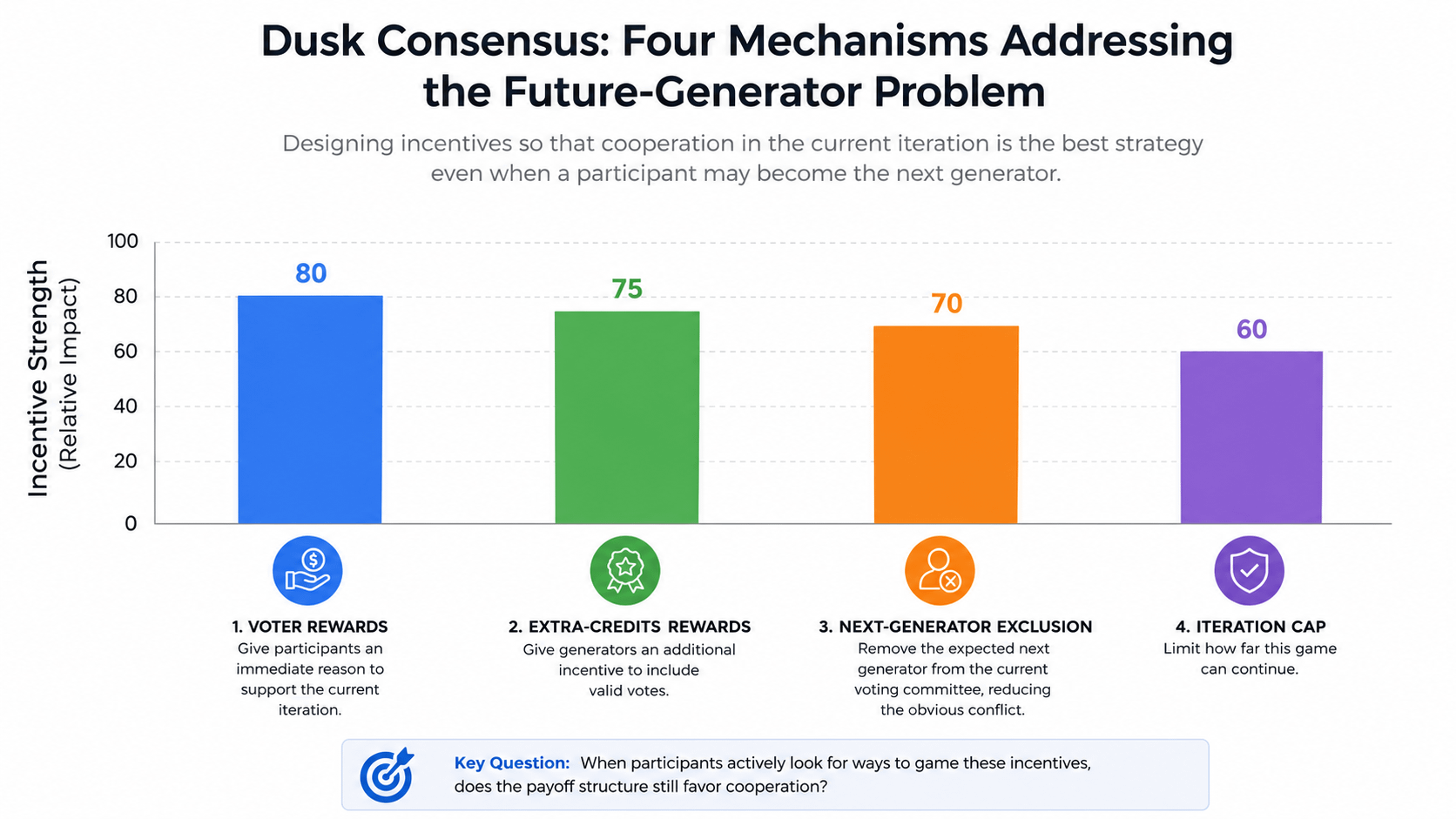
$DUSK approaches it with four mechanisms.
Voter rewards give participants an immediate reason to support the current iteration.
Extra credits rewards give generators another incentive to include valid votes.
Next generator exclusion removes the expected next generator from the current voting committee, reducing the obvious conflict.
And the iteration cap limits how far this game can continue.
I like this because it starts from a realistic assumption validators are economic actors, not perfectly cooperative machines.
The trade off is that every extra incentive rule adds another design assumption to stress test.
So the question I’m left with is.
When participants actively look for ways to game these incentives, does the payoff structure still favor cooperation?
That’s the part of Dusk consensus I’ll be watching.
#dusk #DUSK #Dusk
While going deeper into @Dusk , I found the future generator problem more interesting than the usual consensus discussion.
The basic issue is pretty simple. If a generator knows it may be chosen for a later iteration, there can be a reason to let an earlier iteration fail. That failure could improve its own chance to become the next useful generator. So the protocol has to deal with incentives, not just technical correctness.
$DUSK approaches it with four mechanisms.
Voter rewards give participants an immediate reason to support the current iteration.
Extra credits rewards give generators another incentive to include valid votes.
Next generator exclusion removes the expected next generator from the current voting committee, reducing the obvious conflict.
And the iteration cap limits how far this game can continue.
I like this because it starts from a realistic assumption validators are economic actors, not perfectly cooperative machines.
The trade off is that every extra incentive rule adds another design assumption to stress test.
So the question I’m left with is.
When participants actively look for ways to game these incentives, does the payoff structure still favor cooperation?
That’s the part of Dusk consensus I’ll be watching.
#dusk #DUSK #Dusk
go


静心1688
·
--
💥The highest good is like water. Water benefits all things and does not contend; it dwells in places that people disdain, and thus it is close to the Way.
💥The highest goodness is like water: it nurtures all things, keeps peace with the world, is content with low places, and is closest to the Way.
#以太坊ETF周净流入6.97亿美元
💥The highest goodness is like water: it nurtures all things, keeps peace with the world, is content with low places, and is closest to the Way.
#以太坊ETF周净流入6.97亿美元

go

Bitroot铄鸿
·
--
Flowing clouds pass through mountain peaks; they do not cling to the mortal world. Unfolding or gathering, utterly at ease—wandering serenely with the vast heavens and earth!
Floating clouds drift o’er the hills, clinging no mortal land; rolling free and easy, following heaven’s gentle hand!
Floating clouds drift o’er the hills, clinging no mortal land; rolling free and easy, following heaven’s gentle hand!
go

Bilverse
·
--
🔥 BNB BIG REWARDS GIVEAWAY! 🎁
Want to claim your reward? 👀💰
It’s super simple:
1️⃣ Follow BILVERSE
2️⃣ Comment “999” 👇
That’s it! 🎉
🔥 Big rewards, stronger community!
Click here to DOUBLE your Rewards! 🧧🚀
Join the BILVERSE Army and let’s grow together. 🚀🌎
#BNB #RedPacketMission #Bilverse #CryptoCommunity
Want to claim your reward? 👀💰
It’s super simple:
1️⃣ Follow BILVERSE
2️⃣ Comment “999” 👇
That’s it! 🎉
🔥 Big rewards, stronger community!
Click here to DOUBLE your Rewards! 🧧🚀
Join the BILVERSE Army and let’s grow together. 🚀🌎
#BNB #RedPacketMission #Bilverse #CryptoCommunity

go

DIYA_加密
·
--
🧧🎁 Red Packet is here!
Don’t miss your chance to claim your reward. 💰✨
#RedPacket #Crypto #Rewards
Don’t miss your chance to claim your reward. 💰✨
#RedPacket #Crypto #Rewards
go

NAJAF_加密 143
·
--
BNB has evolved from Binance’s exchange utility token into one of the most important assets in the crypto ecosystem. Its biggest strength is utility: BNB is used to pay gas fees on BNB Smart Chain, support staking, and power transactions across a large Web3 ecosystem.
🔥 Another key factor is BNB’s token-burning mechanism, which reduces supply over time and can create deflationary pressure.
📊 Current market position: As of August 24, 2026, BNB is trading around $700, with a market capitalization of roughly $93 billion, placing it around #5 among cryptocurrencies by market cap according to CoinMarketCap’s live data.
BNB’s importance comes from the combination of exchange utility + blockchain usage + staking + token burns + a large ecosystem.
The future of BNB will depend on BNB Chain adoption, Binance’s ecosystem strength, competition from other Layer-1 networks, and regulatory developments.
BNB is no longer simply a “Binance token” — it has become a major infrastructure asset in the crypto market. 🔶
$BNB #Binance #BNBChain #Crypto #Web3 #Blockchain
🔥 Another key factor is BNB’s token-burning mechanism, which reduces supply over time and can create deflationary pressure.
📊 Current market position: As of August 24, 2026, BNB is trading around $700, with a market capitalization of roughly $93 billion, placing it around #5 among cryptocurrencies by market cap according to CoinMarketCap’s live data.
BNB’s importance comes from the combination of exchange utility + blockchain usage + staking + token burns + a large ecosystem.
The future of BNB will depend on BNB Chain adoption, Binance’s ecosystem strength, competition from other Layer-1 networks, and regulatory developments.
BNB is no longer simply a “Binance token” — it has become a major infrastructure asset in the crypto market. 🔶
$BNB #Binance #BNBChain #Crypto #Web3 #Blockchain

go

大仁Jaron
·
--
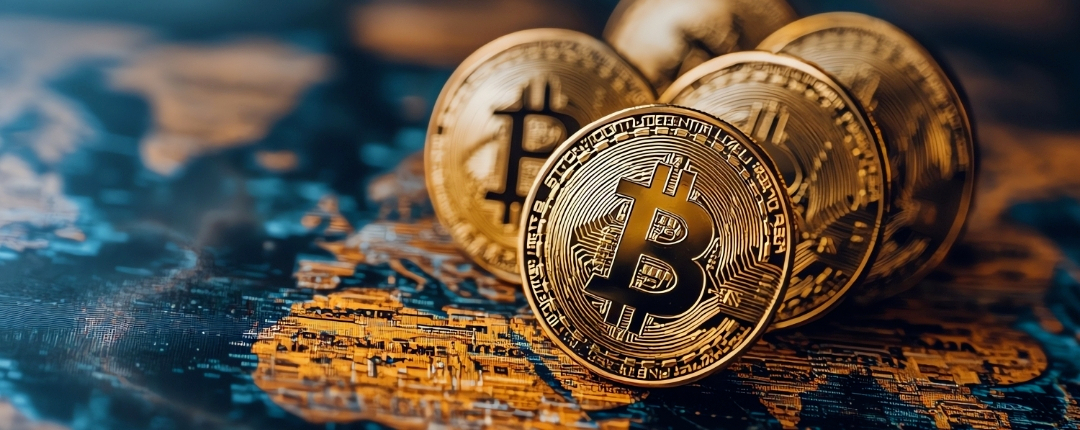
U.S. Bets on Stablecoins [ Takeover ] as It Sells Off $29 Billion in Short-Term Treasuries
In June, foreign investors had a total net inflow of $133.5 billion into U.S. financial markets, but during the same period they sold $29.0 billion worth of Treasury bills.
Two sets of data show two distinctly different directions of capital flows within the same month: most incoming funds flowed toward the U.S. stock market, but demand for U.S. government debt weakened significantly. Foreign buyers purchased $181.4 billion worth of U.S. stocks, but only $6.8 billion in long-term Treasury bonds; in the short-term bond segment, they sold off Treasury bills that are often used as a cash reservoir.
This divergence in capital flows also helps explain why stablecoins were included in the U.S. government debt-response strategy. Stablecoin issuers such as Tether and Circle typically allocate most of the reserve assets supporting the value of their tokens to Treasury bills and similar assets. If overseas buyers continue to reduce their holdings of Treasury bills, the rapidly growing stablecoin sector—potentially on a scale comparable to, and with demand power that could rival, overseas capital—may become another significant force. The June data shows that this industry already has a sufficient size, but the recent token-issuance scale is small and cannot by itself account for the $29.0 billion in selling pressure.
Two sets of data show two distinctly different directions of capital flows within the same month: most incoming funds flowed toward the U.S. stock market, but demand for U.S. government debt weakened significantly. Foreign buyers purchased $181.4 billion worth of U.S. stocks, but only $6.8 billion in long-term Treasury bonds; in the short-term bond segment, they sold off Treasury bills that are often used as a cash reservoir.
This divergence in capital flows also helps explain why stablecoins were included in the U.S. government debt-response strategy. Stablecoin issuers such as Tether and Circle typically allocate most of the reserve assets supporting the value of their tokens to Treasury bills and similar assets. If overseas buyers continue to reduce their holdings of Treasury bills, the rapidly growing stablecoin sector—potentially on a scale comparable to, and with demand power that could rival, overseas capital—may become another significant force. The June data shows that this industry already has a sufficient size, but the recent token-issuance scale is small and cannot by itself account for the $29.0 billion in selling pressure.
go

Crypto狼少
·
--
$BTC $ETH $BNB
Money red packet dropping 🧧🧧🧧
✅ Follow
❤️ Like
🔄 Share
💬 Comment
🎁 You can now get free crypto rewards 🎁🎁🎁
Money red packet dropping 🧧🧧🧧
✅ Follow
❤️ Like
🔄 Share
💬 Comment
🎁 You can now get free crypto rewards 🎁🎁🎁

go
灼见
·
--
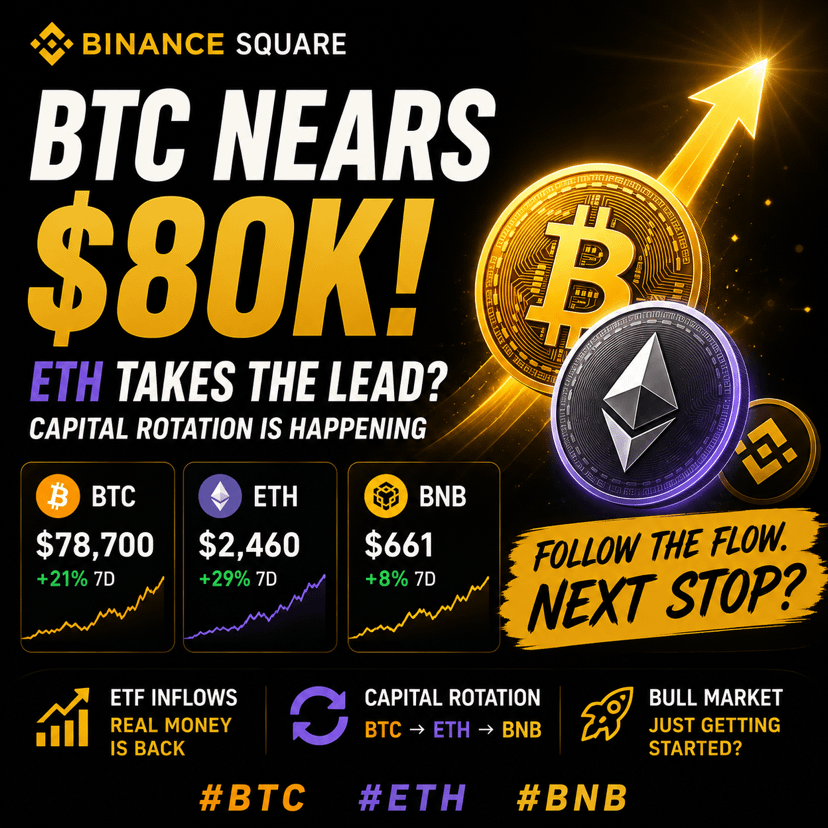
🔥 BTC is still pushing toward $80K, but what may be even more worth watching today is ETH.
Over the past week, the crypto market went through a very rapid correction.
$BTC has rallied from the lows and is still holding around $78K, not far from the $80K psychological level.
But a new change is emerging:
ETH is starting to clearly outperform BTC.
Over the past week, ETH’s cumulative gain is close to 29%, noticeably higher than BTC’s同期約21% rise; at the same time, Ethereum spot ETFs recorded about $697M in net inflows last week.
This suggests a signal worth paying attention to:
Capital may be shifting from “BTC leading alone” toward a broader mainstream asset rotation.
BTC is responsible for kick-starting market sentiment.
ETH is starting to attract the capital.
What to watch next is whether this rotational momentum can keep spreading.
📊 Right now, I’m paying more attention to three signals:
🔹 Whether BTC can hold steady around $80K
🔹 Whether ETH’s relative strength vs. BTC can continue
🔹 Whether mainstream assets like BNB can become the direction for the next wave of capital spread
If BTC stays strong at high levels while ETH continues to outperform, then the focus of market discussion may gradually shift from:
“How much more can BTC rise?”
to:
“Where will the next leg of capital go?”
Once the market reaches this phase, looking at BTC alone isn’t enough.
What’s truly worth tracking is the rotation of capital.
👇 Who are you watching more closely in the next phase?
BTC / ETH / BNB
#BTC #ETH #BNB
Over the past week, the crypto market went through a very rapid correction.
$BTC has rallied from the lows and is still holding around $78K, not far from the $80K psychological level.
But a new change is emerging:
ETH is starting to clearly outperform BTC.
Over the past week, ETH’s cumulative gain is close to 29%, noticeably higher than BTC’s同期約21% rise; at the same time, Ethereum spot ETFs recorded about $697M in net inflows last week.
This suggests a signal worth paying attention to:
Capital may be shifting from “BTC leading alone” toward a broader mainstream asset rotation.
BTC is responsible for kick-starting market sentiment.
ETH is starting to attract the capital.
What to watch next is whether this rotational momentum can keep spreading.
📊 Right now, I’m paying more attention to three signals:
🔹 Whether BTC can hold steady around $80K
🔹 Whether ETH’s relative strength vs. BTC can continue
🔹 Whether mainstream assets like BNB can become the direction for the next wave of capital spread
If BTC stays strong at high levels while ETH continues to outperform, then the focus of market discussion may gradually shift from:
“How much more can BTC rise?”
to:
“Where will the next leg of capital go?”
Once the market reaches this phase, looking at BTC alone isn’t enough.
What’s truly worth tracking is the rotation of capital.
👇 Who are you watching more closely in the next phase?
BTC / ETH / BNB
#BTC #ETH #BNB
go

周周1688
·
--
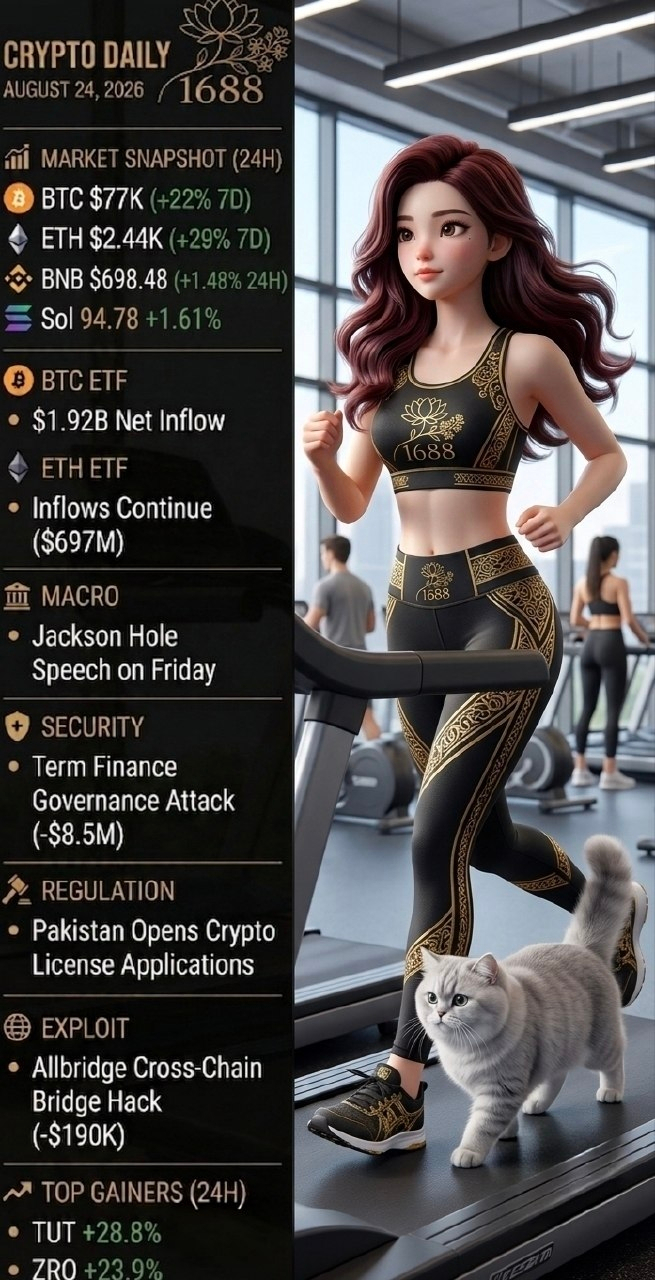
🚀 August 24|Crypto Daily News
$BNB 🧧🧧
🔥 BTC $77K: Surges then enters consolidation
Last week, BTC surged from about $64K to nearly $80K; this week, it has started trading in a high-range consolidation.
BTC is currently around $77,000–$77,600, with the weekly gain still at 22–23%; ETH is about $2,430–$2,460, with a weekly gain close to 30%. The total market cap for the whole market is about $2.7 trillion.
💰 BTC ETF: $1.92B net inflow
Last week, US spot BTC ETFs saw net inflows of about $1.92B, becoming one of the strongest weeks in the past few months.
Institutional capital continues to flow in, providing an important support that helps the current rally stay at high levels.
🏦 ETH ETF: Institutional capital continues to enter
Last week, US spot ETH ETFs recorded net inflows of about $697M.
ETH briefly broke back above $2,500, and ongoing buying by large holders also shows that market confidence in ETH remains strong.
⏳ Jackson Hole: Biggest macro focus this week
The market is waiting for Fed Chair Kevin Warsh’s speech at Jackson Hole on Friday.
Investors will focus on signals related to interest rates, inflation, and future monetary policy.
⚠️ Term Finance suffers a governance attack: losses of about $8.5M
The DeFi lending protocol Term Finance was hit by a governance attack. The attacker gained enough voting power to take control of the governance process and transferred assets.
This incident once again reminds the market: DeFi risks come not only from smart contracts, but also from the governance mechanisms themselves.
🇵🇰 Pakistan opens crypto license application
Pakistan has officially launched a portal for virtual asset service provider license applications.
Existing VASPs must submit applications by September 5; otherwise, they will face requirements to stop related business.
🌉 Allbridge cross-chain bridge attacked, losses of about $190K
The attacker used forged cross-chain messages to bypass the verification mechanism, resulting in losses of about $190K in assets.
Security issues remain an important risk point in the current DeFi ecosystem.
📈 Gainers/Losers today
🥇 TUT +28.8% → $0.0570
🥈 ZRO +23.9% → $1.26
🥉 MORPHO +20.6% → $2.66
🧭 Last week was the breakthrough; this week is the validation.
Can BTC hold $77K?
Can ETF funds continue to flow in?
And what direction will the policy signals from Jackson Hole push the market?
After a surge, what truly matters isn’t how fast it can keep rising—but how firmly it can hold.
$BTC
#1688家族family
$BNB 🧧🧧
🔥 BTC $77K: Surges then enters consolidation
Last week, BTC surged from about $64K to nearly $80K; this week, it has started trading in a high-range consolidation.
BTC is currently around $77,000–$77,600, with the weekly gain still at 22–23%; ETH is about $2,430–$2,460, with a weekly gain close to 30%. The total market cap for the whole market is about $2.7 trillion.
💰 BTC ETF: $1.92B net inflow
Last week, US spot BTC ETFs saw net inflows of about $1.92B, becoming one of the strongest weeks in the past few months.
Institutional capital continues to flow in, providing an important support that helps the current rally stay at high levels.
🏦 ETH ETF: Institutional capital continues to enter
Last week, US spot ETH ETFs recorded net inflows of about $697M.
ETH briefly broke back above $2,500, and ongoing buying by large holders also shows that market confidence in ETH remains strong.
⏳ Jackson Hole: Biggest macro focus this week
The market is waiting for Fed Chair Kevin Warsh’s speech at Jackson Hole on Friday.
Investors will focus on signals related to interest rates, inflation, and future monetary policy.
⚠️ Term Finance suffers a governance attack: losses of about $8.5M
The DeFi lending protocol Term Finance was hit by a governance attack. The attacker gained enough voting power to take control of the governance process and transferred assets.
This incident once again reminds the market: DeFi risks come not only from smart contracts, but also from the governance mechanisms themselves.
🇵🇰 Pakistan opens crypto license application
Pakistan has officially launched a portal for virtual asset service provider license applications.
Existing VASPs must submit applications by September 5; otherwise, they will face requirements to stop related business.
🌉 Allbridge cross-chain bridge attacked, losses of about $190K
The attacker used forged cross-chain messages to bypass the verification mechanism, resulting in losses of about $190K in assets.
Security issues remain an important risk point in the current DeFi ecosystem.
📈 Gainers/Losers today
🥇 TUT +28.8% → $0.0570
🥈 ZRO +23.9% → $1.26
🥉 MORPHO +20.6% → $2.66
🧭 Last week was the breakthrough; this week is the validation.
Can BTC hold $77K?
Can ETF funds continue to flow in?
And what direction will the policy signals from Jackson Hole push the market?
After a surge, what truly matters isn’t how fast it can keep rising—but how firmly it can hold.
$BTC
#1688家族family
go

Mahi_玛希BNB
·
--
BTC Queen 👑₿
BTC is still the queen of the crypto market. 👑
Strong community, limited supply, and long-term potential make Bitcoin a favorite for many investors. 🚀
Keep learning, manage risk, and DYOR. 💎
1️⃣ **Follow MAHI BNB** ✅
2️⃣ **Like & Comment “BTC ”** ✅
3️⃣ **Repost This Post** 🔄✅
4️⃣ **Stay Tuned for the Next Gift 🎁🧧** ✅
#BTC☀ #Bitcoin❗ #Crypto_Jobs🎯 #BinanceSquareFamily #BTCQueen #CryptoCommunity #trading
$BTC $BNB $ETH
BTC is still the queen of the crypto market. 👑
Strong community, limited supply, and long-term potential make Bitcoin a favorite for many investors. 🚀
Keep learning, manage risk, and DYOR. 💎
1️⃣ **Follow MAHI BNB** ✅
2️⃣ **Like & Comment “BTC ”** ✅
3️⃣ **Repost This Post** 🔄✅
4️⃣ **Stay Tuned for the Next Gift 🎁🧧** ✅
#BTC☀ #Bitcoin❗ #Crypto_Jobs🎯 #BinanceSquareFamily #BTCQueen #CryptoCommunity #trading
$BTC $BNB $ETH

go

橙子Joyce
·
--
NVIDIA Announces Full-Scale Production of Groq 3 LPX, Vera Rubin Improves Inference Efficiency by Multiple Times, SpaceXAI Doubles Down on Agentic and Space AI
NVIDIA says that for the AgentX workload based on SemiAnalysis, using the DeepSeek V4 Pro model, Vera Rubin can achieve up to 30x the throughput per megawatt of the previous-generation GB300 NVL72, reducing the cost per token by up to 35x. SpaceXAI will adopt Vera CPU acceleration for the next generation of agentic AI applications, and will expand the buildout of the Vera Rubin-based platform. SpaceXAI also plans to extend an optimized Vera Rubin NVL72 for space, to be used in the first Starmind AI satellite.
NVIDIA is accelerating competition in AI infrastructure, moving from traditional model training and inference performance to a new phase centered on agentic AI (Agentic AI)—specifically the token generation speed, power consumption, and cost.
NVIDIA is accelerating competition in AI infrastructure, moving from traditional model training and inference performance to a new phase centered on agentic AI (Agentic AI)—specifically the token generation speed, power consumption, and cost.
Today, respond to receive the red envelope
凯哥的进击
·
--
Bearish🎁🎁Reply today to claim your red envelope🎁🎁$SOL
🌹Thank you for your help in forwarding and sharing🌹
🌹Thank you for your help in forwarding and sharing🌹

go

@大丽7613
is speaking[LIVE] 🎙️ Let's talk about the primary market and invest in BNB regularly
12.7k listens

Today, respond to receive the red envelope
凯哥的进击
·
--
Bearish🎁🎁Reply today to claim your red envelope🎁🎁$SOL
🌹Thank you for your help in forwarding and sharing🌹
🌹Thank you for your help in forwarding and sharing🌹
Reply today to get red envelopes
凯哥的进击
·
--
Bearish🎁🎁Reply today to claim your red envelope🎁🎁$SOL
🌹Thank you for your help in forwarding and sharing🌹
🌹Thank you for your help in forwarding and sharing🌹
Reply to receive red envelopes today
凯哥的进击
·
--
Bearish🎁🎁Reply today to claim your red envelope🎁🎁$SOL
🌹Thank you for your help in forwarding and sharing🌹
🌹Thank you for your help in forwarding and sharing🌹
Today respond to receive the red envelope
凯哥的进击
·
--
Bearish🎁🎁Reply today to claim your red envelope🎁🎁$SOL
🌹Thank you for your help in forwarding and sharing🌹
🌹Thank you for your help in forwarding and sharing🌹
Reply to claim the red envelope today
凯哥的进击
·
--
Bearish🎁🎁Reply today to claim your red envelope🎁🎁$SOL
🌹Thank you for your help in forwarding and sharing🌹
🌹Thank you for your help in forwarding and sharing🌹
Log in to explore more content