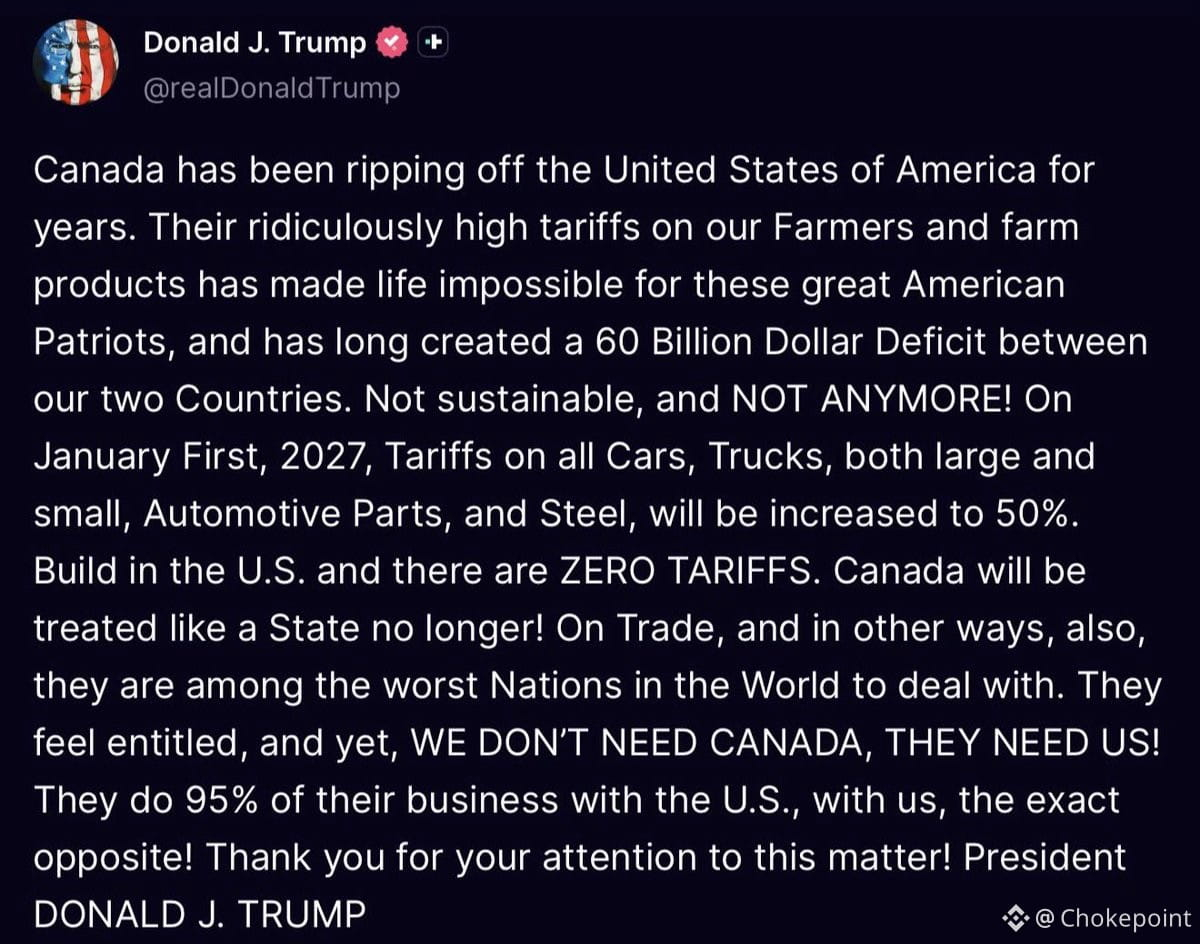
Trump just announced 50% tariffs on Canadian autos and steel starting January 2027. That's not a negotiating chip — that's a supply-chain grenade.
Here's the problem: North American auto manufacturing is deeply integrated. Parts cross the border multiple times during assembly. A 50% tariff doesn't just hit the final car price — it compounds at every stage. GM, Ford, Stellantis all have Canadian plants feeding US assembly lines. Steel tariffs hit the input cost before the car even gets built.
This isn't about "needing" anyone. It's about how modern supply chains actually work. You can't just flip a switch and reshore an entire auto supply base in two years. The tooling, the labor, the logistics — none of that moves fast.
Watch the auto OEMs and steel names. If this sticks, margin compression hits before any reshoring benefit shows up. And if you're long anything tied to cross-border manufacturing efficiency, you just got a new risk factor.
Here's the problem: North American auto manufacturing is deeply integrated. Parts cross the border multiple times during assembly. A 50% tariff doesn't just hit the final car price — it compounds at every stage. GM, Ford, Stellantis all have Canadian plants feeding US assembly lines. Steel tariffs hit the input cost before the car even gets built.
This isn't about "needing" anyone. It's about how modern supply chains actually work. You can't just flip a switch and reshore an entire auto supply base in two years. The tooling, the labor, the logistics — none of that moves fast.
Watch the auto OEMs and steel names. If this sticks, margin compression hits before any reshoring benefit shows up. And if you're long anything tied to cross-border manufacturing efficiency, you just got a new risk factor.