
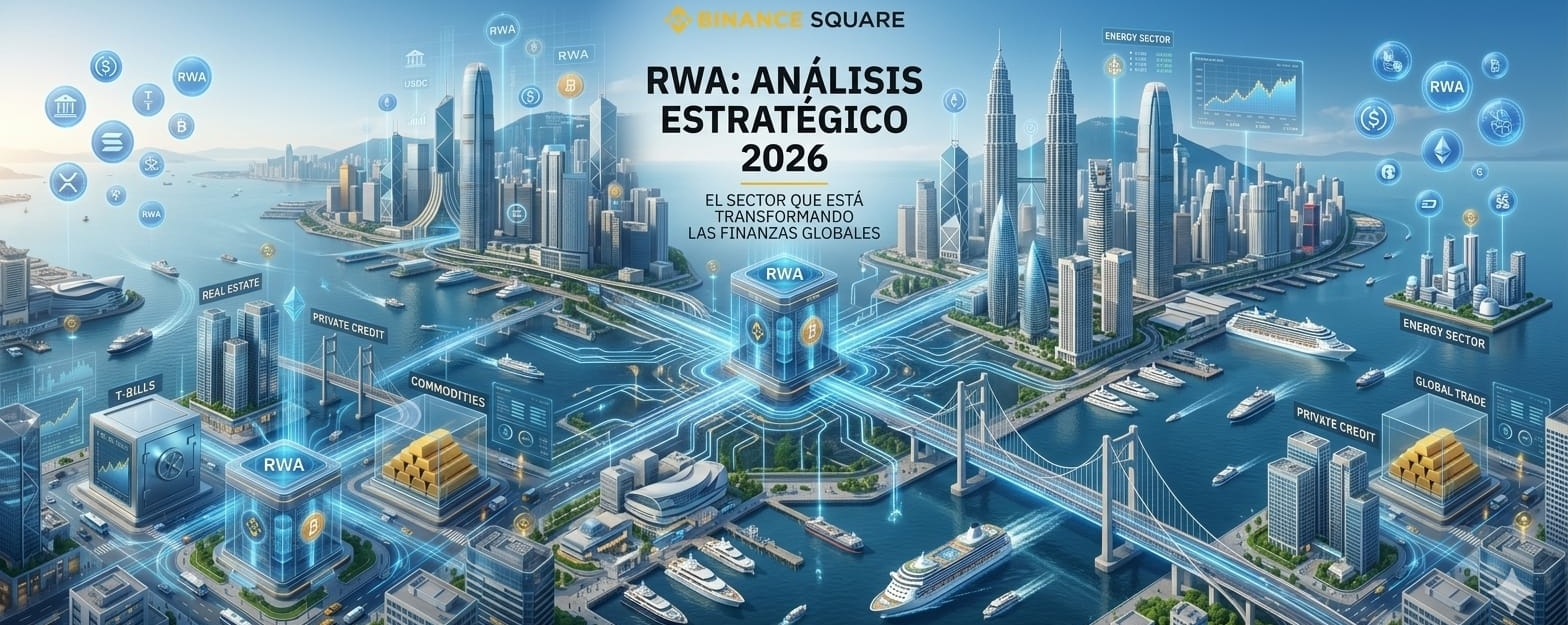

Real World Assets (RWA), or tokenized real-world assets, have consolidated as one of the most relevant segments within the blockchain-based financial ecosystem. Beyond a technological trend, tokenization seeks to connect traditional instruments—such as government debt, private credit, real estate, and commodities—with more agile and transparent digital infrastructures.
In an environment where much of the crypto market remains exposed to high volatility, RWAs provide use cases tied to real-world assets and financial flows. This has boosted the interest of financial institutions, asset managers, and DeFi protocols that are exploring new ways to issue, distribute, and settle financial products.
Market status and institutional adoption
During 2026, the market for tokenized assets has maintained a growth trajectory, especially in fixed-income instruments and treasury products. Large asset management entities have developed initiatives related to tokenized funds, credit notes, and digital settlement solutions, reflecting growing institutional interest in this technology.
However, the sector’s growth should be analyzed with caution: metrics such as value locked, volume, and adoption may vary depending on the methodology used, regulatory constraints, and the liquidity available in each protocol or asset.
Main RWA categories
1. Treasury Bills and Fixed-Income Products
Tokenization of Treasury bills and bonds makes it possible to represent public debt instruments on a blockchain. These products are especially attractive to users seeking exposure to fixed-income yields without completely leaving the digital ecosystem.
2. Real Estate
Real estate fractionalization can make it easier to access shares in commercial or residential properties. However, liquidity of these tokens, valuation of the properties, and associated legal rights remain essential factors for assessing each issuance.
3. Private Credit
Tokenized debt can connect companies with new funding sources and offer liquidity providers exposure to corporate loans. In return, it includes relevant risks: default, concentration, credit assessment, and legal enforcement of collateral.
4. Commodities
Assets such as gold can be represented through tokens backed by physical reserves. This model can simplify digital transfer and custody, although it is important to verify reserve quality, audits, the custodian, and the exchange conditions.
Potential advantages of tokenization
Blockchain technology can bring several operational improvements to traditional markets:
Greater accessibility: the possibility of reducing entry barriers through fractionalization, subject to applicable regulation.
Continuous operation: records and on-chain transfers can function outside usual banking hours.
Settlement and automation: smart contracts can speed up processes such as payments, distribution of yields, and reconciliation.
Transparency: information recorded on a blockchain can facilitate traceability, although it does not replace audits, legal controls, or due diligence.
The challenge: interoperability, regulation, and liquidity
The development of RWAs will depend largely on the ability to connect different networks, custodians, issuers, and traditional financial systems. Interoperability, data standards, and mechanisms for regulatory compliance will be decisive for these assets to be used efficiently across multiple platforms.
Improving secondary liquidity will also be essential, along with legal clarity regarding token ownership and investor protection. Tokenization does not eliminate the risks of the underlying asset; it simply transforms the infrastructure through which it is issued, recorded, and transferred.
Conclusion
RWAs represent one of the most concrete applications of blockchain in finance. Their value proposition combines operational efficiency, traceability, and new ways to access traditional instruments. However, their evolution will not depend on technology alone, but also on regulation, the quality of issuers, liquidity, and responsible risk management.
Investors interested in this sector should evaluate each product independently, considering the underlying asset, legal structure, custody, fees, and market risks. Past or projected performance does not guarantee future results, and any investment may involve losses.
Which RWA sector do you think will see the most growth before the end of the year? I’d love to hear your thoughts in the comments. 👇
#RWA #Tokenization #DeFi #TradFi #CryptoStrategy #Finance2026 $LINK $USDC $BTC


