


If you execute trades every so often, a small difference in fees might not catch your attention
But when your trading volume becomes 100,000 dirhams or more, those small numbers start to mean something different.
That’s why I wanted to compare Binance and Bybit from one clear angle:
If you were a regular user in the UAE in 2026, which one would cost me less in trading fees?
The answer isn’t the same in every case.
In spot trading between cryptocurrencies, competition between the two platforms is very close. But when trading directly on some AED pairs on Bybit, the picture changes clearly.
This is where Binance’s advantage for UAE users starts to show.
First: normal spot trading fees
If you trade crypto pairs like Bitcoin vs Tether or Ethereum vs Tether, then the basic difference between Binance and Bybit is almost nonexistent for a regular user.
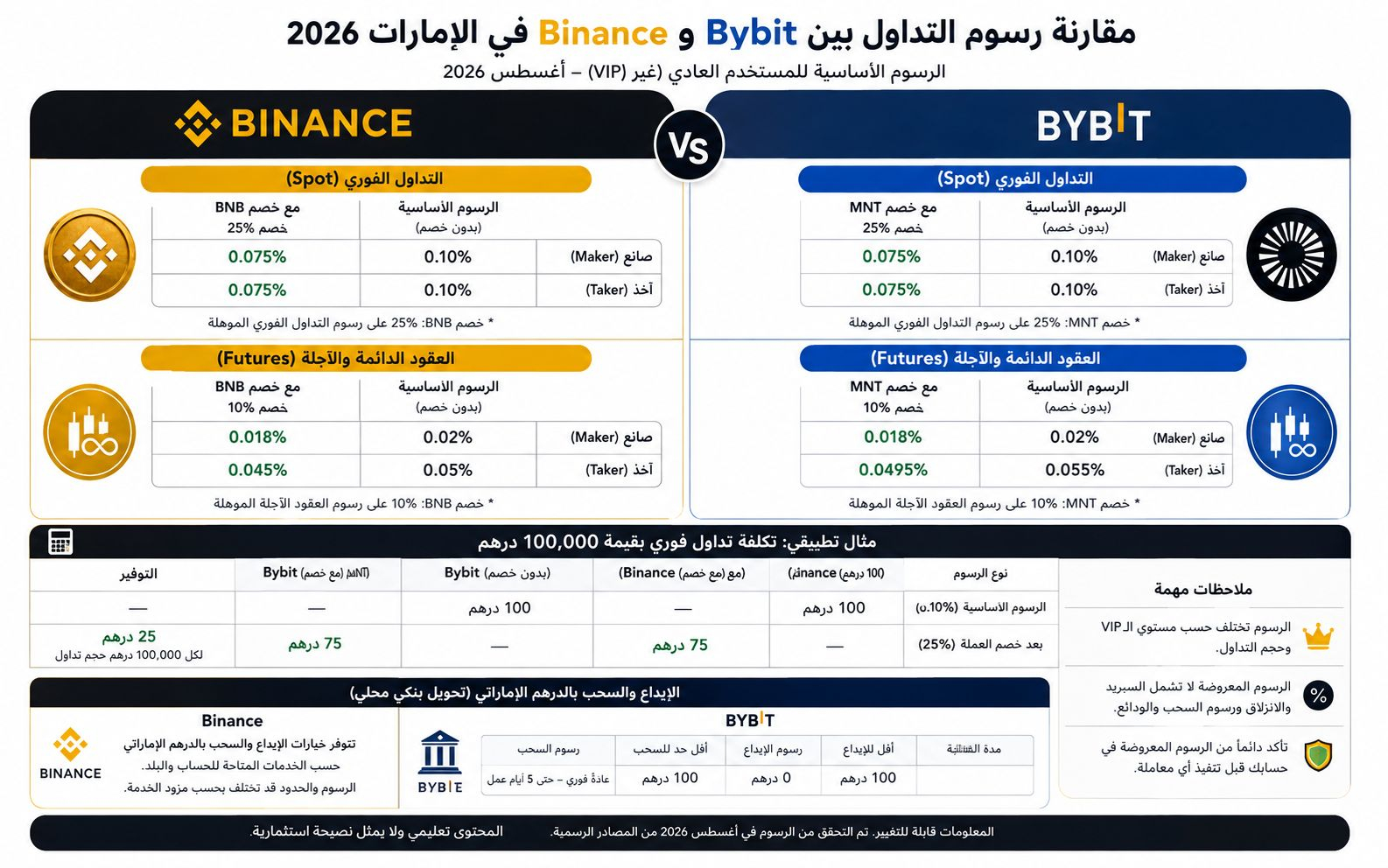
On Binance, the base fees for a regular user are usually:
Market maker ← 0.10%
Market take ← 0.10%
And when eligible users pay trading fees with BNB, they can get a 25% discount on eligible spot trading fees.
So the fees become:
0.075%
Bybit also starts for non-VIP eligible users from:
Market maker ← 0.10%
Market take ← 0.10%
And Bybit currently offers a similar discount when paying eligible trading fees using MNT.
The discount is 25%, so fees can also drop to:
0.075%
So in normal spot trading between cryptocurrencies:
Binance and Bybit are very similar in terms of fees for a regular user.
Here, I won’t try to claim a Binance win that doesn’t exist in the numbers.
But what happens when the UAE dirham enters the trade?
For us in the UAE, this is where the comparison becomes more interesting.
As of June 1, 2026, Bybit announced an update to its spot trading fees for a set of major UAE dirham pairs, including:
Bitcoin vs the dirham
Ethereum vs the dirham
Solana vs the dirham
Tether vs the dirham
According to the update, the trading fees for these pairs became 0.55%.
This is a big difference compared to the 0.10% you see in crypto trading against each other.
Here, specifically, I don’t like using ratios alone.
Let’s convert that into dirhams.
What does 0.55% really mean?
If your trade size is 10,000 dirhams:
At a fee of 0.10%:
10 dirhams
And at a fee of 0.075%:
7.50 dirhams
And for 0.55% fees:
55 dirhams
Now the difference is clear.
And with a trading volume of 100,000 dirhams:
0.10% means:
100 dirhams
0.075% means:
75 dirhams
While 0.55% means:
550 dirhams
For me, we’re no longer talking about a small difference in the fees column.
We’re talking about a number that can really become impactful as trading volume increases.
The picture isn’t: Binance is cheap and Bybit is expensive
This is an important point.
If we leave the article with a sentence like that, we would be doing the comparison an injustice.
Bybit’s base fees for trading crypto against crypto are 0.10% for the maker and 0.10% for the taker for non-VIP eligible users.
And with the eligible MNT discount, it can become 0.075%.
Practically the same base Binance fee level and BNB discount in this scenario.
The big difference we’re talking about is related to specific AED pairs included in Bybit’s update.
So the right question isn’t:
“Which platform has the lower fee number?”
Instead:
“Which pair should I trade, and in which currency should I enter the trade?”
And these details can change the answer completely.
Alright, what about futures contracts?
Here too, the two platforms are quite close.
Bybit’s base fees published for non-VIP users on perpetual and futures are:
Market maker ← 0.02%
Market take ← 0.055%
And when using MNT to pay eligible fees, Bybit gives a 10% discount, making it:
Market maker ← 0.018%
Market take ← 0.0495%
Binance also has a tiered fee structure for futures contracts, plus a 10% discount on eligible futures contract fees when using BNB.
But for me, I don’t see that a very small difference in futures fees should be a reason to use the product.
Futures contracts are high-risk products, and fees are only a very small part of the decision.
Fees aren’t everything
There’s something I learned over time:
Lower commission doesn’t always mean a cheaper trade.
Assume a platform charges you lower fees.
Excellent.
But what if the difference between the buy and sell price is wider?
Or what if there’s bigger price slippage when executing a large order?
You might save 10 dirhams on fees and lose more than that on execution price.
That’s why when I compare Binance and Bybit, I don’t look at commission alone.
Look also at:
Liquidity
Order book depth
The spread between the buy and sell price
Price slippage
Deposit and withdrawal costs
And the way to deposit dirhams into the platform
For me, high liquidity on Binance is a very important factor—especially when trading on major markets or during fast market moves.
I don’t want just a low commission.
I also want the trade to be executed at a good price.
What about depositing and withdrawing in dirhams?
The good advantage for UAE users today is that the comparison is no longer between one platform that supports AED bank transfers and another that doesn’t.
Both platforms offer options for handling the dirham for eligible users, depending on the services available to the account.
This makes the comparison focus more on what happens after funds reach the platform.
Here, personally, I look at the cost of trading, liquidity, and available markets—rather than having the UAE dirham support be the deciding factor.
How do I reduce trading fees on Binance?
The simplest way for eligible users is to enable trading fee payments using BNB.
The current discount on eligible spot trading fees is:
25%
There’s also a discount of:
10%
On eligible futures contract fees.
In addition, Binance provides VIP tiers with lower fees for users who meet the program requirements.
But personally, I don’t see any point in increasing your trading volume just to reach a higher VIP level.
If your natural trading volume qualifies you, use the discount.
And executing extra trades just to save on fees can make you pay more instead of saving.
Sometimes the best way to save on fees is not to trade.
This sounds like a weird sentence in an article about trading fees, but it’s true.
If you keep buying, selling, and transferring assets without any clear reason, fees, price spread, and slippage start accumulating without you noticing.
Sometimes you don’t need to look for an extra 10% or 25% discount.
You only need to reduce the trades you never really needed in the first place.
So, for UAE users, is Binance or Bybit better in terms of fees?
If you’re trading cryptocurrencies against each other, competition is very close.
Base fees for a regular user:
Binance ← 0.10%
Bybit ← 0.10%
And with the eligible discount paid in the platform coin:
Binance with BNB ← 0.075%
Bybit with MNT ← 0.075%
Here, the result is almost a tie.
But for UAE users, there’s a second layer of comparison that can’t be ignored.
Bybit increased trading fees for a number of major AED pairs to 0.55% as of June 1, 2026.
This makes Binance, for me, the most attractive option on the cost side in scenarios where dealing with the UAE dirham is an essential part of the trading method.
Especially when I combine the fees with liquidity, order book depth, and the variety of available markets.
Summary
If you ask me:
Is Binance always cheaper than Bybit?
No.
In crypto trading against each other, the base fees are very similar, and eligible users on each platform can reach 0.075% using BNB or MNT.
But if you ask me:
Which one do I choose as a user in the UAE who cares about fees?
Here, I lean toward Binance.
And the reason isn’t just the BNB discount.
The reason is that the UAE comparison changed after Bybit raised fees for a number of major dirham pairs to 0.55%.
And when I add liquidity and order book depth to that, the balance becomes clearer for me.
Don’t just look for the lowest percentage written on the fees page. Calculate the actual trading cost you will execute.
Quick questions
Are Binance fees lower than Bybit?
In spot trading between cryptocurrencies, the base fees are very similar. Both start at 0.10% for a regular user, and can reach 0.075% with the BNB discount on Binance or MNT on Bybit for eligible users and eligible trades.
But some of Bybit’s major AED pairs have a different fee structure, which affects the comparison for UAE users.
Why does Bybit show a fee of 0.55%?
As of June 1, 2026, Bybit announced an update to the fees for a number of major UAE dirham pairs, including Bitcoin, Ethereum, Solana, and Tether pairs against the dirham, to 0.55%.
What are Binance spot trading fees?
Base fees for a regular user are usually 0.10%, and can drop to 0.075% when applying an eligible BNB discount. Fees may vary depending on market, pair, user level, and any active promotions.
Is the cheaper commission always actually the cheaper deal?
Not always.
Liquidity, the price spread, slippage, and deposit/withdrawal fees can make the final trade cost different from the advertised commission.
How can I reduce Binance fees?
Eligible users can use BNB to pay trading fees and get a 25% discount on eligible spot trading fees and 10% on eligible futures contract fees, plus reductions related to VIP tiers when they meet the requirements.
The information and fees mentioned were verified in August 2026. Fees may vary by pair, account, VIP level, and the service used, and platforms may change their fee schedules. Check the fees shown in your account before executing any trade.
This is educational content and not investment advice.