I was digging through Dusk Network documentation today and came across something interesting — they have two layers: DuskDS (calculations and data) and DuskEVM (smart contracts).
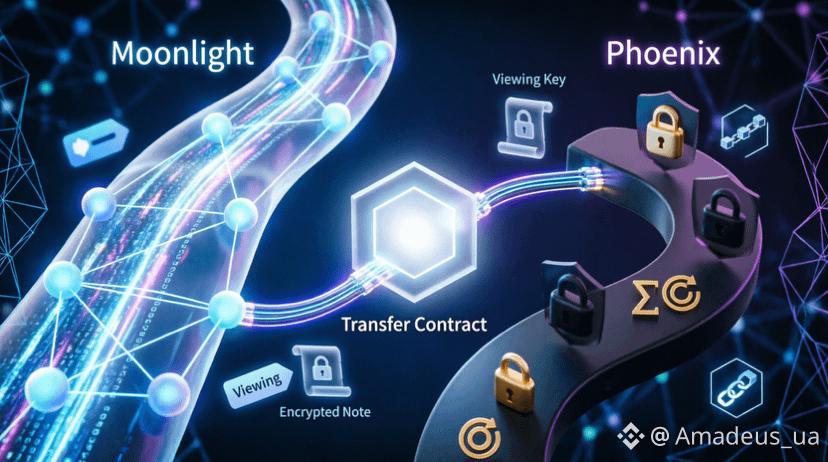
What caught my attention most is that at the DuskDS layer, transactions can be made in two ways. Moonlight is a transparent model, like a normal bank account: you can see who sent what to whom and how much. And Phoenix is privacy through zero-knowledge proofs: the funds are stored as encrypted “notes,” and the network proves everything is fair (no double-spending, enough funds) without revealing the amount, the sender, or which specific notes were used.
And what’s interesting is that even in private mode there are “viewing keys” that allow selectively sharing information when an audit or regulation is needed. So it’s not total anonymity, but controlled privacy.
All of this is coordinated by the so-called Transfer Contract, which supports both types of transactions and ensures the global state remains consistent.
Question: how convenient is this kind of hybrid approach (transparency + privacy in one network) for an ordinary user — or is it more of a story for institutions that have to balance anonymity with compliance? Share your thoughts 👇
#dusk $DUSK @Dusk
What caught my attention most is that at the DuskDS layer, transactions can be made in two ways. Moonlight is a transparent model, like a normal bank account: you can see who sent what to whom and how much. And Phoenix is privacy through zero-knowledge proofs: the funds are stored as encrypted “notes,” and the network proves everything is fair (no double-spending, enough funds) without revealing the amount, the sender, or which specific notes were used.
And what’s interesting is that even in private mode there are “viewing keys” that allow selectively sharing information when an audit or regulation is needed. So it’s not total anonymity, but controlled privacy.
All of this is coordinated by the so-called Transfer Contract, which supports both types of transactions and ensures the global state remains consistent.
Question: how convenient is this kind of hybrid approach (transparency + privacy in one network) for an ordinary user — or is it more of a story for institutions that have to balance anonymity with compliance? Share your thoughts 👇
#dusk $DUSK @Dusk