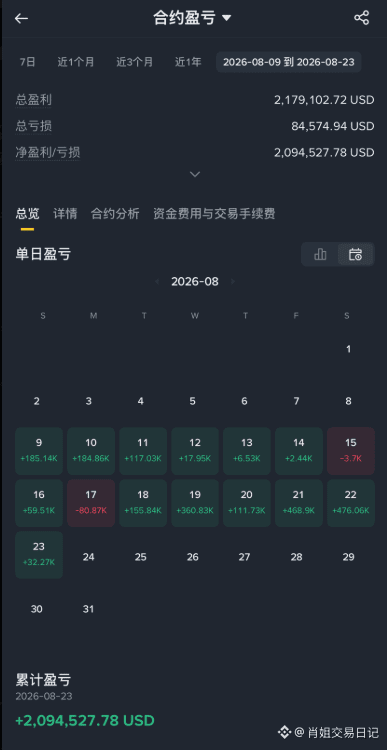
After losing $2 million, I was left with only 3,500 U.
That period, I genuinely thought about giving up.
In the bear market, I couldn’t sleep every day, and I cleared my Moments feed.
My family didn’t understand. Friends gradually stopped contacting me.
My whole state hit rock bottom.
Until one day, I刷到 a line:
“Lose as much as you want—it's only the beginning. Holding on stubbornly is what ends you.”
In that moment, it was like I was suddenly jolted awake.
I took out the remaining 3,500 U and started over.
This time, I didn’t think about turning it around overnight. I sat down properly and reviewed—one by one, digging out the reasons I used to lose money.
Later I realized: my losses weren’t as complicated as I had made them out to be.
No stop-loss, going all-in with a huge position, chasing trends to buy coins, switching coins too frequently—my position management was a complete mess.
In plain terms, back then I wasn’t really trading. I was betting on the dice roll.
So after restarting, I focused on just two words: roll the position.
Split the 3,500 U into two parts—one for defense, one for offense.
I only trade the market I can understand.
If a single trade makes 5%-10% profit, I close it—no greed for that last little bit.
If I get the direction wrong, I stop-loss immediately.
If there’s no opportunity, I stay in cash.
I’d rather not trade for a day than open random orders just because I’m itching to act. $ENA
In the first week, I turned 3,500 U into 5,200 U.
In the second week, I reached 10,000 U.
By the sixth week, my account finally broke through 5WU.
That night, I shut off my computer and sat there alone for a long time.
What truly made me happy wasn’t how much money the account had grown—it was that for the first time, I felt:
Turns out I really can pull myself back little by little.
Later, I came to understand more and more that the hardest thing in trading isn’t that mysterious.
You don’t need to look for some miracle move every day.
You also don’t need to go around asking about so-called insider info.
Just keep your rhythm stable, manage your position size well, and only trade the market you understand.
Take profit when it’s time to take profit. Stop-loss when it’s time to stop-loss.
People lose money—at the end of the day, it’s just one word: chaos.
If you don’t understand the market, you charge in.
When you lose, you try to hold on.
When it rises, you don’t want to leave.
After a string of losing trades, you start to get reckless.
Then the more you do, the more chaotic it gets; the more chaotic it gets, the more you lose.
So now I’ve always believed: for small funds to grow, the first step is never to think about how to make fast money.
It’s to first stabilize your own rhythm.
As long as your principal is still there, opportunities will always be there.
If you walk in the dark alone, it’s easy to take the wrong path.
But if you have people to exchange ideas with and remind each other, you really can avoid a lot of detours.
That period, I genuinely thought about giving up.
In the bear market, I couldn’t sleep every day, and I cleared my Moments feed.
My family didn’t understand. Friends gradually stopped contacting me.
My whole state hit rock bottom.
Until one day, I刷到 a line:
“Lose as much as you want—it's only the beginning. Holding on stubbornly is what ends you.”
In that moment, it was like I was suddenly jolted awake.
I took out the remaining 3,500 U and started over.
This time, I didn’t think about turning it around overnight. I sat down properly and reviewed—one by one, digging out the reasons I used to lose money.
Later I realized: my losses weren’t as complicated as I had made them out to be.
No stop-loss, going all-in with a huge position, chasing trends to buy coins, switching coins too frequently—my position management was a complete mess.
In plain terms, back then I wasn’t really trading. I was betting on the dice roll.
So after restarting, I focused on just two words: roll the position.
Split the 3,500 U into two parts—one for defense, one for offense.
I only trade the market I can understand.
If a single trade makes 5%-10% profit, I close it—no greed for that last little bit.
If I get the direction wrong, I stop-loss immediately.
If there’s no opportunity, I stay in cash.
I’d rather not trade for a day than open random orders just because I’m itching to act. $ENA
In the first week, I turned 3,500 U into 5,200 U.
In the second week, I reached 10,000 U.
By the sixth week, my account finally broke through 5WU.
That night, I shut off my computer and sat there alone for a long time.
What truly made me happy wasn’t how much money the account had grown—it was that for the first time, I felt:
Turns out I really can pull myself back little by little.
Later, I came to understand more and more that the hardest thing in trading isn’t that mysterious.
You don’t need to look for some miracle move every day.
You also don’t need to go around asking about so-called insider info.
Just keep your rhythm stable, manage your position size well, and only trade the market you understand.
Take profit when it’s time to take profit. Stop-loss when it’s time to stop-loss.
People lose money—at the end of the day, it’s just one word: chaos.
If you don’t understand the market, you charge in.
When you lose, you try to hold on.
When it rises, you don’t want to leave.
After a string of losing trades, you start to get reckless.
Then the more you do, the more chaotic it gets; the more chaotic it gets, the more you lose.
So now I’ve always believed: for small funds to grow, the first step is never to think about how to make fast money.
It’s to first stabilize your own rhythm.
As long as your principal is still there, opportunities will always be there.
If you walk in the dark alone, it’s easy to take the wrong path.
But if you have people to exchange ideas with and remind each other, you really can avoid a lot of detours.