
橙子Joyce
181 Posts

橙子Joyce
 Square Verified+
价值投资者:以十年为单位投资美股及BTC.ETH.BNB.SOL.推特X:@Joyce88ai

BNB Holder
Frequent Trader
8.7 Years
700 Following
31.1K+ Followers
37.4K+ Liked
Posts
All
Quotes
Videos
Live
PINNED
PINNED
Verified
NVDAUS+7.29%
SPCXUS+0.86%

蒋雅琪1368
·
--
$BNB, the great Binance. This time, they’re going straight into Bhutan and teaming up with local DK Bank. Now, just with the Binance app, you can scan and spend crypto at more than 3,700 stores!
What’s most explosive is that all fees are waived before the end of 2026!
Binance’s global expansion this round is too aggressive—more and more use cases are coming up, and the BNB ecosystem is about to take off.
$BNB $GIGGLE $Binance Life
What’s most explosive is that all fees are waived before the end of 2026!
Binance’s global expansion this round is too aggressive—more and more use cases are coming up, and the BNB ecosystem is about to take off.
$BNB $GIGGLE $Binance Life
go

Suadagar Ali
·
--
#BNB $
follow ☘️🥀🌹like
comments repost
follow ☘️🥀🌹like
comments repost



周周1688
·
--
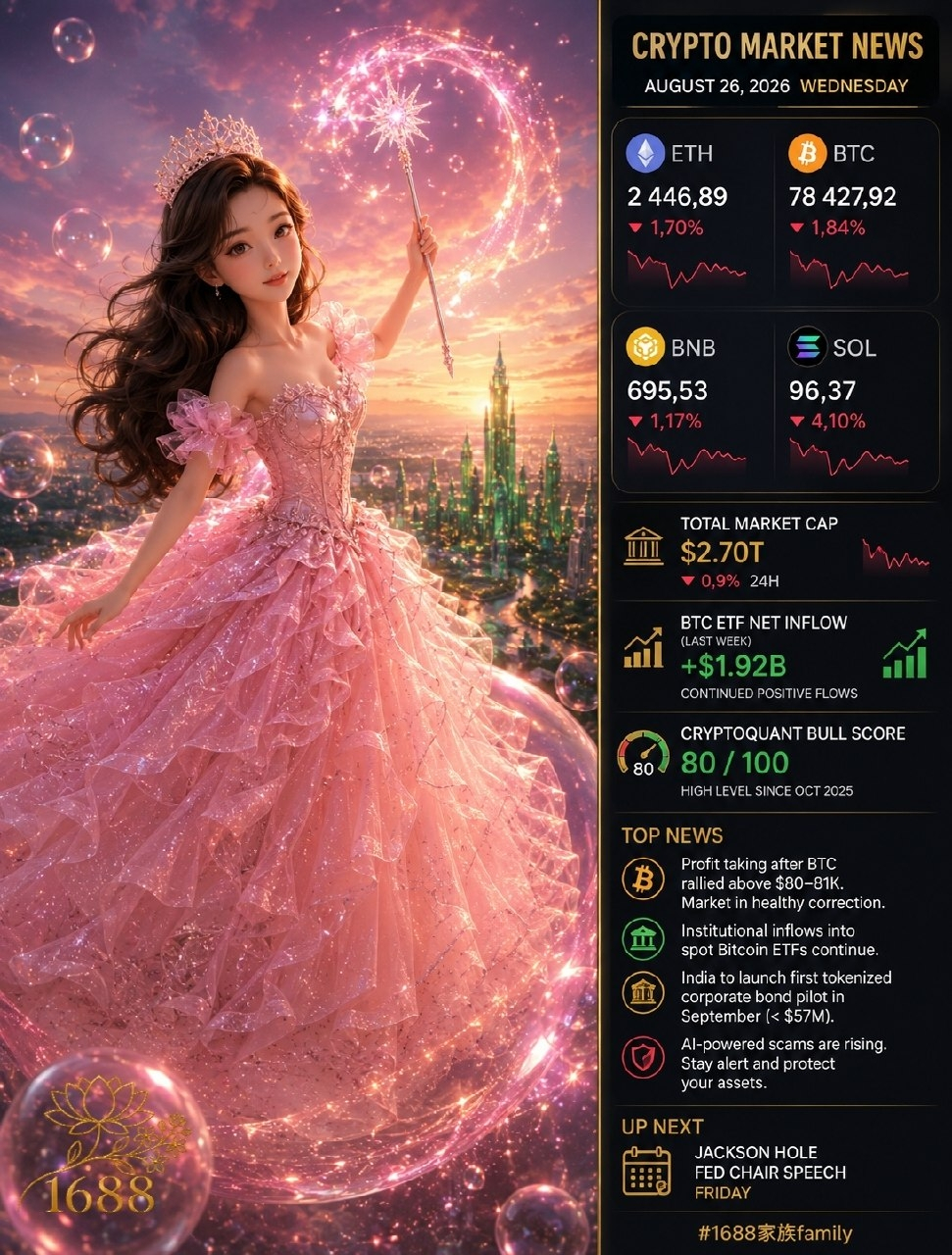
🚀 August 26|Crypto Market Snapshot
$BNB 🧧🧧
📉 BTC dips to $79K, entering a phase of taking profits
BTC briefly surged to over $81,000 yesterday, setting a new high since May, before pulling back to about $78,500–$79,500.
Despite short-term cooling, BTC is still up roughly 22–23% over the past week. ETH is around $2,450–$2,470, with a weekly gain close to 29%.
Total market cap has fallen back to about $2.7 trillion.
💰 BTC ETF inflows remain the core support
In the previous week, US spot BTC ETFs saw net inflows of about $1.92B and maintained positive flows for multiple consecutive days.
Institutional demand remains an important driver behind this leg of gains.
🐂 CryptoQuant Bull Score rises to 80
CryptoQuant Bull Score climbed from 30 to 80 within a week, reaching the highest level since October 2025.
More importantly, spot and futures demand are growing in sync—of 10 market indicators, 8 have turned bullish.
However, for BTC to confirm the next phase of a major bull run, the market is still watching the key zone around $83K.
🏦 Jackson Hole is the biggest catalyst this week
The market is waiting for Federal Reserve Chair Kevin Warsh’s speech at Jackson Hole on Friday.
Meanwhile, US GDP, PCE inflation data, and Nvidia’s earnings report will also be released this week.
Interest-rate and liquidity expectations may determine BTC’s next move around the $80K level.
🇮🇳 India to issue its first batch of tokenized corporate bonds in September
India plans to launch the first tokenized corporate bond pilot in September, with a size of less than ₹5 billion (about $57M).
The project will combine blockchain with India’s central bank CBDC to digitize bond issuance, holding, and settlement.
Traditional finance is gradually moving onto the blockchain.
🟣 ZEC: After ETF launch, a pullback follows
Zcash previously surged to around $850; now it’s following the market pullback.
Notably, the ZEC spot ETF is already live in the US—institutionalization of crypto assets is expanding from BTC and ETH into more assets.
⚠️ AI is becoming a new tool for crypto scams
Voice cloning, AI-generated phishing messages, and automated scamming are increasing.
Don’t verify identity using only voice, profile photos, or chat records. Before transferring funds, double-check the wallet address.
🚀 Top gainers
ONG +36.9%
TLM +18.2%
AMP +16.2%
🧭 After the big surge, the market is “catching its breath.”
Can BTC reclaim and hold above $80K?
#1688家族family
$BTC $BNB
$BNB 🧧🧧
📉 BTC dips to $79K, entering a phase of taking profits
BTC briefly surged to over $81,000 yesterday, setting a new high since May, before pulling back to about $78,500–$79,500.
Despite short-term cooling, BTC is still up roughly 22–23% over the past week. ETH is around $2,450–$2,470, with a weekly gain close to 29%.
Total market cap has fallen back to about $2.7 trillion.
💰 BTC ETF inflows remain the core support
In the previous week, US spot BTC ETFs saw net inflows of about $1.92B and maintained positive flows for multiple consecutive days.
Institutional demand remains an important driver behind this leg of gains.
🐂 CryptoQuant Bull Score rises to 80
CryptoQuant Bull Score climbed from 30 to 80 within a week, reaching the highest level since October 2025.
More importantly, spot and futures demand are growing in sync—of 10 market indicators, 8 have turned bullish.
However, for BTC to confirm the next phase of a major bull run, the market is still watching the key zone around $83K.
🏦 Jackson Hole is the biggest catalyst this week
The market is waiting for Federal Reserve Chair Kevin Warsh’s speech at Jackson Hole on Friday.
Meanwhile, US GDP, PCE inflation data, and Nvidia’s earnings report will also be released this week.
Interest-rate and liquidity expectations may determine BTC’s next move around the $80K level.
🇮🇳 India to issue its first batch of tokenized corporate bonds in September
India plans to launch the first tokenized corporate bond pilot in September, with a size of less than ₹5 billion (about $57M).
The project will combine blockchain with India’s central bank CBDC to digitize bond issuance, holding, and settlement.
Traditional finance is gradually moving onto the blockchain.
🟣 ZEC: After ETF launch, a pullback follows
Zcash previously surged to around $850; now it’s following the market pullback.
Notably, the ZEC spot ETF is already live in the US—institutionalization of crypto assets is expanding from BTC and ETH into more assets.
⚠️ AI is becoming a new tool for crypto scams
Voice cloning, AI-generated phishing messages, and automated scamming are increasing.
Don’t verify identity using only voice, profile photos, or chat records. Before transferring funds, double-check the wallet address.
🚀 Top gainers
ONG +36.9%
TLM +18.2%
AMP +16.2%
🧭 After the big surge, the market is “catching its breath.”
Can BTC reclaim and hold above $80K?
#1688家族family
$BTC $BNB

大仁Jaron
·
--
Analysts Weigh the Impact of OpenAI’s In-House Chip: NVIDIA Profit Margins May Face New Challenges
With OpenAI and other tech giants rolling out their own chips, analysts have begun to believe that $NVIDIA (NVDA.US)$'s near-monopoly position in the advanced AI chip arena is facing a “threat.”
On Tuesday (August 25), OpenAI disclosed technical details of the company’s first custom inference chip, Jalapeno, claiming that the chip’s response speed and energy efficiency performance have surpassed NVIDIA’s GB300. At present, $Google-C (GOOG.US)$, $Amazon (AMZN.US)$, $Meta Platforms (META.US)$, and others are also developing their own AI chips.
Yole Group technology analyst Adrien Sanchez said Jalapeno is a chip designed specifically for inference, indicating that “chips designed by ultra-large cloud service providers (hyperscalers) can now match—and even exceed—NVIDIA Blackwell-class GPUs in inference energy efficiency.”
On Tuesday (August 25), OpenAI disclosed technical details of the company’s first custom inference chip, Jalapeno, claiming that the chip’s response speed and energy efficiency performance have surpassed NVIDIA’s GB300. At present, $Google-C (GOOG.US)$, $Amazon (AMZN.US)$, $Meta Platforms (META.US)$, and others are also developing their own AI chips.
Yole Group technology analyst Adrien Sanchez said Jalapeno is a chip designed specifically for inference, indicating that “chips designed by ultra-large cloud service providers (hyperscalers) can now match—and even exceed—NVIDIA Blackwell-class GPUs in inference energy efficiency.”


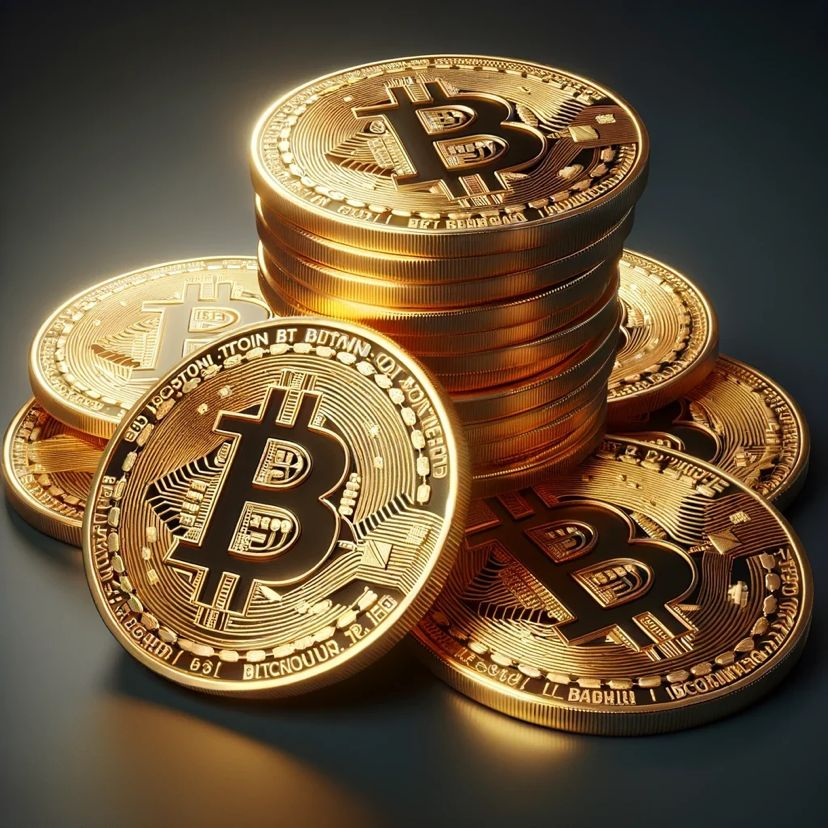
It is expected that by 2029, the price of BTC will reach $300,000, making it the main beneficiary of “currency devaluation trades.” The core logic behind this prediction is that the era of falling interest rates over the past 40 years has ended. Governments around the world are now facing increasingly heavy debt-interest burdens amid unprecedented sovereign-debt levels. Rising yields will create a self-reinforcing vicious cycle—higher interest payments, widening fiscal deficits, and a continued surge in borrowing demand.
Investors who hold scarce assets that cannot be easily diluted will benefit from this. BTC’s unique holding structure—about 60% of BTC is held by long-term holders who are insensitive to price movements (even if the price drops by more than 50%, they will continue to hold)—combined with the ongoing expansion of institutional and retail investment channels, further strengthens BTC’s position. I am very optimistic about BTC’s scarcity, and continuing to invest in BTC is the best choice.
$BTC
$BNB
Investors who hold scarce assets that cannot be easily diluted will benefit from this. BTC’s unique holding structure—about 60% of BTC is held by long-term holders who are insensitive to price movements (even if the price drops by more than 50%, they will continue to hold)—combined with the ongoing expansion of institutional and retail investment channels, further strengthens BTC’s position. I am very optimistic about BTC’s scarcity, and continuing to invest in BTC is the best choice.
$BTC
$BNB
@橙子Joyce 🧧🧧🧧🧧🧧🧧🧧🧧💰💸
橙子Joyce
·
--
Are global markets holding their breath tonight?
Hello everyone. Tonight, global capital markets are holding their breath, waiting for Nvidia to release its latest earnings report early Thursday morning. This report will point the way forward for the next phase of development in artificial intelligence. Tonight, U.S. stock market performance is somewhat lackluster, as if it’s calm before the storm, with popular stocks and sectors moving up and down in mixed fashion.
The latest released economic data has not significantly changed market expectations for the Federal Reserve to raise interest rates this year. One of the Fed’s commonly used inflation indicators—the U.S. personal consumption expenditures (PCE) price index for July—showed that prices rose 0.2% from the previous month and increased 3.7% from the same period last year. Both figures are 0.1 percentage point higher than economists surveyed by the Dow Jones had expected.
The latest released economic data has not significantly changed market expectations for the Federal Reserve to raise interest rates this year. One of the Fed’s commonly used inflation indicators—the U.S. personal consumption expenditures (PCE) price index for July—showed that prices rose 0.2% from the previous month and increased 3.7% from the same period last year. Both figures are 0.1 percentage point higher than economists surveyed by the Dow Jones had expected.

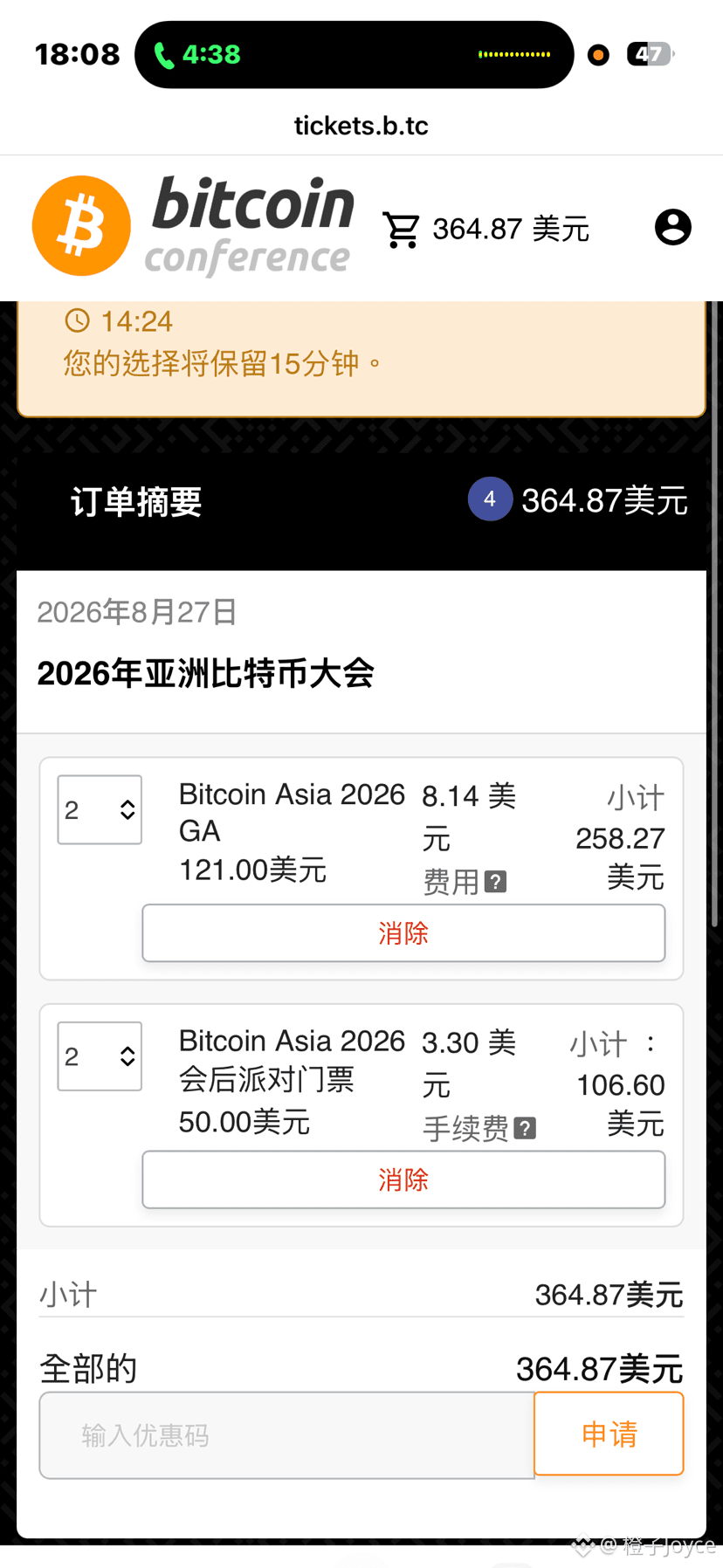
Bitcoin Asia 2026 (Asian Bitcoin Conference) will be held on August 27–28, 2026 at the Hong Kong Convention and Exhibition Centre (HKCEC). It is hosted by BTC Inc. (a subsidiary of Nakamoto Inc.), and Metaplanet is the naming sponsor. It is one of the largest Bitcoin-themed conferences in Asia.
According to the official announcements and confirmations released by multiple media outlets (including the first wave and subsequent updates, as of the eve of the event), the major big names/key speakers in the crypto community and related fields include:
Core Headliners
• CZ (Changpeng Zhao): Founder of Binance (later focusing on education and regulatory consulting, etc.); already confirmed to deliver a keynote on the main stage.
• Balaji Srinivasan: Founder of Network School and author of The Network State; featured as the top-tier closing keynote guest.
• Justin Sun (孙宇晨): Founder of TRON; advisor to WBTC/HTX, etc.
• Simon Gerovich: CEO of Metaplanet (the largest corporate Bitcoin holder in Japan; naming sponsor of the conference).
• David Bailey: CEO & Chairman of Nakamoto Inc. (NASDAQ: NAKA).
• Gracy Chen: CEO of Bitget.
• Mark Yusko: Managing Partner at Morgan Creek Digital.
• AJ Scaramucci: Founder and CEO of Treasure Trove.
Other Important Confirmed Guests
• Hugh Hendry: Founder of Acid Capitalist; former macro hedge fund manager (publicly shifted to supporting Bitcoin as a monetary asset).
• Matt Cole: Chairman and CEO of Strive (companies related to publicly listed Bitcoin treasuries).
• Jack Kong: Founder of Nano Labs; related to Hong Kong Cyberport.
• Bonnie Chang: Founder and host of Bonnie Blockchain.
• Policy and institutional side: Dr. Hon. Johnny Ng (吳杰庄) (Hong Kong Legislative Council member, member of the National Committee of the Chinese People’s Political Consultative Conference), Bilal Bin Saqib (Chairman of Pakistan’s virtual asset regulatory authority), etc.
In addition, there will be many speakers from exchanges, custodianship, mining, development, institutional investment, and other fields (the official website lists 150+ people, including figures such as Stephan Livera, Bitget/BitGo/Bitdeer, and others). The agenda covers institutional adoption, macro finance, regulation, infrastructure, and more.
For the complete latest list and agenda, please visit the official website: asia.b.tc/speakers and the agenda page.
According to the official announcements and confirmations released by multiple media outlets (including the first wave and subsequent updates, as of the eve of the event), the major big names/key speakers in the crypto community and related fields include:
Core Headliners
• CZ (Changpeng Zhao): Founder of Binance (later focusing on education and regulatory consulting, etc.); already confirmed to deliver a keynote on the main stage.
• Balaji Srinivasan: Founder of Network School and author of The Network State; featured as the top-tier closing keynote guest.
• Justin Sun (孙宇晨): Founder of TRON; advisor to WBTC/HTX, etc.
• Simon Gerovich: CEO of Metaplanet (the largest corporate Bitcoin holder in Japan; naming sponsor of the conference).
• David Bailey: CEO & Chairman of Nakamoto Inc. (NASDAQ: NAKA).
• Gracy Chen: CEO of Bitget.
• Mark Yusko: Managing Partner at Morgan Creek Digital.
• AJ Scaramucci: Founder and CEO of Treasure Trove.
Other Important Confirmed Guests
• Hugh Hendry: Founder of Acid Capitalist; former macro hedge fund manager (publicly shifted to supporting Bitcoin as a monetary asset).
• Matt Cole: Chairman and CEO of Strive (companies related to publicly listed Bitcoin treasuries).
• Jack Kong: Founder of Nano Labs; related to Hong Kong Cyberport.
• Bonnie Chang: Founder and host of Bonnie Blockchain.
• Policy and institutional side: Dr. Hon. Johnny Ng (吳杰庄) (Hong Kong Legislative Council member, member of the National Committee of the Chinese People’s Political Consultative Conference), Bilal Bin Saqib (Chairman of Pakistan’s virtual asset regulatory authority), etc.
In addition, there will be many speakers from exchanges, custodianship, mining, development, institutional investment, and other fields (the official website lists 150+ people, including figures such as Stephan Livera, Bitget/BitGo/Bitdeer, and others). The agenda covers institutional adoption, macro finance, regulation, infrastructure, and more.
For the complete latest list and agenda, please visit the official website: asia.b.tc/speakers and the agenda page.

Apple (AAPL) will hold the biggest product launch of this year at its Cupertino headquarters at 10:00 a.m. Pacific Time on September 9 (1:00 a.m. the next day Beijing time). This will also be the first time that John Ternus, after taking over as CEO, will lead a major new product launch. Apple is expected to unveil its first foldable-screen iPhone, with a device size roughly like a standard passport; when unfolded, the screen size will be close to that of a small iPad. This will be the most significant design change for the iPhone in nearly 20 years since it was introduced. Apple also plans to release iPhone 18 Pro and Pro Max, featuring a faster chip, improved battery life, and a major upgrade to the camera—at least the larger models will be equipped with a mechanical aperture. The second-generation iPhone Air and the standard iPhone 18 are expected to be delayed until next spring. A new Apple Watch could also be unveiled around the same time. Tim Cook, who is stepping down as CEO, will continue to serve as Executive Chairman.
Despite a potential price as high as $2,500 for Apple’s first foldable-screen iPhone launching in September, first-year shipments are still expected to exceed 10 million units, helping to restart growth in the foldable phone market. Market expectations are that global shipments of foldable-screen phones will grow by 12.6% this year and 18% next year; by 2027, Apple will account for 40% of worldwide foldable phone shipments. At the same time, due to rising prices for components such as memory chips and supply constraints, the global overall smartphone market is expected to shrink by a record 16.7% this year, with the claim that “the era of cheap smartphones has already ended.”
$AAPL
Despite a potential price as high as $2,500 for Apple’s first foldable-screen iPhone launching in September, first-year shipments are still expected to exceed 10 million units, helping to restart growth in the foldable phone market. Market expectations are that global shipments of foldable-screen phones will grow by 12.6% this year and 18% next year; by 2027, Apple will account for 40% of worldwide foldable phone shipments. At the same time, due to rising prices for components such as memory chips and supply constraints, the global overall smartphone market is expected to shrink by a record 16.7% this year, with the claim that “the era of cheap smartphones has already ended.”
$AAPL

Looking forward to NASA—the U.S. space agency—fulfilling astronauts’ dream of returning to the Moon, and also “urging” SpaceX to increase launch frequency. NASA Administrator Jared Isaacman said this month that if “Starship” can maintain one launch per month, and even achieve launches every few weeks by the end of the year, he would feel more confident about conducting tests of next year’s “Starship Human Landing System.”
SpaceX says the base is designed to support “thousands of Starship flights per year.”
In the end, the “Louisiana Spaceport” will have “more than a dozen” launch pads, enabling 30 “Starship” launches per day, becoming the largest launch site on Earth.
This is crucial to SpaceX’s plan to build up to 1 million data center satellites, which the company hopes to deploy into near-polar orbits.
Now SpaceX’s stock price is very attractive—maybe you can consider stocking up!
For reference only!
$SPCX.US
SpaceX says the base is designed to support “thousands of Starship flights per year.”
In the end, the “Louisiana Spaceport” will have “more than a dozen” launch pads, enabling 30 “Starship” launches per day, becoming the largest launch site on Earth.
This is crucial to SpaceX’s plan to build up to 1 million data center satellites, which the company hopes to deploy into near-polar orbits.
Now SpaceX’s stock price is very attractive—maybe you can consider stocking up!
For reference only!
$SPCX.US
Verified
USDC issues nearly $2 billion more in one week—what supports Circle’s next growth cycle?
1.USDC ends nearly six months of sideways, weak performance, adding about $1.7 billion to $2.0 billion in supply within a week, becoming a direct signal that Circle’s fundamentals are recovering.
2.Awarded Circle a “beat the broader market” rating with a $140 target price, the long-term thesis hinges on whether Arc can convert institutional partnerships into assets, settlement, and revenue.
3.USDC’s total supply still lags behind USDT, but in transaction volumes after excluding bots and high-frequency activity, USDC’s share has already risen to 60% or more in 2026.
4.Real-world stablecoin payments are growing at about 30% year over year, but they currently account for only around 3% of adjusted transaction volume—so they have not yet become a major source of demand.
5.AI agent payments see nearly 19 million monthly transactions, but the value is only about $1 million; at this stage, it mainly reflects infrastructure adoption.
USDC re-expands, and the top-tier competitive landscape has not changed for now
Even with supply below USDT, USDC captures more effective trading volume
Payments grow steadily, while AI agents remain stuck in “small-ticket, high-frequency”
Arc will be the real test of Circle’s platformization
At this stage, Circle’s most certain growth still comes from the rebound in USDC supply and an increase in trading share. Payment rails, tokenized asset economics, and AI agent activity also offer further room to expand valuation potential, but these businesses still need to go through the transformation from partnership announcements to infrastructure adoption, and ultimately to asset realization and revenue capture.
Next, the market needs to watch four variables:
1.Can USDC supply continue to grow?
2.Can the adjusted transaction share hold steady?
3.Can the share of real-world payments increase?
4.After Arc goes live, can it attract real assets and pull transactions in?
$BTC
$BNB
1.USDC ends nearly six months of sideways, weak performance, adding about $1.7 billion to $2.0 billion in supply within a week, becoming a direct signal that Circle’s fundamentals are recovering.
2.Awarded Circle a “beat the broader market” rating with a $140 target price, the long-term thesis hinges on whether Arc can convert institutional partnerships into assets, settlement, and revenue.
3.USDC’s total supply still lags behind USDT, but in transaction volumes after excluding bots and high-frequency activity, USDC’s share has already risen to 60% or more in 2026.
4.Real-world stablecoin payments are growing at about 30% year over year, but they currently account for only around 3% of adjusted transaction volume—so they have not yet become a major source of demand.
5.AI agent payments see nearly 19 million monthly transactions, but the value is only about $1 million; at this stage, it mainly reflects infrastructure adoption.
USDC re-expands, and the top-tier competitive landscape has not changed for now
Even with supply below USDT, USDC captures more effective trading volume
Payments grow steadily, while AI agents remain stuck in “small-ticket, high-frequency”
Arc will be the real test of Circle’s platformization
At this stage, Circle’s most certain growth still comes from the rebound in USDC supply and an increase in trading share. Payment rails, tokenized asset economics, and AI agent activity also offer further room to expand valuation potential, but these businesses still need to go through the transformation from partnership announcements to infrastructure adoption, and ultimately to asset realization and revenue capture.
Next, the market needs to watch four variables:
1.Can USDC supply continue to grow?
2.Can the adjusted transaction share hold steady?
3.Can the share of real-world payments increase?
4.After Arc goes live, can it attract real assets and pull transactions in?
$BTC
$BNB
Verified
SpaceX plans to build a $100 billion Starship launch base on the southern coast of Louisiana, adding a third Starship launch site. The facility will be located on Pea Island, covering about 125,000 acres. It is planned to construct five launch complexes, 10 launch pads, as well as propellant production, power generation, spacecraft processing, and employee housing facilities. The base will help SpaceX increase the frequency of Starship launches and support plans to build up to 1 million data center satellites in the future. Starship will also be used to launch upgraded Starlink satellites, with the earliest orbit data center mission planned for 2027, and NASA astronauts for a Moon landing as early as 2028.
Acquiring Cursor is an important step for SpaceX to expand its enterprise-grade artificial intelligence capabilities, because Cursor’s technology and data can help improve the performance of Grok.
After integrating Cursor’s data into Grok’s supplemental training, Grok’s performance has already improved significantly. Grok 4.6 combines powerful AI capabilities with costs that are substantially lower than comparable products, making it more appealing to users and supporting broader applications.
As enterprise customers’ profitability potential for Grok becomes increasingly important over time, artificial intelligence may become a larger contributor to SpaceX’s revenue. More widespread applications and continuously improving profitability will provide new momentum for growth beyond SpaceX’s existing business.
Now SpaceX’s stock price is very attractive, and positioning ahead of time to buy is the best investment strategy. In the next 3–5 years, you could see multiple times the returns!
For reference only!
$SPCXB
Acquiring Cursor is an important step for SpaceX to expand its enterprise-grade artificial intelligence capabilities, because Cursor’s technology and data can help improve the performance of Grok.
After integrating Cursor’s data into Grok’s supplemental training, Grok’s performance has already improved significantly. Grok 4.6 combines powerful AI capabilities with costs that are substantially lower than comparable products, making it more appealing to users and supporting broader applications.
As enterprise customers’ profitability potential for Grok becomes increasingly important over time, artificial intelligence may become a larger contributor to SpaceX’s revenue. More widespread applications and continuously improving profitability will provide new momentum for growth beyond SpaceX’s existing business.
Now SpaceX’s stock price is very attractive, and positioning ahead of time to buy is the best investment strategy. In the next 3–5 years, you could see multiple times the returns!
For reference only!
$SPCXB
A very professional analysis

心悦Joy
·
--
In the past three weeks, speculative buy orders have flooded into the gold futures market, with a scale so large that it has drawn attention from market participants. From July 28 to August 18, managed funds, other categories, and non-reportable categories together recorded a net purchase of $22.2 billion in gold futures—the highest nominal amount in more than a decade. This round of buying consists of two parts: long position increases contributed $13.6 billion, while short covering contributed $8.6 billion. As of the statistics cutoff date, the gold net long position has already been at the 93rd percentile within the two-year lookback range. There is a "significant upside risk" to recent gains in gold. A friendly reminder: the risk of short-term position overheating is elevated, and the Jackson Hole meeting is the biggest near-term variable.
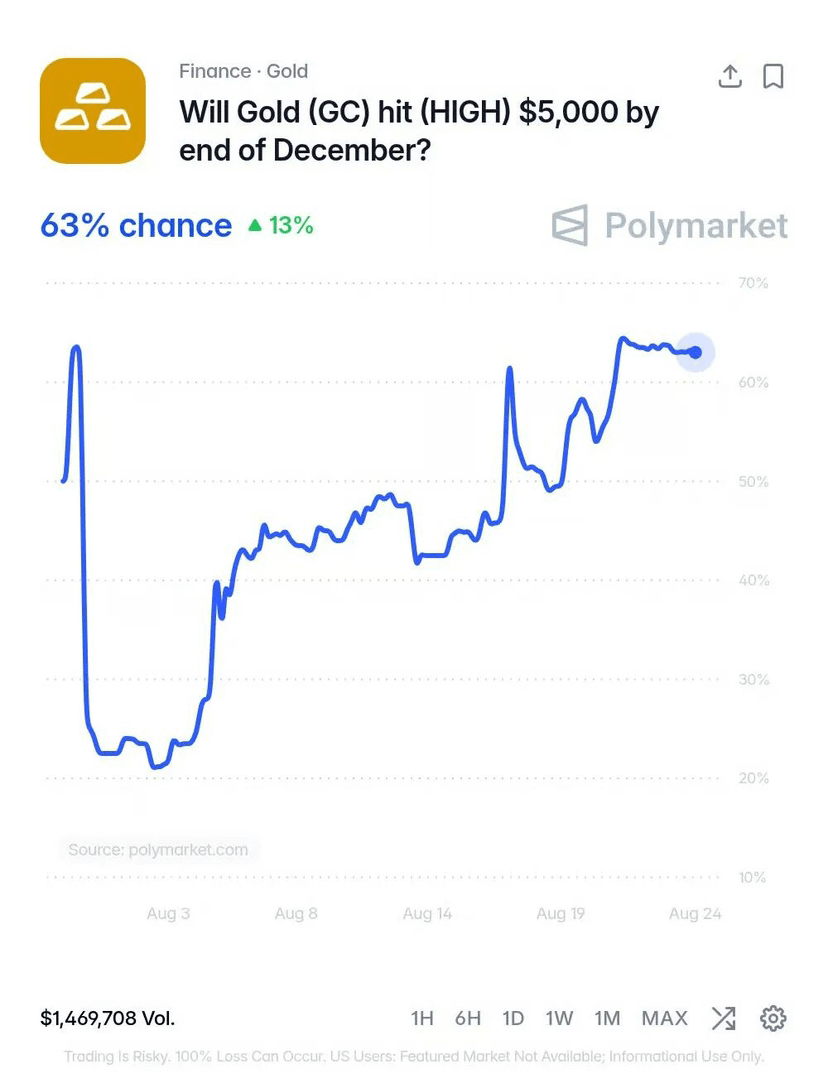
As the gold price continues to strengthen, the odds in the market are also moving rapidly. According to predicted market data, the market-implied probability of gold reaching $5,000 per ounce within the year has jumped from 40% a week ago to currently more than 60%.
The provided near-term technical reference levels are as follows: Resistance levels: 4670, 4770, 4890 Support levels: 4520, 4380, 4305 $XAU
As the gold price continues to strengthen, the odds in the market are also moving rapidly. According to predicted market data, the market-implied probability of gold reaching $5,000 per ounce within the year has jumped from 40% a week ago to currently more than 60%.
The provided near-term technical reference levels are as follows: Resistance levels: 4670, 4770, 4890 Support levels: 4520, 4380, 4305 $XAU


Verified
On August 26 at 20:30, the July PCE data will be released. If the reading comes in hotter than expected, expectations for the Federal Reserve’s September policy path are likely to be affected, and fluctuations in U.S. Treasury yields may move in tandem with global risk assets. In addition, the revised estimate of the U.S. real GDP for Q2 will be released on August 26 at 20:30. On a month-over-month basis, investors expect the Fed’s preferred inflation gauge—the core PCE price index—to rise by 0.2%. If the increase is larger, it could lead investors to reconsider expectations that the Fed will stay on hold in September, potentially opening the door for a pullback in gold. Conversely, if the monthly core PCE inflation data is weaker than expected, it may help gold move higher further.
Then on Thursday, August 27, traders will focus on the weekly initial jobless claims report. At 22:00 on Friday, the preliminary annual benchmark revision to nonfarm payrolls data will also be released, along with the final reading of the University of Michigan’s August consumer sentiment index.
The preliminary annual benchmark revision to nonfarm employment data will indicate whether previously reported U.S. employment figures were overestimated or underestimated. After recent signs of softer hiring, this revision may become even more important. If it suggests a significant weakening in the labor market, it could affect expectations for Fed policy.
Then on Thursday, August 27, traders will focus on the weekly initial jobless claims report. At 22:00 on Friday, the preliminary annual benchmark revision to nonfarm payrolls data will also be released, along with the final reading of the University of Michigan’s August consumer sentiment index.
The preliminary annual benchmark revision to nonfarm employment data will indicate whether previously reported U.S. employment figures were overestimated or underestimated. After recent signs of softer hiring, this revision may become even more important. If it suggests a significant weakening in the labor market, it could affect expectations for Fed policy.
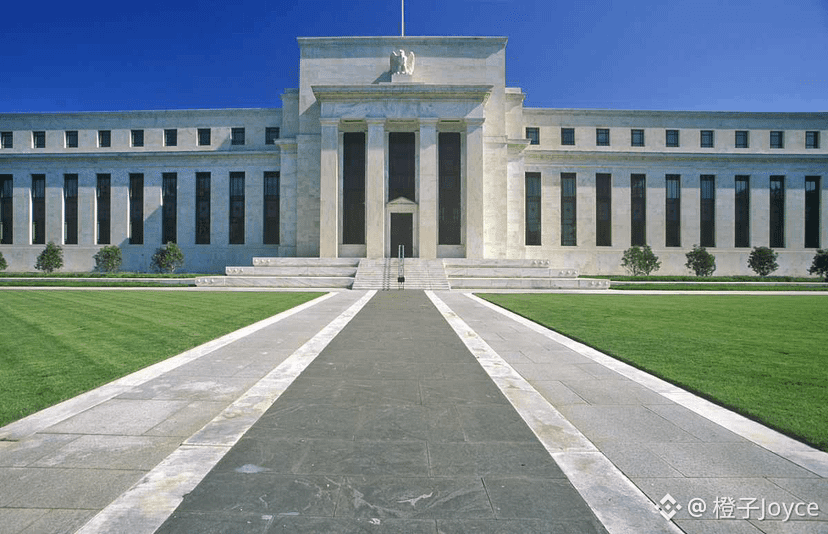
Partly True
The momentum of U.S. economic growth is accelerating. S&P Global’s U.S. Composite PMI rose by 1.5 points in August to 56.0, the highest level since April 2022 and the third consecutive month of gains. At the same time, the Services PMI increased by 2.2 points to 56.8, the highest level since March 2022. The Manufacturing PMI fell by 0.7 points to 53.9, the lowest level in the past five months, but it remains in the expansion range.
Meanwhile, U.S. firms’ hiring activity is led by the services sector, with headcount increasing at the fastest pace since January 2025. These data suggest that the United States’ year-on-year GDP growth rate in Q3 2026 will reach +3.0%, compared with +1.5% in Q2. Artificial intelligence is driving a historic wave of growth.
Meanwhile, U.S. firms’ hiring activity is led by the services sector, with headcount increasing at the fastest pace since January 2025. These data suggest that the United States’ year-on-year GDP growth rate in Q3 2026 will reach +3.0%, compared with +1.5% in Q2. Artificial intelligence is driving a historic wave of growth.

Log in to explore more content