
I bought ten tickets in the raffle, but the winner announcement said, "Your ten tickets count as ten votes." That’s when I realized weights and ticket counts aren’t the same.
At the community raffle, buying more tickets can increase your chance of winning. But the organizer made it clear—buying more doesn’t directly mean you’ll get a bigger reward. Each ticket counts as one vote, and during the drawing the votes are used with weighted calculation.
I didn’t think it through at the time. Later, when I looked at Dusk’s voting mechanism, I realized this logic is actually a crucial part of the consensus design.
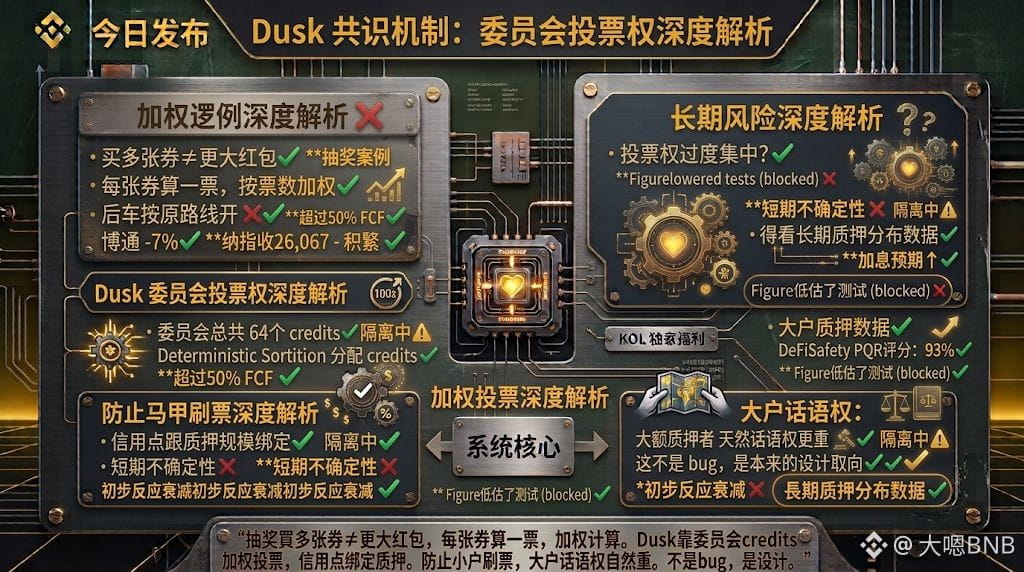
In Dusk’s verification/approval stage, it relies on "committee voting." Committee members aren’t counted as equal one-person-one-vote. Instead, voting is weighted by the "credits" (credit points) each member holds. The committee has a fixed total of 64 credits. The more you’ve staked, the more credits you get assigned through deterministic sortition. For example, if a member is assigned 3 credits, then the vote they cast is counted as 3 votes—not a simple "headcount democracy."
This weighted design addresses the problem of preventing people with small stakes from using sockpuppet accounts to inflate vote counts. Since credit points are tied to the size of your stake, getting more votes requires staking more real value—fake identities won’t help. But it also means that big stakers naturally have more influence in voting. That’s not a bug; it’s the mechanism’s intended design direction.
The more you stake, the greater your voting power—this logic itself doesn’t seem wrong. But whether it causes voting power to become overly concentrated among a small number of large players depends on the long-term distribution of stakes.
$DUSK
#dusk @Dusk
At the community raffle, buying more tickets can increase your chance of winning. But the organizer made it clear—buying more doesn’t directly mean you’ll get a bigger reward. Each ticket counts as one vote, and during the drawing the votes are used with weighted calculation.
I didn’t think it through at the time. Later, when I looked at Dusk’s voting mechanism, I realized this logic is actually a crucial part of the consensus design.
In Dusk’s verification/approval stage, it relies on "committee voting." Committee members aren’t counted as equal one-person-one-vote. Instead, voting is weighted by the "credits" (credit points) each member holds. The committee has a fixed total of 64 credits. The more you’ve staked, the more credits you get assigned through deterministic sortition. For example, if a member is assigned 3 credits, then the vote they cast is counted as 3 votes—not a simple "headcount democracy."
This weighted design addresses the problem of preventing people with small stakes from using sockpuppet accounts to inflate vote counts. Since credit points are tied to the size of your stake, getting more votes requires staking more real value—fake identities won’t help. But it also means that big stakers naturally have more influence in voting. That’s not a bug; it’s the mechanism’s intended design direction.
The more you stake, the greater your voting power—this logic itself doesn’t seem wrong. But whether it causes voting power to become overly concentrated among a small number of large players depends on the long-term distribution of stakes.
$DUSK
#dusk @Dusk