
Last week, U.S. Treasury yields suddenly spiked, startling the whole market
This week (Aug 24–28) is even more intense
With AI earnings reports and the Fed’s stance—both laid bare in the same week
I’ll go over a few key points
//
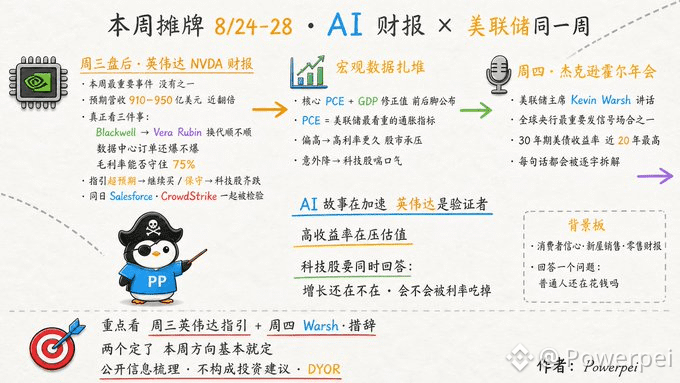
On Wednesday night, Nvidia (NVDA) releases its earnings report after the close
This is the single most important event of the week—no question
Wall Street expected revenue: $91–95 billion, nearly doubling year over year
But the numbers themselves aren’t the main point
What everyone is really nervous about are three things:
➢ How smooth the chip transition is—Blackwell moving to the next generation, Vera Rubin
➢ Whether data-center orders are still booming
➢ Whether gross margin can keep holding around 75%
(Explanation: gross margin is how much gross profit you have left out of every 100 dollars in sales. 75% is already extremely high—the market worries it could drop.)
If Nvidia’s guidance for the next quarter beats expectations → people will feel that the AI investment cycle isn’t anywhere near over, and they’ll keep buying
If the guidance is conservative—even a little → highly valued tech stocks could all fall together
On the same day, Salesforce and CrowdStrike also report results
In other words, the entire AI software sector is being tested at once: Are you making real money with AI or not?
//
Macroeconomic data is also packed into this week
Core PCE and GDP revisions come out back-to-back
You can think of PCE as the inflation gauge the Fed cares about most
If this number comes in too high → it suggests inflation hasn’t cooled enough, interest rates may stay elevated for longer, and the stock market will face pressure
If it unexpectedly falls → tech stocks may finally catch their breath
//
On Thursday: the Jackson Hole annual symposium
Fed Chair Kevin Warsh is scheduled to speak
This event happens once a year. Global central bank governors all attend, and it’s one of the most important occasions when the Fed signals its intentions
With the 30-year Treasury yield just brushing the highest levels in nearly 20 years, the market really wants to know: What does the Fed think about this yield spike? Will it take action?
Every word Warsh says will be parsed line by line
//
In between, there are also consumer confidence, new home sales, and earnings from several retailers
These are more like background indicators
But they answer one question: Are ordinary people still spending?
//
So the core conflict this week is:
> In AI: the story is still accelerating, and Nvidia is the proving ground
> In interest rates: persistently high yields are compressing valuations
> For tech stocks this time, they have to answer two questions at once—whether growth is still there, and whether the cost of that growth gets eaten away by higher rates
This week (Aug 24–28) is even more intense
With AI earnings reports and the Fed’s stance—both laid bare in the same week
I’ll go over a few key points
//
On Wednesday night, Nvidia (NVDA) releases its earnings report after the close
This is the single most important event of the week—no question
Wall Street expected revenue: $91–95 billion, nearly doubling year over year
But the numbers themselves aren’t the main point
What everyone is really nervous about are three things:
➢ How smooth the chip transition is—Blackwell moving to the next generation, Vera Rubin
➢ Whether data-center orders are still booming
➢ Whether gross margin can keep holding around 75%
(Explanation: gross margin is how much gross profit you have left out of every 100 dollars in sales. 75% is already extremely high—the market worries it could drop.)
If Nvidia’s guidance for the next quarter beats expectations → people will feel that the AI investment cycle isn’t anywhere near over, and they’ll keep buying
If the guidance is conservative—even a little → highly valued tech stocks could all fall together
On the same day, Salesforce and CrowdStrike also report results
In other words, the entire AI software sector is being tested at once: Are you making real money with AI or not?
//
Macroeconomic data is also packed into this week
Core PCE and GDP revisions come out back-to-back
You can think of PCE as the inflation gauge the Fed cares about most
If this number comes in too high → it suggests inflation hasn’t cooled enough, interest rates may stay elevated for longer, and the stock market will face pressure
If it unexpectedly falls → tech stocks may finally catch their breath
//
On Thursday: the Jackson Hole annual symposium
Fed Chair Kevin Warsh is scheduled to speak
This event happens once a year. Global central bank governors all attend, and it’s one of the most important occasions when the Fed signals its intentions
With the 30-year Treasury yield just brushing the highest levels in nearly 20 years, the market really wants to know: What does the Fed think about this yield spike? Will it take action?
Every word Warsh says will be parsed line by line
//
In between, there are also consumer confidence, new home sales, and earnings from several retailers
These are more like background indicators
But they answer one question: Are ordinary people still spending?
//
So the core conflict this week is:
> In AI: the story is still accelerating, and Nvidia is the proving ground
> In interest rates: persistently high yields are compressing valuations
> For tech stocks this time, they have to answer two questions at once—whether growth is still there, and whether the cost of that growth gets eaten away by higher rates