
Is this a bull run rebound—or a “big dip” return? Here might be the answer
┈➤ BTC spot/futures volume ratio
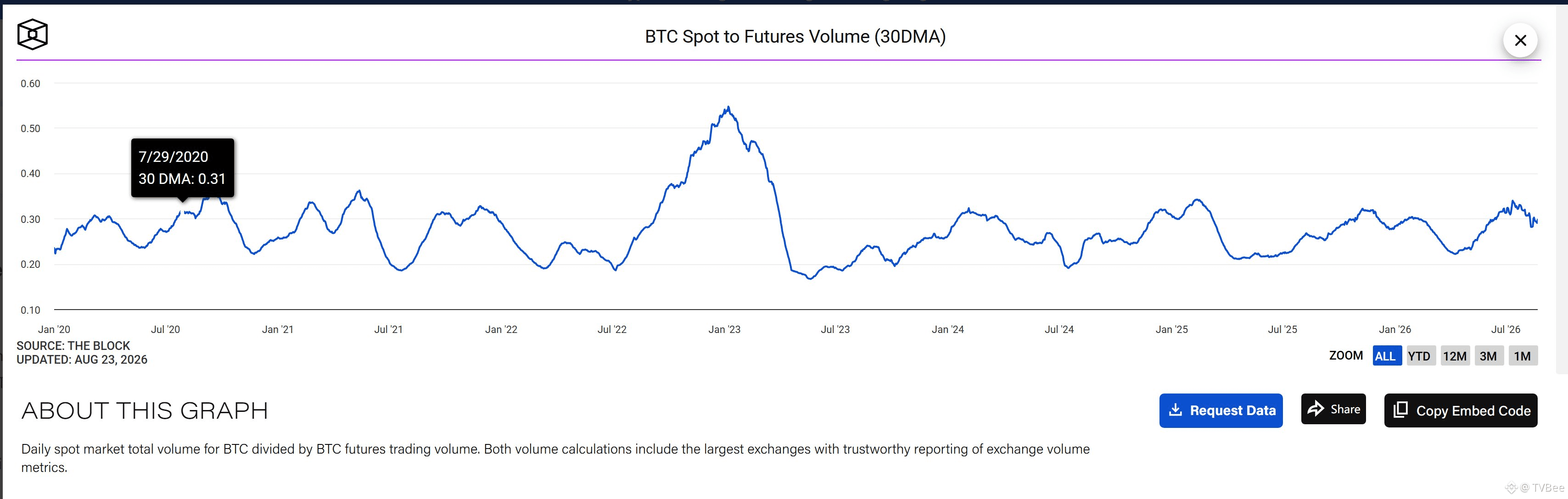
The 30-day moving average of this ratio is shown in the chart.
From July 2022 to January 2023, there was a clear rise to an extremely high point. This process is when the smart money (including both institutions and retail participants) completes accumulation.
After that, all the way through the bull top in 2025, there has never been such a high spot/futures volume ratio again.
Now, this ratio hasn’t risen to a very high level yet. Even if there are ETF buy flows, it still requires the ETF market makers (APs) to buy BTC spot.
So, the main players may not have finished accumulating yet.
┈➤ Political and economic factors
Geopolitically, the U.S.-Iran issue may be far from being resolved. The current calm is only because Trump has had to pause some more extreme measures in order to deal with the midterm election. There’s still a possibility of more “things blowing up” afterward.
Economically, my view is that the Federal Reserve will most likely not raise rates again. But from December to next Q1, it’s still not possible to rule out one more hike.
What’s most frightening is U.S. Treasuries. If long-term Treasury yields keep rising, it may eventually trigger a blow-up risk. Even if Treasuries don’t “blow up,” it’s still a sword of Damocles hanging over our heads.
┈➤ Written at the end
I believe the bear market is nearing its end, but it’s not certain that a bull market has already started. Due to political and economic uncertainty, the outlook for what comes next is more likely to be continued shakeouts, and the main players also need this shakeout process to keep accumulating.
I’ve always thought there would be a three-step probe (three dips), but I never said the third probe would definitely be a new low—or that it would definitely drop to around 60,000. From the perspective of “the cartel’s conspiracy,” why would they drop further below 60,000 to let retail investors get on board?
Either it drops even lower and lower, making retail investors afraid to board, or it drops to a place that doesn’t hurt much—so retail investors feel unwilling, not satisfied, but also not fully shaken out.
┈➤ BTC spot/futures volume ratio
The 30-day moving average of this ratio is shown in the chart.
From July 2022 to January 2023, there was a clear rise to an extremely high point. This process is when the smart money (including both institutions and retail participants) completes accumulation.
After that, all the way through the bull top in 2025, there has never been such a high spot/futures volume ratio again.
Now, this ratio hasn’t risen to a very high level yet. Even if there are ETF buy flows, it still requires the ETF market makers (APs) to buy BTC spot.
So, the main players may not have finished accumulating yet.
┈➤ Political and economic factors
Geopolitically, the U.S.-Iran issue may be far from being resolved. The current calm is only because Trump has had to pause some more extreme measures in order to deal with the midterm election. There’s still a possibility of more “things blowing up” afterward.
Economically, my view is that the Federal Reserve will most likely not raise rates again. But from December to next Q1, it’s still not possible to rule out one more hike.
What’s most frightening is U.S. Treasuries. If long-term Treasury yields keep rising, it may eventually trigger a blow-up risk. Even if Treasuries don’t “blow up,” it’s still a sword of Damocles hanging over our heads.
┈➤ Written at the end
I believe the bear market is nearing its end, but it’s not certain that a bull market has already started. Due to political and economic uncertainty, the outlook for what comes next is more likely to be continued shakeouts, and the main players also need this shakeout process to keep accumulating.
I’ve always thought there would be a three-step probe (three dips), but I never said the third probe would definitely be a new low—or that it would definitely drop to around 60,000. From the perspective of “the cartel’s conspiracy,” why would they drop further below 60,000 to let retail investors get on board?
Either it drops even lower and lower, making retail investors afraid to board, or it drops to a place that doesn’t hurt much—so retail investors feel unwilling, not satisfied, but also not fully shaken out.