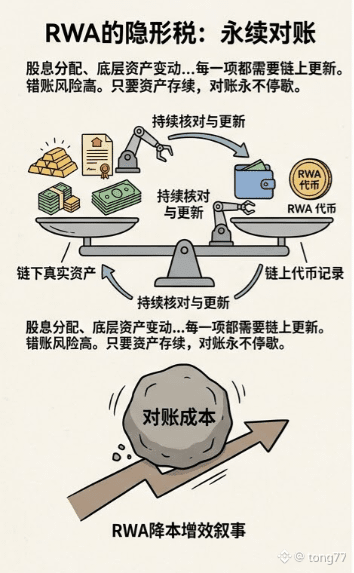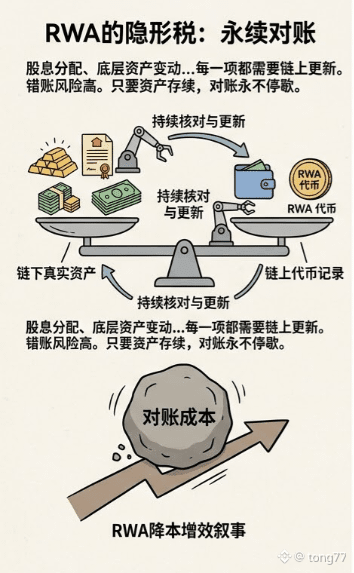
There’s a topic in the RWA track that every project party tacitly understands: reconciliation costs. No matter how beautifully Dusk and NPEX tell the story of moving assets on-chain, they can’t get around this invisible tax.
Let’s lay that tax out. Tokenization is only the first step; the on-chain record string and the real underlying assets off-chain must be kept in continuous alignment. How much dividends were paid, whether the underlying assets changed—every real-world change requires someone to update the corresponding records on-chain. This reconciliation work isn’t a one-time thing; it’s perpetual. As long as the assets still exist, reconciliation can’t stop for a single day. Who performs the reconciliation, who’s responsible if it’s wrong, how to account for transactions during the period when the books don’t match—every stage comes with costs. Almost nobody in the industry brings this up proactively, because it would undermine the narrative that RWA reduces cost and boosts efficiency. What everyone sells is a story that’s cheaper on-chain than off-chain, but very few have actually calculated how much profit this long-term, ongoing reconciliation expense eats away over time.
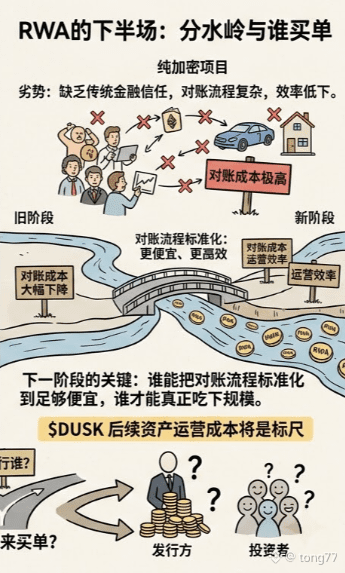
Dusk has its advantages, and NPEX itself is a licensed exchange. Its off-chain custody and settlement infrastructure is already in place, so reconciliation can reuse existing processes instead of building from scratch. That’s a much higher starting point than a pure crypto team entering the RWA space. But this also exposes the other side of the problem: the reconciliation cost advantage comes from being tightly coupled to traditional institutions. If this model needs to expand into an open ecosystem where any asset can be put on-chain, then each new issuer would have to bring along its own set of trusted off-chain systems—and that threshold is definitely not low.
In my view, the watershed moment for the next phase of the RWA track won’t be determined by technology, but by this invisible tax. Whichever party can standardize the reconciliation process to make it cheap enough will be the one that can truly capture scale. Otherwise, all projects can only stay with one or two pilot projects to tell their stories. What reconciliation costs get down to—at what “water level”—is what will determine whether RWA has truly crossed the commercialization threshold. I’ll use the ongoing on-chain asset operation costs for DUSK as the benchmark. In your opinion, who ultimately pays this tax—the issuer or the investors?
#dusk $DUSK @Dusk