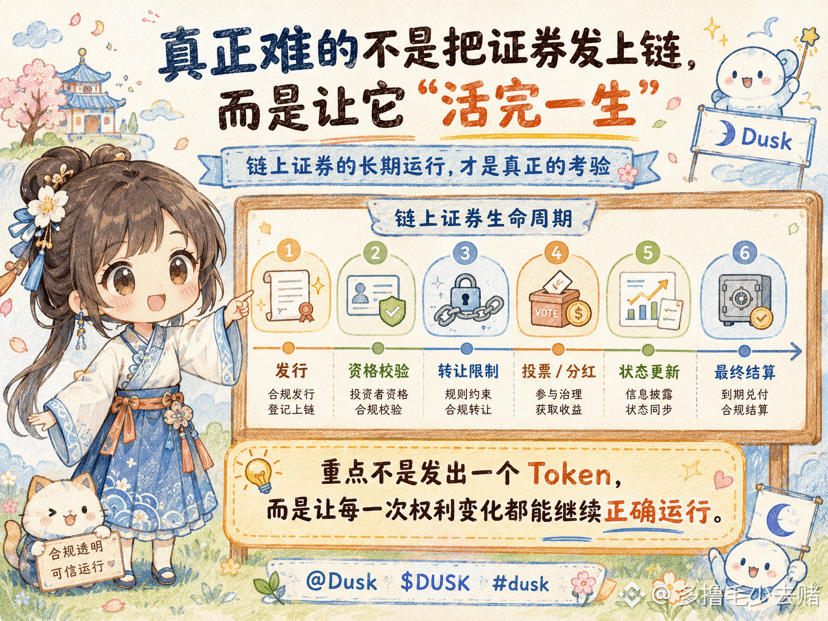
I used to look at RWA, and the first question I always asked was: when will it be issued, and can it be traded? Recently, when I kept breaking down the asset flow for @Dusk , I realized I’d missed the more troublesome half—issuance is only day one. What happens after day two?
Suppose a company natively issues securities onto the chain. A year later, there will be dividends and shareholder voting. Meanwhile, due to a change in eligibility, a certain account can no longer keep receiving that security. If all of these things ultimately still depend on a broker’s backend systems, Excel, and manual re-verification, then “putting it on-chain” only completes the easiest step. Tokens can be transferred—that only proves the asset has been digitized. Whether the rules can run alongside the asset for the long term determines whether it truly functions as a market on the chain.
Now Dusk’s Docs place these issues directly into a regulated asset workflow: define eligibility and lifecycle rules at issuance; check eligibility and restrictions during transfers; and handle corporate actions like dividend, coupon, burn, split, and other state changes. The Mainnet docs also clearly list shareholder registries and on-chain voting. Citadel’s job is to prove whether “this address meets the requirements,” without having to lay out the entire set of identity information. And after the asset rules execute, the resulting state still needs to be finally settled as an outcome that all participants jointly recognize.
Here’s a clear cognitive reversal I’ve had. I used to think the most core data of a tokenized security was the balance. After splitting it out, I found that the balance might actually be the simplest part. What’s really hard is: who does this balance belong to? Can they still hold it now? Do they have eligibility to vote this time? Does the next distribution count for them? After the rules change, can it still be transferred to another address?
So I don’t evaluate any single Dusk module in isolation anymore. Identity, asset rules, state changes, and settlement must work together continuously. If any layer breaks, the rules simply revert back to off-chain.
Of course, just because the Docs can design it doesn’t mean it can remain stable years from now. Complex permissions, identity upgrades, regulatory changes, and long-term mainnet stability all need to keep being validated. Going forward, when I look at RWA, I’ll ask one more question: five years from now, can this security still vote normally on-chain, make distributions, transfer, update eligibility, and complete settlement? This is a better test of whether a chain is real financial infrastructure than simply asking how many tokens were issued today.
#dusk $DUSK @Dusk