#dusk $DUSK @Dusk Recently, while rewatching Dusk, I suddenly thought of a question:
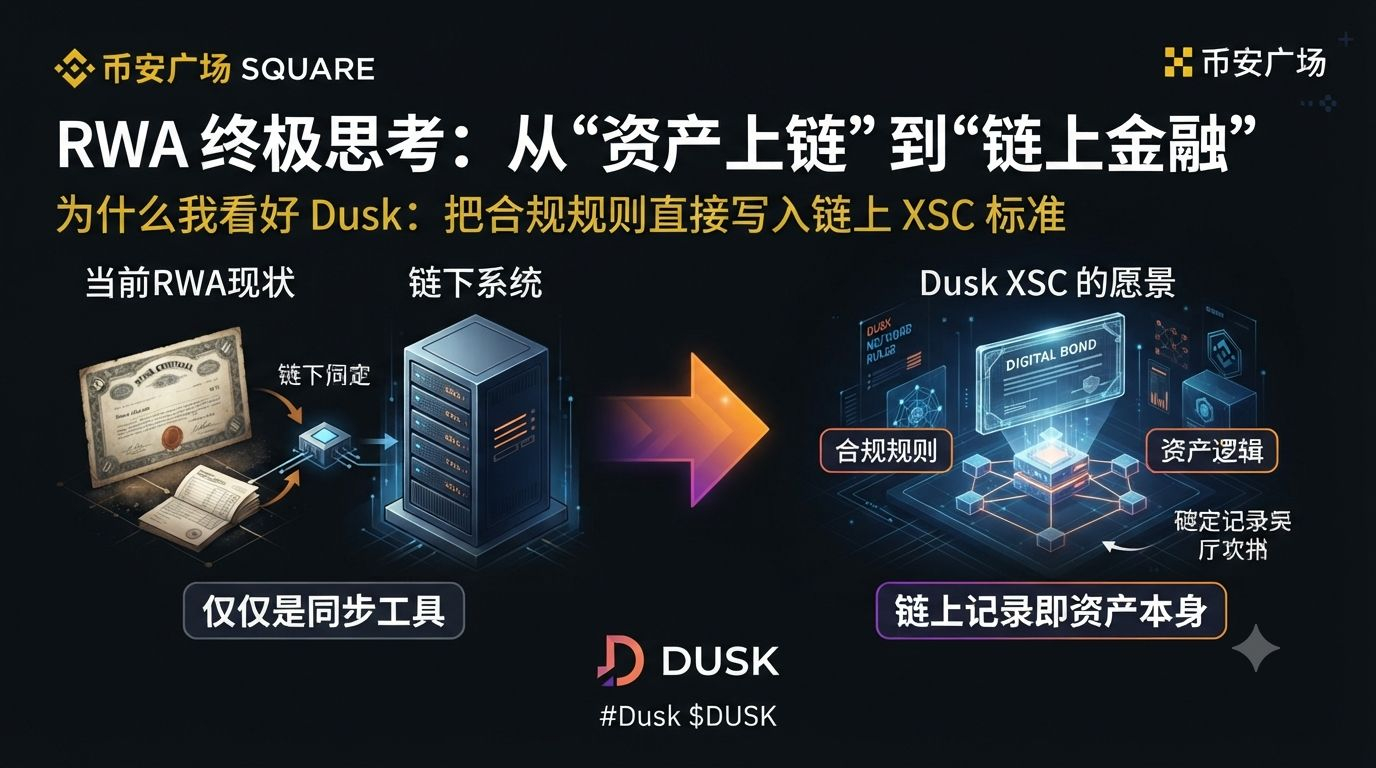
Could RWA’s real endpoint not be “moving assets on-chain,” but rather the on-chain records becoming the asset itself as the only valid state?
Nowadays, most RWA projects are more like adding a blockchain alongside the traditional financial system.
Issuance is on-chain, and queries are on-chain—but the thing that truly has authority may still be in offline systems.
For example, consider a security:
Who owns it? Can it be transferred? When are dividends distributed? Does it satisfy investment eligibility requirements?
If, in the end, all of these statuses are still determined by an off-chain database, then blockchain is more like a synchronization tool rather than a foundational financial infrastructure.
This is also the part of Dusk that I’m paying more attention to after rewatching it.
Dusk’s XSC design isn’t simply turning securities into tokens—it’s an attempt to encode the rules of the asset directly into the chain itself.
Holder restrictions, transfer conditions, and compliance requirements can all become part of how the asset operates.
The biggest difference from ordinary tokens is:
Typical tokens record “who transferred to whom.”
But financial assets need to record “who is eligible to hold them, and under what conditions that eligibility can change.”
Of course, the biggest challenge on this path isn’t technical.
It’s whether institutions are willing to gradually migrate the backend systems they formed over decades onto the chain.
So now when I look at Dusk, I don’t care as much about how many more partnerships it adds.
I’d rather look for one signal:
Has any institution started to genuinely treat on-chain state as the primary basis, instead of a backup for the off-chain system?
If that happens, RWA could truly move from “on-chain assets” into genuine on-chain finance.
Could RWA’s real endpoint not be “moving assets on-chain,” but rather the on-chain records becoming the asset itself as the only valid state?
Nowadays, most RWA projects are more like adding a blockchain alongside the traditional financial system.
Issuance is on-chain, and queries are on-chain—but the thing that truly has authority may still be in offline systems.
For example, consider a security:
Who owns it? Can it be transferred? When are dividends distributed? Does it satisfy investment eligibility requirements?
If, in the end, all of these statuses are still determined by an off-chain database, then blockchain is more like a synchronization tool rather than a foundational financial infrastructure.
This is also the part of Dusk that I’m paying more attention to after rewatching it.
Dusk’s XSC design isn’t simply turning securities into tokens—it’s an attempt to encode the rules of the asset directly into the chain itself.
Holder restrictions, transfer conditions, and compliance requirements can all become part of how the asset operates.
The biggest difference from ordinary tokens is:
Typical tokens record “who transferred to whom.”
But financial assets need to record “who is eligible to hold them, and under what conditions that eligibility can change.”
Of course, the biggest challenge on this path isn’t technical.
It’s whether institutions are willing to gradually migrate the backend systems they formed over decades onto the chain.
So now when I look at Dusk, I don’t care as much about how many more partnerships it adds.
I’d rather look for one signal:
Has any institution started to genuinely treat on-chain state as the primary basis, instead of a backup for the off-chain system?
If that happens, RWA could truly move from “on-chain assets” into genuine on-chain finance.