


Original title: (DeepSeek releases a vision understanding model; the “big blue whale” and other delayed eyes)
Original author: Insight Beating
On August 21, 2026, DeepSeek released a brand-new vision understanding model, deepseek-v4-flash-vision-exp, and the multimodal API was officially opened. For the first time, developers can send images directly into DeepSeek’s official interface.
The model retains V4 Flash’s 1 million-token context window and a maximum output of 384,000 tokens. It supports JSON Output, Tool Calls, and the Responses API, and it is also compatible with the Anthropic API.
Pricing is also fully based on V4 Flash. For every one million tokens of input, when the cache is not hit, it costs 3 RMB during peak hours and 1.5 RMB during off-peak hours; with cache hits, the cost is 0.1 RMB and 0.05 RMB respectively. Output costs are 9 RMB during peak hours and 4.5 RMB during off-peak hours. In Beijing, 9:00–12:00 and 14:00–18:00 each day are peak hours; the remaining 17 hours are half price.
Images are also billed by tokens. Before entering the model, each image is automatically resized based on its dimensions: those smaller than about 384×384 pixels are upscaled, while larger images are compressed down to about 800×800 pixels’ total pixel amount. A single image can occupy up to 384 tokens. A 2000×2000 image and a 5000×5000 image may end up consuming exactly the same number of tokens.
Based on an upper limit of 384 tokens, during peak times and when the cache is missed, the input cost for a single image is about 0.001152 yuan. Processing 1,000 such images means the image input itself is only about 1.152 yuan; the text and model outputs are charged separately.
Also launched at the same time was the Files API. Developers can upload images in advance, then put the file_id into the request. Each image only needs to be uploaded once, and after that it can be referenced repeatedly across different requests. In a single request, up to 600 images can be included. When using external links or Base64, the limit per image is 32 MiB; after referencing via the Files API, it can reach 64 MiB.
This API itself is free. The maximum size of a single file is 64 MiB; each user can store up to 25 GiB and 10,000 files. Files can be set to expire from 1 hour to 30 days; if no expiration is set, they can be kept indefinitely. Currently, the official site also does not provide an interface to download the file contents. Developers can upload, query, and delete files; the model can read them. It’s more like a free image repository prepared for inference than a normal cloud drive.
But what’s strange isn’t that DeepSeek only starts looking at pictures today.
These two timelines.
If you only look at the research, DeepSeek’s vision isn’t late.
If you only look at the product and the API, then yes, it is indeed late by a long time.
On March 11, 2024, DeepSeek-VL was open-sourced.
It has two versions, 1.3B and 7B. It can see natural images, webpages, formulas, charts, and documents. In October, Janus appears, putting image understanding and generation into the same autoregressive framework. On November 13, JanusFlow follows. In December, DeepSeek-VL2 is released, switching to a mixture-of-experts architecture, with total parameters split into three tiers: 3B, 16B, and 27B.
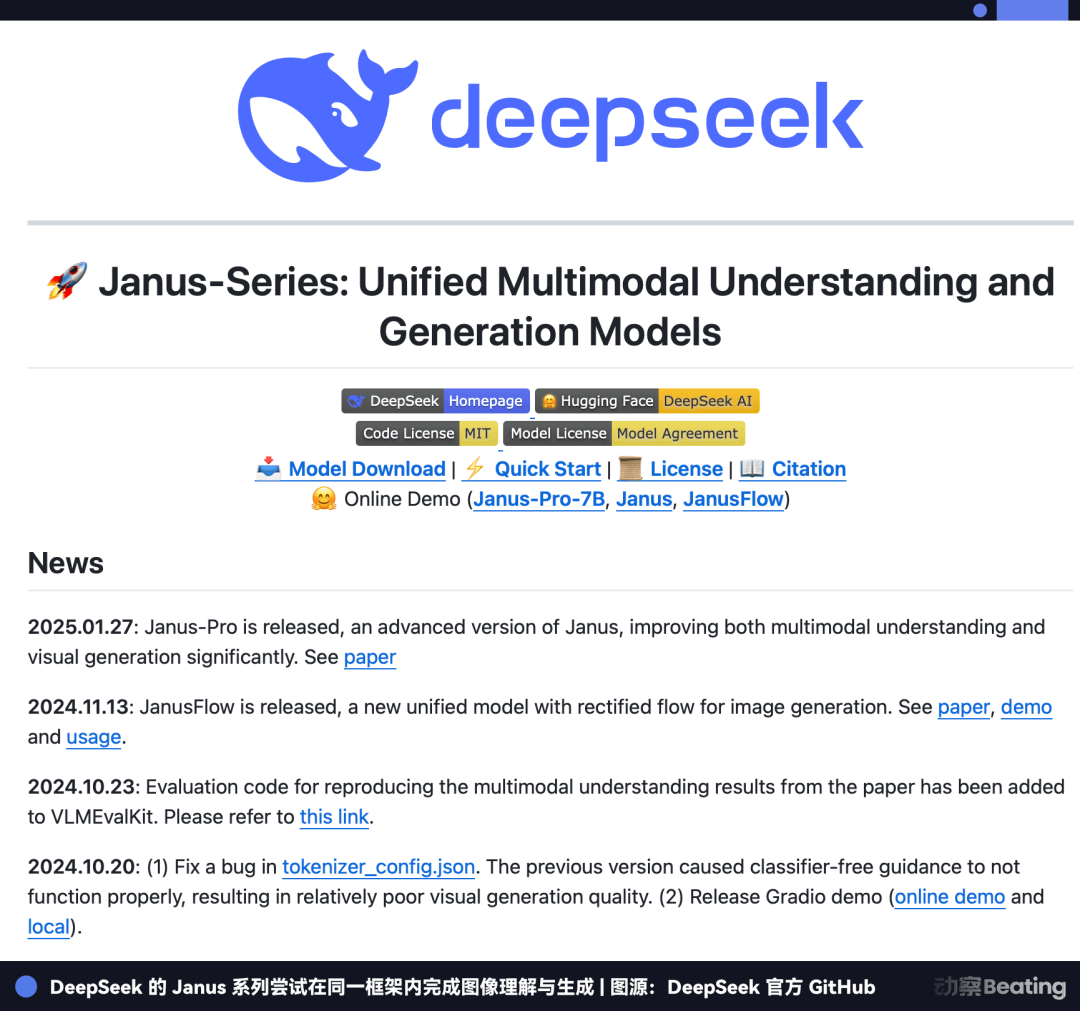
At 1:00 a.m. on January 28, 2025 (Chinese New Year’s Eve), Janus-Pro was open-sourced. The official repository recorded it as January 27 according to UTC.
In the 7B version, for GenEval’s text-to-image instruction-following evaluation, it scores 0.80, exceeding the DALL-E 3 value of 0.67 listed in the paper. It has open-sourced weights that can be deployed locally, and there are also public demos.
DeepSeek didn’t plug it into its hosted API.
Just a week before that, R1 had already pushed DeepSeek into the spotlight. Janus stayed on GitHub and Hugging Face. For most ordinary users, it quickly disappeared from view again.
On October 20, 2025, DeepSeek-OCR was open-sourced, compressing long documents with visual tokens. On January 27, 2026, OCR 2 was released.
Starting from DeepSeek-VL, over two years you can find at least seven public records: DeepSeek-VL, Janus, JanusFlow, VL2, Janus-Pro, OCR, and OCR 2.
Visual research has been ongoing, and it has always been pushed outward.
It’s just that ordinary developers still hadn’t gotten that entry point.
On the other hand, by March 2024, the developer interfaces of several major competitors already accepted images. In November 2023, OpenAI opened GPT-4 Turbo with Vision, allowing images to go directly into the Chat Completions API. One month later, Google launched the Gemini Pro Vision API. In March 2024, Claude 3 added visual capabilities across the board.
On April 25, 2025, at Baidu Create, Li Yanhong said, “DeepSeek is not all-powerful either.” Among the issues he listed afterward, there’s also one about modality being singular.
His view is that multimodality will become standard equipment for base models, while the market for pure text models will keep shrinking.
Back then, DeepSeek had already been doing one year of visual research.
At dawn.
On April 7 and 8, 2026, some users opened DeepSeek and suddenly saw three new entry points appear in the interface.
“Fast,” “expert,” “vision.”
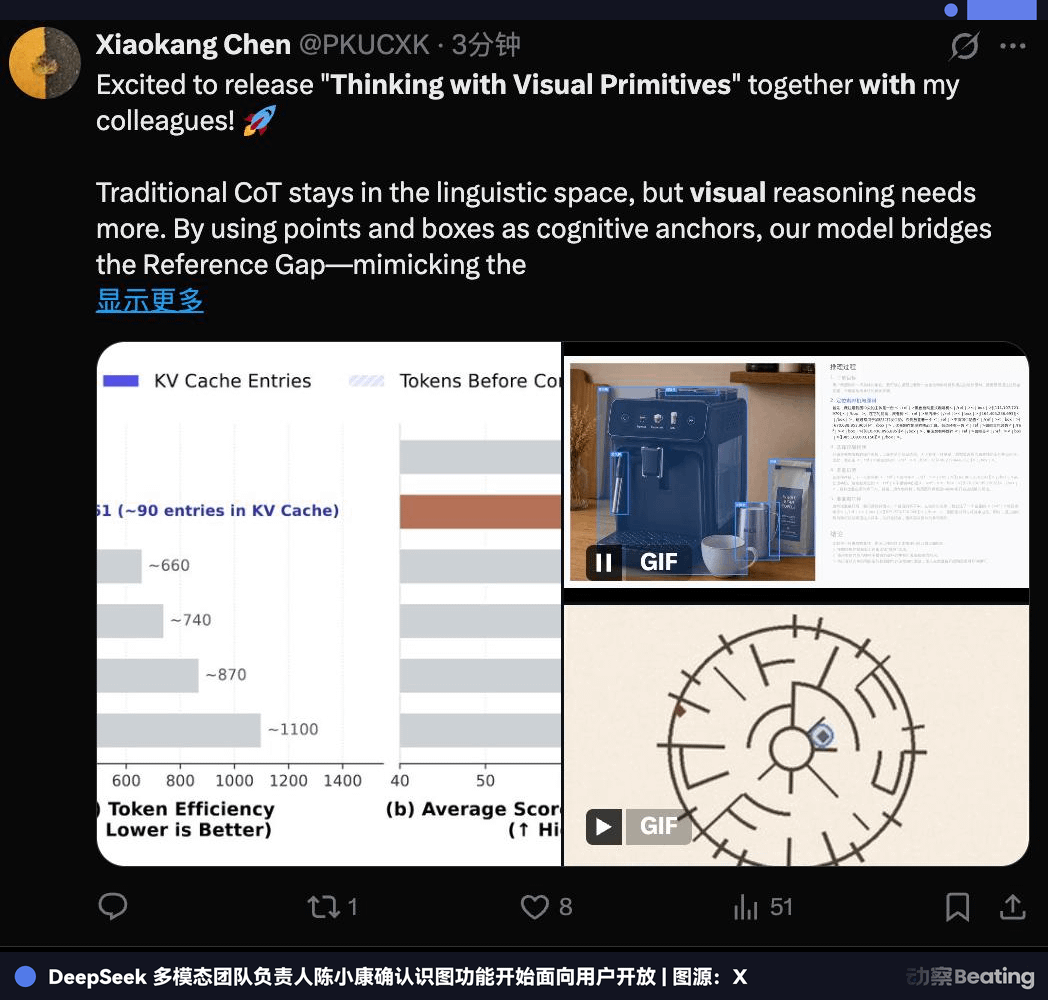
On April 29, Chen Xiaokang, head of DeepSeek’s multimodal team, confirmed that the image-understanding feature had begun rolling out to some users in a gradual beta. Afterwards, a senior researcher at DeepSeek wrote, “The little whale can now see.” The South China Morning Post directly put that sentence into the headline.
For the first time, DeepSeek’s eyes truly show through from the product interface.
The next day, DeepSeek put (Thinking with Visual Primitives) on GitHub. A few hours later, both the repository and the paper were taken down. By May 1, the original address returned 404. DeepSeek didn’t explain; all that remained online were mirrored copies of the paper and reports relayed by the media.
The paper studies a very specific problem.
After the model sees a very crowded image, it often knows what it’s talking about, but can’t clearly say which person or which line is actually being referred to. The team inserts point coordinates and bounding boxes directly into the reasoning process, so the model both points out the location and keeps reasoning forward.
A 756×756 image first goes through a vision encoder, turning into 2,916 image-patch tokens, and then through 3×3 spatial compression into 324 tokens. V4 Flash’s sparse attention keeps compressing the cache, until only 81 visual KV entries remain.
The team also generated more than 40 million training samples for this approach, including data specifically trained for maze navigation and path tracking.
What this paper spent a lot of effort solving, is actually “pointing to the exact spot.”
The model must first be able to see, and then also know where it is looking. Only then can it continue reasoning forward.
This time, DeepSeek didn’t explain whether Vision Exp fully retained that Visual Primitives approach. More importantly, for the first time, this research exposed DeepSeek’s understanding of “visual reasoning” to the outside world.
On June 18, the image-recognition mode for the web and app officially launched. The next day, a media outlet uploaded Liang Wenfeng’s photo for a test. DeepSeek mistook him for Zhang Yiming twice in a row. In a different conversation, it again identified Zhang Yiming as Chen Tianshi, founder of Cambricon.
It can read English screenshots, and it can also turn webpages into code.
But when it faces a human, it can’t even recognize its own boss.
On August 19, DeepSeek Harness left behind a technically explicit note with a clear date. The official adapter can already serialize an image sequence into image_url. The documentation also states that the default model directory will temporarily not display deepseek-v4-flash-vision-exp; you have to wait until the corresponding API endpoint is available.
On August 20, developers also tested that if you try to send an image to the still-unreleased model name, you only get a 400 error.
On August 21, this restriction was removed. Harness added deepseek-v4-flash-vision-exp into the default model directory, and the corresponding merged commit directly said “publish the vision model.” Soon after, DeepSeek’s official API documentation and WeChat public account simultaneously announced the launch of Vision Exp.
The two lines finally met.
Agent
In a transcript of a conversation with investors in May of this year, Liang Wenfeng laid out the AGI roadmap as several steps in his understanding: language models, chain-of-thought, Agents, continual learning, self-iteration, and then embodied intelligence.
He placed multimodality in the same kind of component position, much like search.
When talking about video generation, there’s a line in the transcript:
Commercially, it’s a good business. But that has nothing to do with intelligence.
His view is that the relationship between video generation and world models on the current stage versus the intelligence ceiling isn’t that big. More urgent right now are AI training and, after training, continued learning.
What’s different about multimodality is that, even though it’s also placed in a “component” position, DeepSeek has explicitly said it will definitely build this component. Liang Wenfeng also mentioned at the time that V4 and later versions would support native multimodality.
In DeepSeek’s roadmap, vision has always had a place—it's just not been positioned as far forward.
Once the roadmap reached the third step—Agents—the situation began to look somewhat different.
DeepSeek hasn’t publicly said that this vision API is launched “for Agents.” But putting Liang Wenfeng’s assessment of the roadmap together with today’s release, the two lines are already very hard to separate completely.
An Agent needs to read the screen, look at charts, and handle screenshots thrown back by tools. It can’t live forever in pure text. Those visual capabilities it has been building for two years finally make their way—straight from papers, repositories, and test pages—into the API.
The three examples DeepSeek showed for Vision Exp today are also not traditional “talking about pictures” demonstrations: an Agent makes a road-trip PPT for a premium client in Tibet; one redesigns the DeepSeek Harness website; and another produces a front-end demo with dynamic effects according to visual requirements.
They all require the model to repeatedly process visual information in long-horizon tasks.
The API design is also moving in that direction. The Responses API likewise accepts input_image. After a browser Agent gets a screenshot of a webpage, it can send it back into the next round of reasoning. A code Agent can check the rendering results, and charts, scans, and software interfaces can also directly become context.
The Files API solves another issue: the same image doesn’t need to be uploaded again and again in every round of requests. A file can stay there long-term, and the Agent only needs to repeatedly send the file_id. In a single request, you can also include up to 600 images. When using external links or Base64, the per-image limit is 32 MiB; after referencing via the Files API, it can go up to 64 MiB.
This doesn’t really look like just adding an “upload image” button to the chat box.
It’s more like it’s building the basic infrastructure that Agents need to use vision.
The four multimodal Agent comparisons DeepSeek published are also rarely about the traditional “talking about pictures.”
ApexBench focuses on long-horizon tasks such as investment banking, consulting, and law. Agents' Last Exam comes from real work across 55 professional domains. Chartography specifically tests Kaplan-Meier curves, candlestick charts, contour lines, Sankey diagrams, and Pareto charts. ZeroBench tests multi-step visual reasoning using 100 manually designed challenging problems.
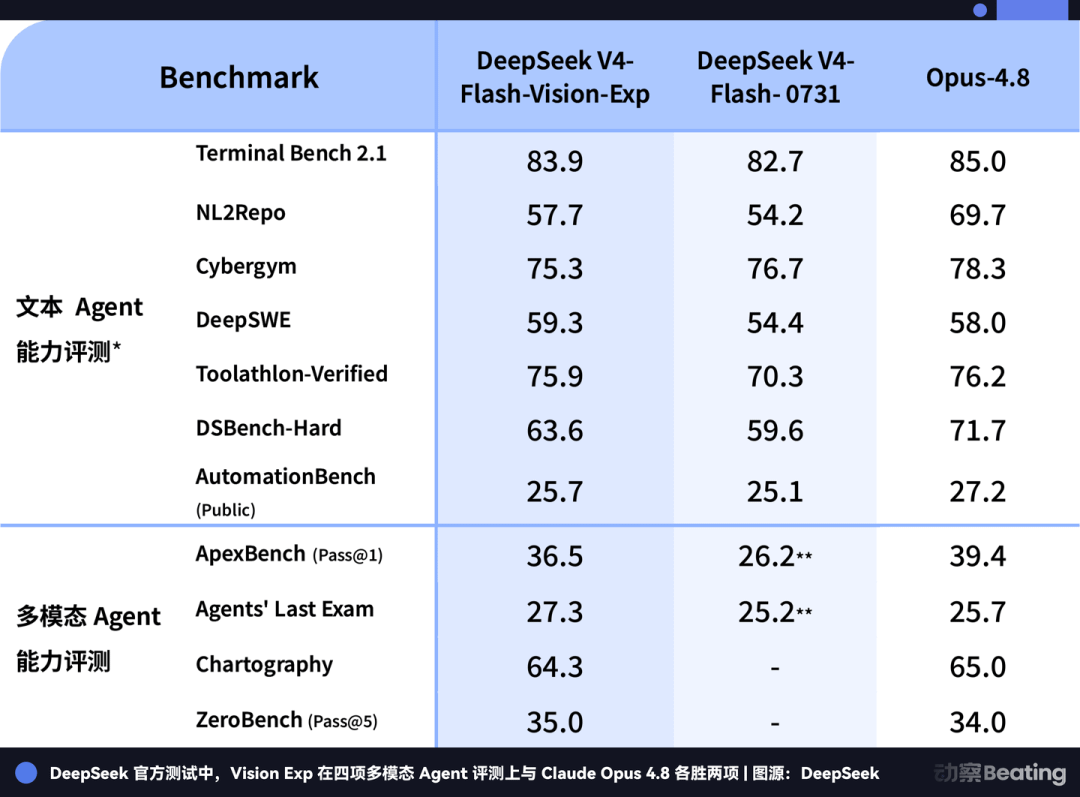
Vision Exp goes 2–2 against Claude Opus 4.8.
Agents' Last Exam is 27.3 vs 25.7; ZeroBench is 35.0 vs 34.0. ApexBench is 36.5 vs 39.4; Chartography is 64.3 vs 65.0. None of the four gaps exceeds 3 points.
More interestingly, after adding vision, the original text-elicited Agent capabilities don’t noticeably drop.
Comparing item by item with the pure-text V4 Flash released on July 31, the website also provided five text Agent evaluation results, and all of them rose for the “before and after” performance.
Terminal Bench 2.1 rises from 82.7 to 83.9; NL2Repo from 54.2 to 57.7; DeepSWE from 54.4 to 59.3; DSBench-Hard from 59.6 to 63.6; AutomationBench from 25.1 to 25.7. DeepSWE’s 59.3 also exceeds Opus 4.8’s 58.0 in the chart.
However, these numbers come from DeepSeek’s own internal tests. The official notes that for the DeepSeek series models used in the publicly documented Code Agent text tasks, DeepSeek Harness runs in a minimal mode and the reasoning configuration is set to max. They’re better suited for observing how Vision Exp changes compared with their own V4 Flash, rather than being used directly as a third-party independent ranking.
The exp after the model name hasn’t been removed yet either.
DeepSeek clearly marked it as an experimental model, and the version may still change. The current interface only supports image understanding; the output is still text. Image generation and video aren’t open. The Files API only accepts JPEG, PNG, GIF, and WebP; you can’t directly send PDFs.
In 2024, when developers wanted to send a picture to DeepSeek, the official API still couldn’t handle it.
By August 21, 2026, this image finally came in.
DeepSeek’s eyes really did open late.
By the time it truly opened its eyes, the road ahead no longer allowed it to keep walking with them closed.
Original link