

Original title: (Yushu Past)
Original author: Zhang Peng, GeekPark
Editor’s note: On August 19, Unitree Technology officially listed on the STAR Market, with its market capitalization peaking at over RMB 440 billion. In 2017, Zhang Peng, founder of GeekPark and founding managing partner of Variance Capital, was the first to spot Wang Xingxing and led the investment in Yushu’s angel round. To date, he has accompanied Yushu for nine years.
In this article (Yushu Past), Zhang Peng looks back at Yushu’s nine-year journey—from “walking the night road” to becoming a breakthrough innovator in embodied intelligence—and shares the investment judgments behind several key milestones, as well as his thoughts on the next generation of Chinese technology entrepreneurs. The original text is as follows:
After 9 years of accompanying Unitree, I want to “distill” from past events some things meaningful for the future. Today, Unitree Technology has sounded the bell for its IPO, having run to a market value exceeding 400 billion yuan.
For the embodied intelligence industry riding a strong headwind, Unitree played the role of a trailblazer breaking the wind, setting a valuable value anchor point for the entire industry.
What everyone has seen in the past few years is perhaps Unitree’s extremely rapid acceleration. But if you look back at its growth path, it wasn’t actually a feel-good drama script. From when Variable Capital, under Geek Park, decided to invest in Unitree’s angel round until today, we’ve already accompanied Unitree for nine years. In my view, it’s a process where fragility and toughness intertwine, confusion and decisions coexist.
The brilliance of going public lasts only a moment, but I want to properly “distill” the stories we shared along this long-distance journey with Unitree. Perhaps we can extract some things that still hold value and meaning for entrepreneurs today and in the future.
01 Moderately pessimistic—“walking at night”
From the perspective of financing, Unitree was born in an “incorrect season.”
Today, embodied intelligence and humanoid robots are booming. But back in 2017, when I first got to know Wang Xingxing, the term “embodied intelligence” hadn’t even started to circulate, and the capital market narrative was completely another world.
Looking back now, it was a stage when growth in China’s internet users had already peaked and the mobile internet wave was entering its final stretch. But the enormous inertia of the era kept dragging everyone along, and they couldn’t sense the slowdown in that time yet. Commercial innovation based on “connectivity” logic and software-driven engines—such as the sharing economy, group-buying, and the later SaaS wave—remained the main melodies that most entrepreneurs and investors focused on.
At that time, deep-tech innovation had begun to germinate, but in the previous AI 1.0 era, there hadn’t yet been companies that ran fast, grew wildly, and could exit like in the mobile internet era. There were only companies that could raise a lot of money, so deep tech hadn’t truly become the focus of the era.
The starting point of the story was in the autumn of 2017. I saw a very short article on a low-visibility account online—just a few pictures and a video. In the video, there was a robot dog called Laikago—“Laika” is the name of the first little dog that explored outer space for humans. As someone who loves spaceflight, I immediately felt a unique kind of rational-engineer romanticism. Of course, even more important was the robot dog’s fluid motion posture—it surprised me a lot.
Because in 2015, I brought a group of domestic entrepreneurs to MIT and, in the bionic robotics lab, we saw Professor Sangbae Kim’s machine cheetah (MIT Cheetah)—a massive quadruped machine body mimicking a cheetah, with steel cables and flying leads all over it, very much a lab vibe. At that time, we all treated it as something that might be truly impressive only after another 10 or 20 years.
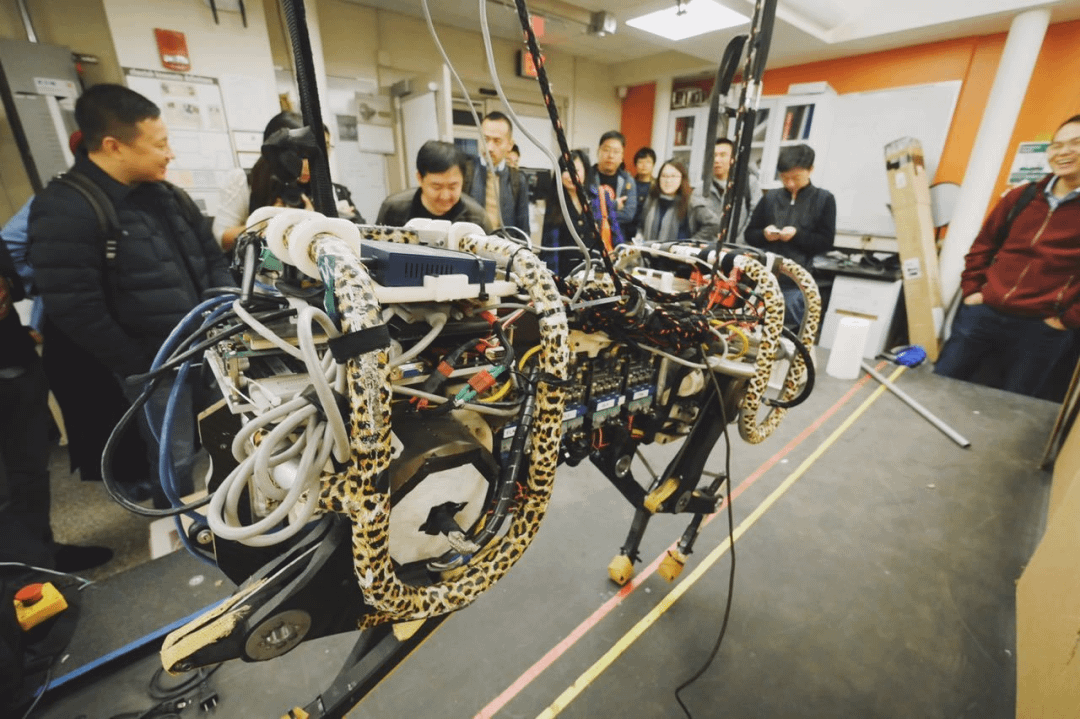
The result was that only two years later, a Chinese team in a “garage” in Hangzhou built a machine dog that was smaller, more mature, and closer to productization than MIT’s machine cheetah. That made me extremely curious and feel we had to meet the young people behind this product.
Very quickly, through friends in my network, I found Wang Xingxing and immediately flew to Hangzhou to meet him. On October 21, 2017, in my first meeting with Wang Xingxing, he was wearing dark jeans and white Adidas sneakers, like a fresh college graduate. His “office” was in a not-so-noticeable building in Binjiang District, Hangzhou—not a standard office building. There were also factory spaces next to it, and you couldn’t even find a company nameplate when you went in. It was a two- to three dozen square meter space, like a garage, piled with parts and two newly assembled machine dogs.
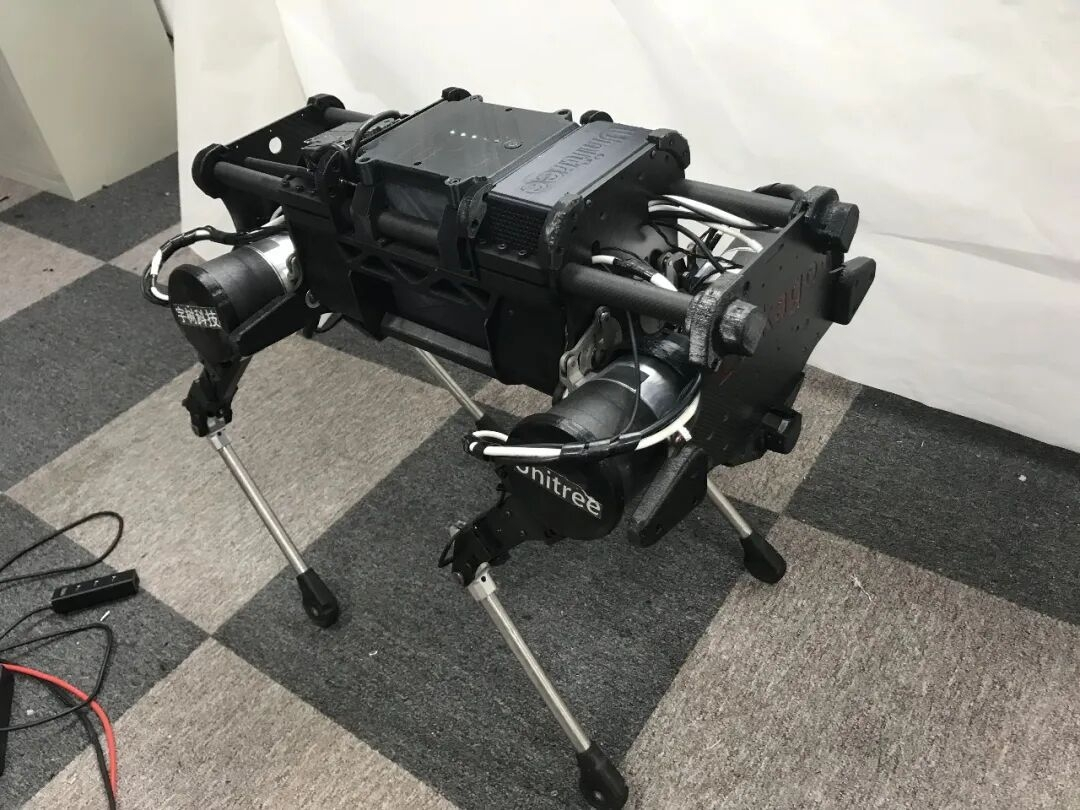
October 21, 2017 — first time seeing Unitree’s machine dog in person
After the demo of the machine dog, we didn’t even have a place to sit down and chat. In the end, we found an old, broken sofa in the hallway, drank water from a public water dispenser nearby, and talked for three hours.
Wang Xingxing didn’t have school teachers or industry resources backing him up. Basically he was an uncredentialed entrepreneurship novice with no established affiliations. And back then, there wasn’t even an attractive BP deck or any big narrative about “a trillion-yuan market in the future.” But as soon as you talked with him about products, technology, and engineering itself, he clearly had an innate passion and a level of understanding that went beyond his age.
At that time, Unitree was indeed hard for most institutional investors to quickly develop an intention to invest. The objective situation was right there: 1) there was no flashy selling point from a star entrepreneur; 2) there was no explosive market imagination space; 3) the technology and product still had a long road to explore. For such an early project with “two zeros and one one” (three negative factors), early-stage institutions really found it difficult to take action.
But if you look at it with a different logic: if, as digitalization and intelligentization progress, the robotics industry begins to gain an opportunity to enter a phase of rapid growth—especially when you see that the technical roadmap of electric drive has advantages far beyond hydraulic solutions—then at this turning point of industrial technological change, Wang Xingxing might be exactly the kind of person who starts “walking at night” before the dawn of the industry.
Because in that meeting, the first thing I felt about him was the powerful internal drive in him—he was, first and foremost, a true Dreamer. After graduating, Wang Xingxing probably could have had a very good future staying at DJI, but he resolutely chose to go independent and build robots. Without a strong love and self-driven force, you can’t make a choice like that. The “color” of this kind of Dreamer inevitably contains a bit of “technological romanticism.” You can even see it in the way he named the first-generation robot dog “Laika,” commemorating the little dog that explored outer space with humans. That’s a glimpse of the same theme.
But what’s even more rare is that he’s also a super rational and practical Doer. His instinctive thinking is: before technology and engineering are Ready, outlining those far-off commercial scenarios has no real meaning.
To be honest, it’s very rare to see this kind of fusion of two traits in one person. Maybe it’s also because I myself back then was a “non-typical investor.” After seeing enough different types of entrepreneurs, I left with a great first impression of Wang Xingxing’s combined qualities: he has both a burning romantic idealism and a down-to-earth willingness to grind through engineering. This combination is rare.
Back then, if certain technical and engineering milestones weren’t overcome, people’s visions of the market were indeed just fantasies. At that time, the only thing Wang Xingxing was certain about was that research institutes would buy such a quadruped platform to do research. That might have been the only market with a chance to find product-market fit back then.
Since I entered the tech media industry in 1998, I’ve been privileged to witness the stories of at least a thousand entrepreneurs up close. If you have to summarize anything from these “datasets,” the most important might be: “extreme optimism and extreme pessimism are both poisons.”
The extremely optimistic people love big narratives and easily turn it into “if you have money you can do it, the future will be better, and effort is enough,” but they often can’t break it down into specific paths, nor do they see which “mountain tops” must be taken to win this battle. The extremely pessimistic people see a field full of technical mountains and a vague market—this doesn’t work and that doesn’t work. Even if they end up touching the edge of a gold mine, they often still regretfully miss out or give up.
My first impression of Wang Xingxing was exactly somewhere in the middle between the two ends—an “appropriately pessimistic, extremely truth-seeking” state. Because there really were problems everywhere, but he still decided to do it. So he had to be diligent enough, truthful enough—there was no room for strategic “romanticism.” Or rather, he was seriously confronting “the darkness before the light,” and didn’t even have time to imagine “the light after the darkness.”
He focused 100% of his attention on the one axis he could control—the electric drive technical roadmap and engineering rigor.
Using the then-industry benchmark Boston Dynamics’ 1% cost as a baseline, Wang Xingxing produced a product with the best global value-for-money, the highest completion level, and an even more advanced technical roadmap. Today, quadrupeds and humanoids seem to be things many companies can do—but the reason Unitree is recognized globally in the industry as the strongest in the core body is precisely because of the founders’ traits and worldview that have never changed. This confirms that what’s more valuable than “telling stories” is indeed engineering rigor and technical aesthetics.
Now it seems that even from a financing perspective, Unitree was born in an “incorrect season,” but from the perspective of technological evolution and entrepreneurship, it perfectly landed in the “right moment.”
I even think that in 2016 and 2017, although Wang Xingxing wasn’t easy for capital to like, this was actually the best timing for him to start a business. If he had gone to a big factory and worked for a few years first, rather than starting to “walk at night” early, and waited until embodied intelligence became consensus after 2023 to start a business, he probably wouldn’t have been able to have the position he has today. For a considerable period, Unitree was the best at product and had the largest scale of revenue, but its valuation was still much lower than other robotics companies. Because it’s a “no-story” company—those early “night roads” it took were the most valuable and hardest to dilute.
I think that in the future, to support more early companies like Unitree that “don’t tell stories” and “walk at night,” we need more capital with different objectives.
For example, we should thank Yin Fangming personally for providing Wang Xingxing with the first RMB 2 million of startup capital. Without Yin Fangming’s support, there wouldn’t be the product we see today that Xingxing built. I believe that back then, he must have seen a young technical genius and given him the opportunity to move forward.
Also, thank the successful entrepreneurs who funded Variable Capital’s first fund. May you believe in our judgments about technology trends and our aesthetic taste for early entrepreneurs. This gave Variable Capital the chance to become one of Unitree’s first institutional investors—and to keep accompanying them up to today.
Actually, at the earliest stage of Unitree’s story, it’s essentially a group of entrepreneurs who understood the risks but identified with the significance of technological innovation. A bit of energy gathered together and carried a new entrepreneur upward—that is the most worth remembering scene in the story.
02 What’s left after shedding the times and luck?
If you stay close enough to Unitree for long enough, you’ll feel that this company wasn’t actually following a “overnight success and instant glory” script. All its strength comes from “self-improvement brings strength.”
In 2017, as an angel investment institution under Geek Park, Variable Capital was the first to give Unitree a TS in the angel round.
The first fund of the venture capital fund—its total pool was very small, and the money we could provide wasn’t enough for Unitree’s next stage funding needs. Meanwhile, we also knew Xingxing had no background, no school, and didn’t tell big narratives. In that kind of era, raising funds for him was very difficult.
But because Variable Capital was born in Geek Park’s entrepreneurs’ community, we felt that as a community there were some capabilities accumulated outside of capital. We set an optimistic goal: besides investing ourselves, we would also help Wang Xingxing find a lead investor who could do more than just provide money—who could add strength in technology, production capacity, and industry understanding.
I took Wang Xingxing to meet many excellent entrepreneurs. On one occasion, we specifically visited a hardware industry entrepreneur who both I and Xingxing deeply respected. The discussion went exceptionally smoothly—both sides talked very well, and very quickly produced a lead investors’ TS. The company’s new architecture also started being built; everything was full of hope and went so smoothly.
But this seemingly smooth process kept getting stretched out, far beyond expectations, and soon Unitree’s cash flow started to get tight.
Later I found out that at that time, Wang Xingxing had already started using his own savings to pay salaries for employees, and he never even told us. Until the end, when he finally couldn’t hold on and found me, he was still calm and restrained—he only said the account was almost out of money, which would affect subsequent product delivery. Even though that investment round hadn’t fully completed the process, he very much hoped that Variable Capital could pay out first to rescue the situation.
We had already done the math back then: the money we gave could hardly last for long. Now, the close for this round has been delayed; there are already some clear variables inside. And if Unitree can’t complete the full financing of this round smoothly, then most likely this will be the last check of money they receive.
So should we make this payment, or not? To be frank: back then, that decision had a certain amount of “stubbornness and risk-taking” and “not knowing the depth.” I remember discussing with Wu Jiang, the fund management partner. In the end, we slapped our thighs—let’s do it. Even if there’s risk, we can help him find investors and close the round.
In that second, my mindset probably wasn’t like an investor, but more like a partner. After we stepped up and put in the first check, it should have added some confidence as well. Later, that round of follow-on investing institutions also completed their payments one after another—at least helping Unitree catch their breath.
But the drama is that—when you think there’s risk, it really happens. The original lead investor couldn’t complete it due to some internal reasons, so the lead investment ultimately wasn’t done. No choice—accept reality. Then become a co-investor and lead instead, and help Wang Xingxing find money again. Recently I went back through my conversation records with Wang Xingxing and found that in 2018, we talked the most about this very topic.
But the drama reversed again. Although Unitree didn’t end up raising enough money in this round, it was precisely these several million that supported their delivery and R&D. Excellent products were quickly recognized unanimously in the market. By the end of 2018, Unitree entered a state of positive cash flow. When we were rushing to help them find money but hadn’t found it yet, the company somehow supported itself just by leaning on its products. In 2019, new investors proactively came looking and completed another round of financing. Then, Sequoia and other mainstream institutions gradually entered.
The outcome was of course good. But later, we did a more serious internal post-mortem on the decision to pay in advance. That decision logic—“we will definitely help entrepreneurs find money”—had a certain element of “stubbornness” and an overestimation of our own ability.
But more fundamentally, we reviewed why Wang Xingxing is the kind of entrepreneur who makes us “lose focus,” even prompting partners’ mindsets.
Back then in robotics, Boston Dynamics was universally recognized as the pinnacle—yet I thought their technical roadmap was wrong. Not only when I talked with Professor Kim at MIT in 2015 did I confirm that electric drive would be the future; even earlier, from 2014 when Geek Park invited Musk to come to China the first time, and then in 2017 and 2018 when intelligent electric vehicles had already started to emerge, you could clearly see that full electrification and intelligence were a major trend, and the electric drive for robots was definitely part of that trend. Getting the technical roadmap right is incredibly important. Wang Xingxing’s worldview on this point is very clear.
The second pillar, in my view, is that Wang Xingxing is someone who can endure loneliness. One memory that stays with me is his precious restraint in business strategy. Two traps that are easy for early deep-tech entrepreneurs to fall into—he seemed to have a kind of “natural immunity”:
One is “not deforming themselves just to make a story”—Wang Xingxing not only didn’t draw fantasies himself; even when investors tried to guide him to tell a story, he didn’t really “go along with it.” I still remember in his 2018 BP, it looked like he had been pressured to write something about future C-end application possibilities for the robot dogs after seeing too many investor decks; but when you really pressed him further, he would always circle back to technical questions and say, “It might be too early for all of this right now.”
Another is that they didn’t choose to “lay eggs along the way”—selling whatever they could sell, or stringing together a series of B2B custom projects just to get revenue numbers. At the time, it wasn’t that nobody came to Unitree to ask them to do projects, but Wang Xingxing was immune to these choices as well. These actions may seem like they create revenue, but in reality they would burden the team with heavy delivery and after-sales obligations. If you lay one egg after another, you might end up exhausting the “mother hen.”
Before the technology was mature enough to be generalized at scale, Wang Xingxing firmly chose this high-quality market: universities and research institutions. This meant he didn’t have to spend too much effort on market education and marketing; he could form a healthy cash flow cycle directly through research orders, and climb step by step by stepping on the ladder of technology. I think this kind of “early-stage tech—if you can drink milk, don’t go eat grass” thinking is truly rare.
So in that one moment of slapping our thighs, there was both impulsive stubborn recklessness and firm conviction in judgment. To be honest, that’s what the truth was at the time.
What deserves real admiration is still Wang Xingxing. Even though he said Variable Capital pulled him through during his most dangerous moment, actually I’m also very grateful to him internally, but in the opposite direction. During that half year, with his extremely strong cost control and product capabilities, he literally turned the business around by himself—“Self-improvement brings strength beyond all” is the best validation of that in him.
It gave us a chance to live up to the name I gave Variable Capital—at a certain moment, the “variable” that helps turn entrepreneurs’ situations around by that small bit of effort.
After watching and writing about so many entrepreneur stories, this time we also played a meaningful role within entrepreneurs’ stories, and stayed with them for 9 years. And that’s why we understand more deeply what lies at the core of entrepreneurship.
No entrepreneur can deny that a large part of success is often granted by the times, and for some, it can even only be explained by luck. Because in the real business world, a reasonable inference doesn’t always lead to inevitable results.
In Wang Xingxing’s brilliant story, what’s worth thinking about is: when we hand the times to the times and give luck to luck, what meaning is left that belongs to entrepreneurs themselves?
I think it’s probably the kind of thinking and action that entrepreneurs remain loyal to their own worldview—they turn themselves into that “small variable” that seemed insignificant at the time, but one day you realize it’s actually the most critical variable.
Without these, the so-called “times” and “luck” are actually meaningless.
03 A “static, but not stable” system
If Unitree had stayed only in the success of quadruped robots, it might today be an extremely healthy category leader with a global 70% share. But it would still be difficult for it to become a world-class top company that represents China’s deep tech and pierces through the industry ceiling within an embodied intelligence track.
In my view, Unitree’s most critical transformation happened at the node where it crossed over from “quadrupeds” to “humanoid.”
To be objective, in 2021 when the industry first started discussing humanoid robots, Wang Xingxing was very reluctant to do it. He thought: The technical challenges of humanoid robots are an order of magnitude more complex than quadrupeds. In a situation where Unitree didn’t have abundant funds at the time, if they rashly took on a humanoid prototype that leans toward “telling stories,” he didn’t have the ability to mobilize the whole industry to challenge that technical progress target together. That wasn’t the choice Unitree at that stage should make.
At that time, Wang Xingxing had already received investments from many mainstream institutions. There were many people around him giving advice, and there were all kinds of voices. Yet for a long time, Wang Xingxing wasn’t moved at all.
Until August 19, 2021, when Musk first publicly proposed the humanoid robot project on the stage of Tesla AI Day 2021, and vowed that they would produce 200,000 units per year in the future—this immediately changed people’s expectations for the robotics field.
In 2022, Wang Xingxing and I kept discussing Musk’s Optimus—this “Totem” idea—for a long time. Wang Xingxing said that from the product and engineering perspective he understood and observed, Musk is indeed not playing around—Optimus was designed with mass production in mind. He was even a bit shocked that Musk would go straight for mass production despite having so many technical problems even now.
And as Musk’s first-generation Chinese fan, I also judged that Musk really intended to push for breakthroughs in biped robots. But according to his usual style, he definitely wouldn’t be able to enter mass production in such an optimistic way. Because what he’s best at is: “set technical goals that align with first principles, then release a progress bar that looks nearly completed and shocks everyone, and finally continue to move forward steadily through repeated slip-ups.”
If Wang Xingxing’s earlier core reason for choosing not to do humanoid robots was: “If I’m not just telling stories, and truly want to push the technological ceiling higher—then Unitree’s capabilities at the time can’t carry the whole industry to challenge this problem.”
But on September 30, 2022, when Optimus’s first-generation prototype appeared and Musk very clearly set the goal for humanoid robots in front of the world, Wang Xingxing began to gradually realize that the environment he was facing had changed: Musk had become the “trailblazer” in that industry. So Unitree had to seriously consider whether it had the capability to join the leading camp in the biped space. And that’s how a two-person team started small experiments to build biped locomotion, and the project quietly began. Wang Xingxing left an open port in his own worldview.
When Unitree truly got down to work on humanoid robots, Wang Xingxing found that the motors, joint modules, mechanical transmission, and gait control algorithms accumulated over the years on quadruped robot dogs had not wasted a single cent—they became the most solid underlying foundation for Unitree’s biped humanoid robots. Once Unitree’s first humanoid robot was released, the engineering completeness across the globe was also the highest. And Unitree later chose to keep making both its quadruped and biped humanoids grow in athletic ability—this roadmap has become clearer and clearer.
This strategic choice wasn’t because Musk did it, so they rushed to join the heat and follow. It’s more like an environmental variable that affects a company’s strategic decisions has emerged—you need to jump out of inertia, then recompute your choices. Your previous “stability” needs, at some moment, to turn into “fierceness”—into explosive power.
To put it another way, it’s kind of like when you see GPT 3.0, or even ChatGPT. If you’re an entrepreneur like Yang Zhilin, do you realize that this is the moment when you absolutely must enter? An environment that you originally couldn’t change is automatically aligning itself toward you. So—do you join in?
I think this is a key growth change for Unitree. Because behind the series of decisions—“don’t do humanoid biped robots; decide to do it—how to do it”—there’s an original, non-storytelling, pragmatic and truth-seeking mindset. It also clearly increased the dynamic thinking about how the environment and the company’s capabilities evolve.
Actually, entrepreneurship is like flying a plane. Early planes are mostly “static stable systems.” They rely on their own aerodynamic characteristics to automatically resist attitude disturbances; control is simple and tolerance for error is good—but the upper limit of maneuverability is locked in. Later, as digital fly-by-wire flight control matured, modern advanced fighter jets widely adopted a “static unstable system” design. Even though control complexity increased dramatically, maneuverability gained a qualitative leap.
A great startup can’t forever be an overly self-consistent “static stable system.” If you’re too stable, you’ll be locked into the original track. Wang Xingxing also said he wanted to thank Musk for that call from “outside the window.” In Unitree’s originally extremely robust system, a hint of a “static unstable” factor was inserted.
Great people inspire great things, and courage can infect courage. That’s precisely because there are top entrepreneurs like Musk in this world who dare to think and act, and have the ability to set directions for the industry. They, in turn, inspire and help more excellent entrepreneurs to step into higher goals. And this—this is exactly the most fascinating and charming part about entrepreneurs as a group: they awaken one another in their exploration of the future, evolve together, and drive the entire era toward higher ground.
Through this leap from quadrupeds to bipeds, Unitree moved into a larger world and embraced a harder Game. But before listing, it still didn’t take another step to build a “general brain.” In an environment where neither brain technology nor data routes have converged, Unitree again reassessed its boundaries and chose to leverage its engineering product advantages—to push the biped body itself to the global extreme. That’s why, the moment Unitree’s humanoid robots were released, they were still among the world’s strongest in terms of engineering implementation and productization. Also, Unitree later kept growing both its quadruped and biped humanoid platforms in terms of athletic ability—this path has only become clearer over time.
But after going public?
This is still a control logic where a “static, but not stable” system faces more complex and dynamic variables: “Time waits for no one” means you proceed steadily and do it well; “Time doesn’t wait for me” means you take it upon yourself without hesitation.
04 Endless life, rolling forward
From the moment in 2017 when I decided to invest in Unitree—because Wang Xingxing is introverted and quiet, not good at socializing, and it was his first startup. He hadn’t earned money or spent money yet, and he didn’t have many mature entrepreneur friends around him. These were issues that Variable Capital felt it needed to provide some help with. Compared with the excellent entrepreneurs I’ve seen in the past, these seemed like relatively obvious “weaknesses.”
In those years, whenever Geek Park organized entrepreneur exchange events or annual conferences—so long as Xingxing had the time and the willingness—we would bring him along. We helped him showcase his products; more importantly, we hoped to help him build some meaningful connections and exchanges.
There’s a photo that was later forwarded by many people. Many interpreted it as me bringing him to seek investments from big-name investors—and also because the machine dog malfunctioned on-site, he didn’t end up getting the investment. That is actually a rumor.
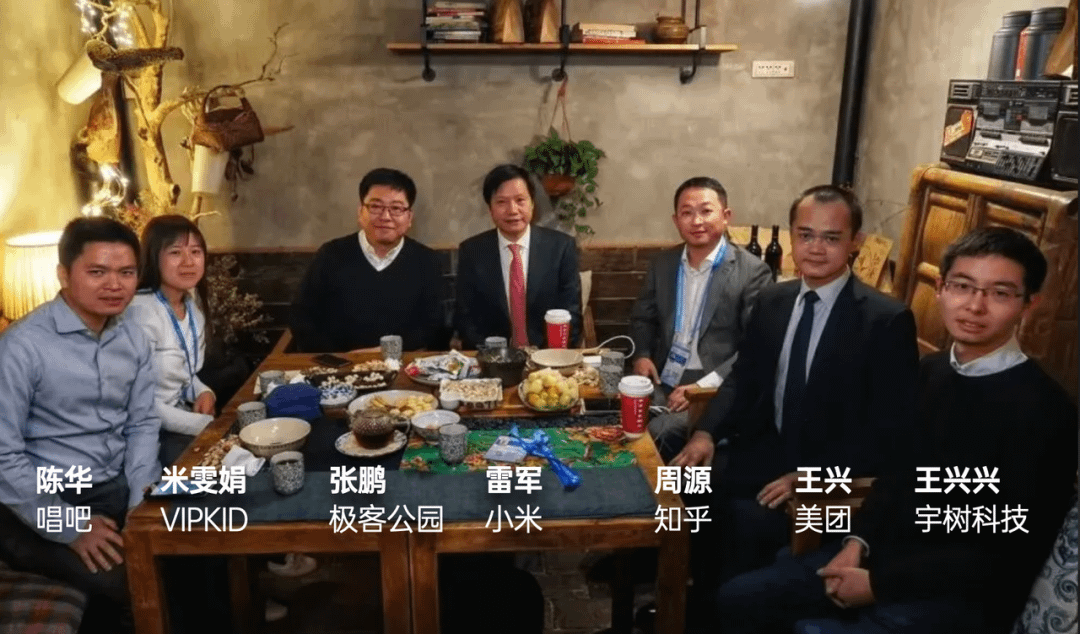
That was a startup gathering that Geek Park held at the Wuzhen Internet Conference in December 2017. The attendees were all friends who had known each other for years. At that time, Xingxing didn’t yet have a credential to enter the main venue, so we arranged the meetup outside the venue on purpose, intending to introduce some technology-industry seniors to him.
When we talked about things pretty much enough, I asked Xingxing to bring the robot dog over so everyone could see it. During the demo, there was indeed a bit of awkwardness: the robot dog froze and crashed when it tried to cross the threshold, so we had to reboot it on the spot. Everyone was generally tolerant and encouraging, but Wang Xingxing was really quite shy—I later confirmed with him that he hadn’t even added anyone’s WeChat account…
Later I became at peace with it. At that stage back then, adding WeChat or creating a group from that exchange wouldn’t solve any problems right in front of us, and it wouldn’t change anything.
But after that, everyone knows the rest of the story. In 2021, Lei Jun invested in Unitree; in 2024, Wang Xing received it as lead investor, and even became Unitree’s largest external shareholder. In this photo, yes, there are indeed two big shots whose involvement helped boost Wang Xingxing’s future development. But at that time, who could have known?
Maybe the role of that only gathering was to mark a point A. When Wang Xingxing’s product improves, the business develops, and the team grows, on some day years later, people at the gathering will remember what you looked like back then—using what you look like now as point B—so that memory forms a continuous line. In doing so, they truly come to understand you and recognize you. That might be the real value.
So, this money—does it count for “nothing, it’s everything”? In the end, whether it is “worthless” or “a treasure of this world” depends on the entrepreneur themselves.
What’s interesting is that in this photo, there happens to be a few generations of excellent Chinese entrepreneurs sitting there. And I was lucky enough to be an observer who has crossed multiple eras, so I truly feel that the environment and mission faced by the new generation of Chinese entrepreneurs have changed fundamentally.
In the past business environment and social conditions, many people believed Chinese entrepreneurs’ advantages lay in “model innovation” or “being close to the global ceiling and following as laggards.” But a new generation of entrepreneurs like Wang Xingxing and Liang Wenfeng at DeepSeek—or mature entrepreneurs starting new ventures—are completely rewriting this picture. The new mission for Chinese entrepreneurs should be to pierce through the ceiling.
Today’s China has far more wealth and resources than nine years ago. Perhaps we should give those “non-consensus” entrepreneurs more opportunities, without being so constrained by the consensus. Entrepreneurs need to be discovered and understood, not shaped. We don’t need to change them, and we don’t need to forcefully package them into some form. Instead, support them to become the version they themselves want to be.
More often than not, it isn’t that entrepreneurs catch up to the times; it’s that the times eventually catch up to them.
Congratulations to Unitree. Congratulations to Wang Xingxing.
And we also wish more new-generation entrepreneurs who want to “pierce through the ceiling,” endless life and rolling forward.
Original link