Last night, I went through the whitepaper for <0>@Dusk </0> and several technical documents again and again. Honestly, what I spent real time thinking about wasn’t the progress unlocking short-term items—it was what this coin actually does across the entire chain, and what it’s paying for in the network.
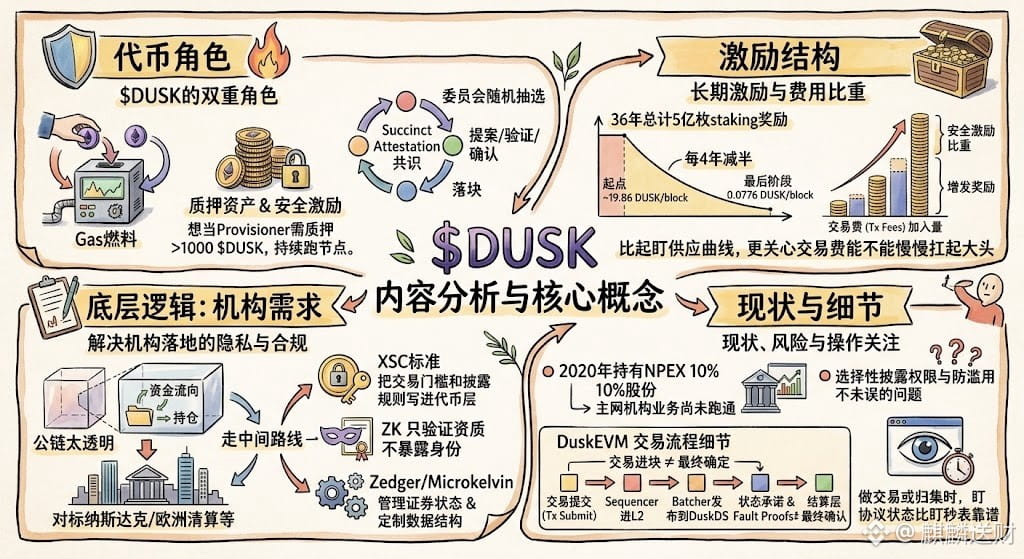
First, the role. $DUSK is both gas fuel and a staked asset used to participate in consensus. To act as a provisioner and enter consensus, you need to stake at least 1000 coins and continuously run a node. The consensus uses the Succinct Attestation scheme: nodes are randomly selected into committees, and in each round they proceed in the order of proposal, validation, and confirmation—only then does the block get finalized. It isn’t just a unit of account; it’s embedded into the network’s security incentive structure.
Next, the rewards. The official plan is to issue a total of 500 million coins over the next 36 years for staking rewards, halving every 4 years. The starting point is roughly 19.86 DUSK per block, and the final phase drops to 0.0776. Block rewards are also stacked with transaction fees. As issuance narrows, if on-chain fees can stay stable or even rise, its share in the security incentives will keep increasing. Compared to watching the supply curve, I care more about whether transaction fees can gradually shoulder the majority.
Then, the underlying logic. What Dusk wants to solve is the awkwardness when institutions roll it out: public chains are too transparent—holdings and fund flows are completely visible; private chains lose neutrality and trust. So it takes a middle path: the XSC standard writes transaction thresholds and disclosure rules into the token layer; ZK only verifies qualifications without exposing identities; Zedger handles the status of securities, and Microkelvin builds tailored data structures. The real target is private/consortium chains like Nasdaq and European clearing—seeking public-chain trust with controllable privacy.
Finally, the current situation and potential risks. In 2020, getting a 10% stake in the Dutch licensed exchange NPEX is definitely a strong signal, but the mainnet’s institutional business still hasn’t been fully operational. Who defines permissions for selective disclosure, and how to prevent abuse—these remain unresolved issues. There’s also a detail on the DuskEVM side: getting a transaction into a block doesn’t mean finality. First it reaches the sequencer into L2, then the batcher publishes it to DuskDS, anchoring to the settlement layer via state commitments and fault proofs. When doing transactions or aggregations, it’s more reliable to watch the protocol state than to obsess over the stopwatch.
Whether this can truly let transaction fees support security, while making compliant privacy real—that’s what I’ll keep monitoring next. #dusk
First, the role. $DUSK is both gas fuel and a staked asset used to participate in consensus. To act as a provisioner and enter consensus, you need to stake at least 1000 coins and continuously run a node. The consensus uses the Succinct Attestation scheme: nodes are randomly selected into committees, and in each round they proceed in the order of proposal, validation, and confirmation—only then does the block get finalized. It isn’t just a unit of account; it’s embedded into the network’s security incentive structure.
Next, the rewards. The official plan is to issue a total of 500 million coins over the next 36 years for staking rewards, halving every 4 years. The starting point is roughly 19.86 DUSK per block, and the final phase drops to 0.0776. Block rewards are also stacked with transaction fees. As issuance narrows, if on-chain fees can stay stable or even rise, its share in the security incentives will keep increasing. Compared to watching the supply curve, I care more about whether transaction fees can gradually shoulder the majority.
Then, the underlying logic. What Dusk wants to solve is the awkwardness when institutions roll it out: public chains are too transparent—holdings and fund flows are completely visible; private chains lose neutrality and trust. So it takes a middle path: the XSC standard writes transaction thresholds and disclosure rules into the token layer; ZK only verifies qualifications without exposing identities; Zedger handles the status of securities, and Microkelvin builds tailored data structures. The real target is private/consortium chains like Nasdaq and European clearing—seeking public-chain trust with controllable privacy.
Finally, the current situation and potential risks. In 2020, getting a 10% stake in the Dutch licensed exchange NPEX is definitely a strong signal, but the mainnet’s institutional business still hasn’t been fully operational. Who defines permissions for selective disclosure, and how to prevent abuse—these remain unresolved issues. There’s also a detail on the DuskEVM side: getting a transaction into a block doesn’t mean finality. First it reaches the sequencer into L2, then the batcher publishes it to DuskDS, anchoring to the settlement layer via state commitments and fault proofs. When doing transactions or aggregations, it’s more reliable to watch the protocol state than to obsess over the stopwatch.
Whether this can truly let transaction fees support security, while making compliant privacy real—that’s what I’ll keep monitoring next. #dusk