
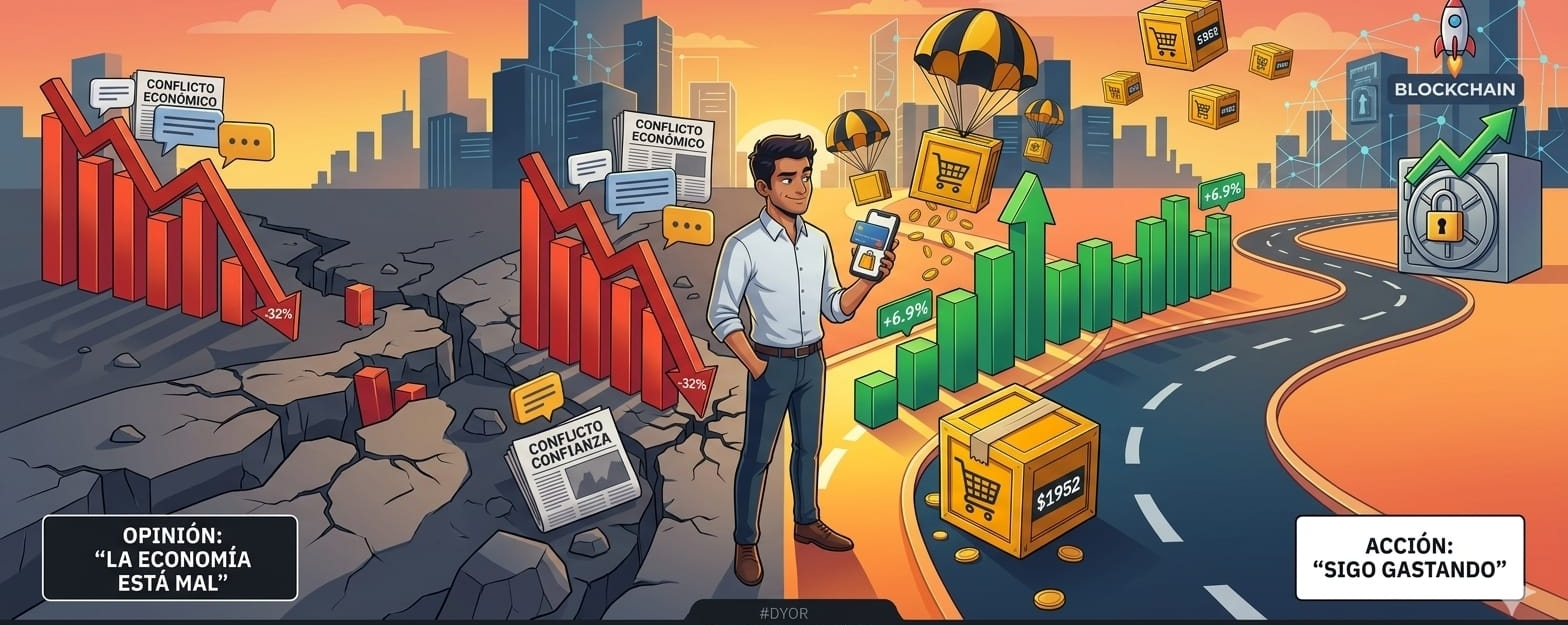

There’s a complete disconnect between what consumers say they feel about the economy and what they actually do with their money. It’s the classic dilemma: “I complain about the price of things, but I stand in line to buy the latest smartphone.”
Historically, consumer confidence in the U.S. has been known to plunge to critical levels not seen in decades (reaching lows reminiscent of the crises of the 1950s), driven by the inflation narrative. However, hard data from real retail sales shows a completely opposite reality: robust year-over-year growth of close to 6.9%. 🛒
How is it possible that people claim they feel worse than ever about the economy, yet at the same time keep spending at a rapid pace? Welcome to the fascinating world of contradictory spending.
📉 The psychology behind “Revenge Spending” and perceived inflation
In the traditional economy, it’s assumed that if consumer confidence falls, spending automatically decreases because people prefer to save out of fear for the future. In the modern ecosystem, this rule has been broken due to two key psychological factors:
Hedonic Adaptation Effect: Consumers complain about rising prices for essential services and products, but they refuse to give up their lifestyle or their small daily luxuries (trips, technology, going out).
The gap between opinion and action: Answering a survey about how you perceive the country’s direction appeals to a political and social bias (the news always sounds pessimistic). Instead, swiping a credit card at the grocery store or an online shop responds to an immediate need or impulse.
For analysts and investors, this phenomenon creates a massive distortion: if you only look at opinion polls, you’d bet on an imminent recession; if you look at real consumption data, the economy looks stronger than ever.
📊 What should you pay attention to as an investor?
In financial markets—including the crypto market—opinion data often creates short-term noise (FUD or FOMO), but real money flows are what set long-term macroeconomic trends.
To evaluate the true health of the markets, consider this comparison:
Indicator based on Opinion (What they say)Indicator based on Action (What they do)Sentiment surveys: Measure fear and political or social perceptions of inflation.Transaction volume: Shows the real movement of capital in goods, services, and assets.Social media monitoring: Susceptible to manipulation, bots, and emotional biases of the moment.Corporate earnings and network fees: Auditable data on how much money is flowing into ecosystems.Search trends: Reflect curiosity or temporary panic, not necessarily purchase intent.Liquidity flows (Inflows/Outflows): The real trail of institutional and retail money entering or exiting an asset.
➡️ The big question: Sentiment or Liquidity?
At the end of the day, real money is what moves the needle. Markets don’t crash because people feel “sad”; markets crash when people run out of liquidity to buy. As long as spending metrics keep rising, the economic engine stays on—no matter how many complaints get logged in opinion polls.
The next time you read a sensational headline about “market pessimism,” remember to look at transaction volume before making a rushed decision.
🤔 And you—what do you believe more?
🔴 What people say (Sentiment)
🔥 How they spend their money (Liquidity)
Leave your answer in the comments! 👇
Do your own research. This is not financial investment advice. #DYOR #MacroEconomia #BİNANCESQUARE #CryptoAnálisis