

Original title: (After XiaMi Music left for five years, Alibaba taught another “XiaMi” to write songs with AI)
Original author: Insight Beating
On August 17, XiaMi is back again.
Alibaba releases an AI music model, HappyShrimp 1.0, with the Chinese name “HappyShrimp.” Users only need to write a single sentence, and it can generate a complete song.
You don’t even need to know what chords, time signatures, or modes are. You can tell it you want to write a song for your just-graduated self—something that’s best suited for playing in a coffee shop; or you can say, it’s almost quitting time, it suddenly starts raining outside the window, and you want a bit of gloom, but not too heavy. In the past, these could only be used to describe feelings. Now they can also be turned into music commands. HappyShrimp will try to understand, and then create something.
At present, it has already launched a web desktop test version. Alibaba says HappyShrimp uses end-to-end full-song generation, processing style, mood, era, and vocals in one generation pipeline. In actual testing, it is especially sensitive to everyday Chinese expressions. Often users cannot clearly say what music they want, only that they want it “a little lighter,” “like summer ten years ago,” or “not too bitter,” and it can keep going based on those vague descriptions.
This has made music production very cheap. Adding a short soundtrack to a short video, making a demo for an ad, or finding background music for a game or podcast no longer requires building an entire production pipeline from scratch. On the test page, the standard membership price was about 30 yuan per month, and it could generate 150 songs—roughly 0.2 yuan per song.
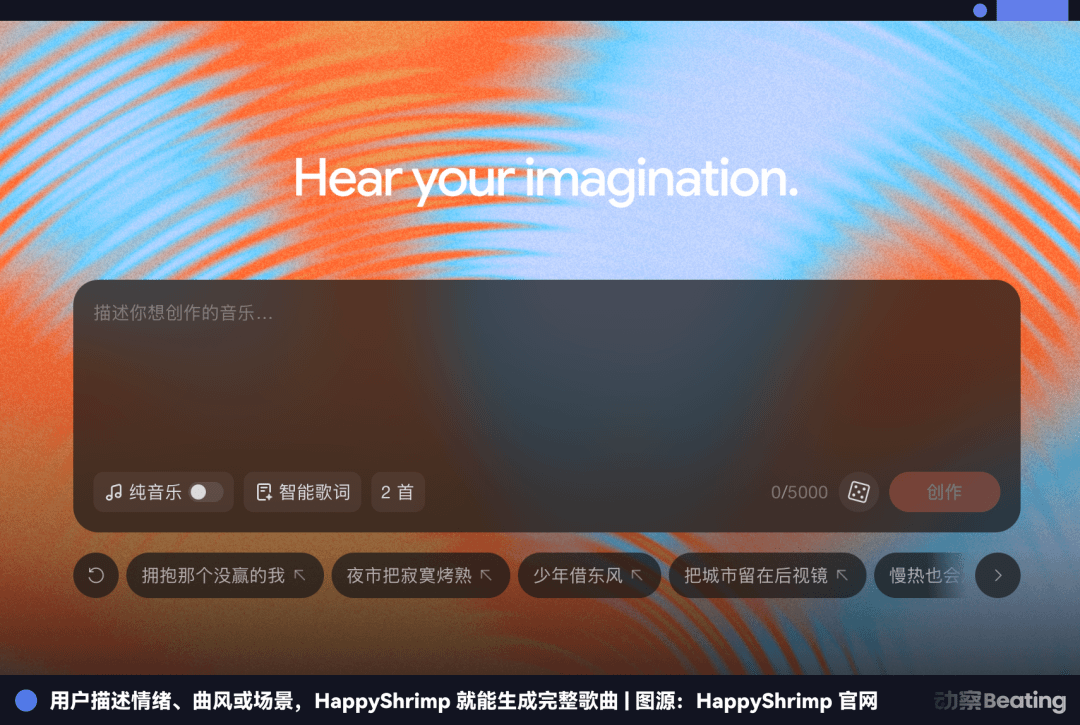
On launch day, HappyShrimp also announced a partnership with Taihe Music. Alibaba also planned to have it appear at this year's Anaya Xiami Music Festival. It was also the third member of Alibaba's “Happy plus animals” series: HappyHorse does video generation, HappyOyster does world models, and the third one is music.
It took Xiami Music twelve years to become the Xiami people later remembered fondly.
HappyShrimp takes about one minute to generate a song.
Manual Era
Old Xiami was very small at the beginning.
Wang Hao was originally an Alibaba programmer who also played in a band, using the screen name “Pumpkin,” taken from his love of Smashing Pumpkins. In college, he played guitar and formed a band called “Black Water.” During summer vacation in his sophomore year, he once got his finger bitten by a dog in the rehearsal room and could not play guitar for a while, so with nothing else to do, he started learning to code.
It started with HTML, later PHP. He even translated the PHP manual and made websites for others to earn pocket money, 200 yuan for a static page. Later still, he wrote his own forum called “Sound Network,” dedicated to underground music in Hangzhou and concert information. By 2001, the forum already had tens of thousands of registered users, with several hundred people online every day. Young people in bands and young rock listeners used it to arrange gigs, find bandmates, and chat. When bands from outside Hangzhou came to town, Wang Hao sometimes helped contact venues.
He later discovered that he might not have the talent to become a professional musician, but he was very good at bringing people who loved music together.
After graduating from college, he still lived with Zhu Qi, who later co-founded Xiami with him. The two of them worked separately during the week, and on weekends, musicians and friends from Hangzhou would all come running over to their place to eat, drink, talk music, and sometimes the whole room would be packed. Wang Hao made a living selling musical instruments online, doing business by day and helping bands find venues at night and on weekends.
In 2003, he felt e-commerce might really become a business, so he went to Alibaba to learn how to do internet products. First Java, then requirements analysis. After a few years there, he started thinking about music again.
At that time, everyone downloaded movies using eMule, Kazaa, and BT. Wang Hao thought: could music also do a P2P system, only with those messy files organized properly, and the people uploading and making music both earning a little money?
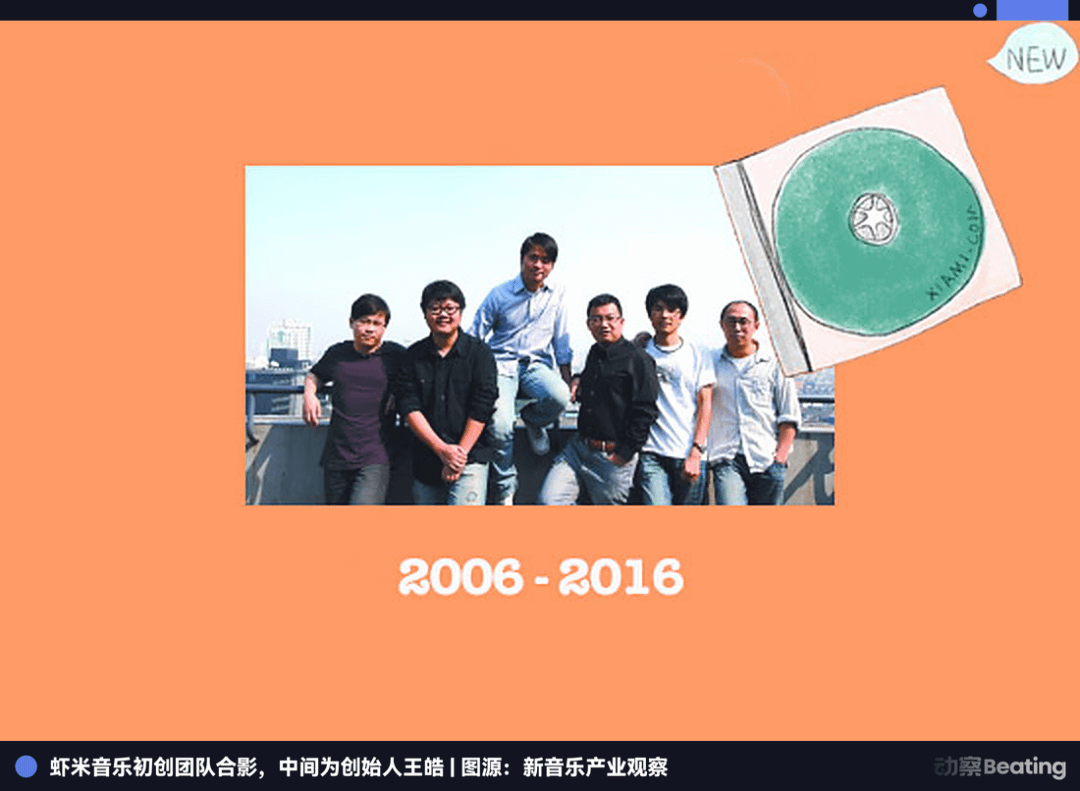
In 2007, he left Alibaba. At first there were six people in total: Wang Hao as general manager, Zhu Qi in charge of content, plus operations and three programmers. Their initial investment was about the same, their shares were about the same, and each month they paid themselves a salary of 3,000 yuan.
They called the site EMUMO, Earn Music & Money. This name almost put the original ambition right on its face: those who listened to music got music, and those who made music got money.
Only later did they change the name to Xiami. Their explanation was: “We are just little shrimp, but we have big dreams.”
In November 2008, Xiami.com officially went online.
The first office also looked very much like a “little shrimp” company. It was in the Longdu Building in Gudang, Hangzhou, a 70-square-meter live-work unit. After the previous company moved out, it left almost nothing behind, so they did not decorate much either; they just moved in a few tables and chairs and started working. There was nowhere to put the servers, so they were set up on the balcony. Every time you walked into the office, you could hear the fans spinning nonstop. Wang Hao later recalled that one good thing about the place was that if you opened the window, you could see the Xiaohe Mountain opposite, all green.
That was 2008. The iPhone 3G had just been released, and smartphones still had not put all music into one app. In China, people listened to songs by searching song titles on Baidu, clicking through forums, blogs, and resource sites to find an MP3, downloading it to a computer, and then putting it into an MP3 player. What you found depended entirely on luck.
File names could be garbled, “320K” was written into the name, and when you opened it, it was just a blur; after a song title, there might be more than a dozen download links, and you had no idea which one was real. Album information was missing pages and words; if there were too many singers in a chorus, they were simply labeled “Various Artists”; track order was often scrambled; and which album a song was on, or what year it was released, was something few people cared about.
At the time, online music was already one of the internet services with the highest usage among Chinese netizens. In a 2008 CNNIC survey, 86.6% of users had listened to online music within the past six months, and 71.2% had downloaded music. Hundreds of millions of songs were moving across the internet, and most of the time, they were just MP3 files.
Xiami, however, wanted to turn those files back into “records.”
Albums had to be arranged in the original release order; if multiple people sang, each name had to be written in full, not just thrown into “Various Artists”; sound quality should be kept at 320K; different versions of the same song had to be separated; singer, album, year, label, and genre—anything that could be filled in had to be filled in.
From the very beginning, editors were the largest group among Xiami employees. Every day they found information, verified information, and pieced an album back together. When the site only had 100,000 users, Xiami already had six language editors; besides Chinese, English, Japanese, and Korean, there were people specifically handling Russian, Thai, and Spanish. These languages could even be used directly in searches.
When the company itself did not have enough people, they let users help. Xiami found more than 300 experienced music lovers from around the world to fill out the catalog together. Later, a group devoted to correcting data errors gradually formed among the users, and they called themselves the “Wikipedia team.”
The name was not an exaggeration at all. They would discuss whether an album should count as a Studio Album, an EP, or a Live Album; what structure classical track titles should use; whether composers should be written in full or abbreviated; and by what rules Western singles should be included. Someone even wrote special guidelines, reminding editors to refer to several classical music sites in the future, “so as not to disappoint the expectations of so many classical music lovers.”
Some information simply could not be found online, so they would go through CD booklets. They would open the case, take out the insert, look line by line at who produced it, who played bass, who arranged the strings, where the studio was, then type it into Xiami word by word. Later, when people asked where, besides buying an official CD, they could find complete production credits for a Chinese song, Xiami staff said that very often even the digital materials sent by record labels were incomplete, and they had to rely on users to fill in the gaps from the booklet.
A user named Desperado once contributed data for 943 artists and 214 albums on his own, and also served as the leader of Xiami's lyric group.
These people even developed a whole set of folk-academic rules for “listening to music.” Xiami's early community was very much like a music BBS. Some people made curated collections, some wrote long reviews, some corrected errors, some studied how to compress better-quality 320K MP3s. Early reviews were once required to be at least 300 characters. You could not just leave a sentence like “sounds good” and leave; since you had clicked in specifically to discuss a song, you had to say something serious.
After users clicked into a genre, they could keep drilling down. What was under Dream Pop, where did Shoegaze come from, and what exactly was the difference between Post-Rock and Progressive Rock? For many people, Xiami was more like a continuously expanding music map. They would move from one album to another, from one band to a person they had never heard of, and in the end forget what they had originally been looking for.
This classification system later grew larger and larger. The genre system Xiami left behind was eventually organized by users into a 436-page document, with 24 first-level categories and 548 second-level categories beneath them. Many categories may only ever be clicked by a handful of people in their entire lives, but Xiami still left a slot for them.
It also had a column called “Desert Island Records.”
This column raised an interesting question: “If one day you were stranded on a desert island and could only bring a few records, what would you bring?”
Using this question as a starting point, the editors recommended records one by one that were less popular, but worthy of being heard. Later, the column got its own slogan: “Do not let good music keep wandering.” In 2020, they even opened a “Desert Island Records Bakery” with Freshippo.
The name is actually very much like Xiami itself: a large sea, with a small island in the middle. Outside is noisy; on the island are songs that nobody is in a hurry to hear. Those willing to swim over can sit for a while.
Xiami's office later began to look more and more like such a place. Several former employees recalled that the休息 area had a small stage, with guitars, a piano, and keyboards beside it. At dinner time, someone would go up to play piano and sing; some people had only just joined the company not long before and were already pulling colleagues together to form a band.
People making music websites were, to some extent, using public tools for private purposes. They moved their hobbies into the office and then found a very legitimate reason to keep listening to music every day.
Even its original business model carried this idealism. Wang Hao wanted to build a closed P2P system. When a user downloaded a song, they would pay 0.8 yuan. According to the early design, part of that would go to rights holders, part to the people who uploaded and distributed the music, and the platform itself would only keep the remainder. After users downloaded music, their own computers would become nodes in the network and continue passing the song along to others.
Xiami even gave its virtual currency a very convenient unit: “mi.”
Uploading original albums and helping spread music all gave people a chance to earn “mi.” Listeners were also distributors of music. Wang Hao wanted to shorten the long chain of the record industry, so that music could move more directly from the hands of creators to listeners.
This design now looks a little naive. But in the first few years, Xiami really grew step by step like this.
Trouble was buried in it from the start. P2P helped Xiami quickly accumulate a huge catalog, but it also left behind a copyright problem that would eventually have to be faced. In 2010, dozens of musicians including Li Zhi, Zhou Yunpeng, Wan Xiaoli, and Zuoxiao Zuzhou publicly signed a joint protest against their works appearing on Xiami without authorization.
Occasionally
Old Xiami of course also used algorithms. By 2011, Xiami's own recommendation system had basically taken shape. Employees later recalled that Wang Hao required the backend to build more than thirty music tags for each user, while Douban FM at roughly the same time only recorded four or five items.
But Xiami did not let the algorithm flatter people blindly. It would first give you most of what was familiar, then deliberately mix in a bit of the unfamiliar. In the early product philosophy, the ratio was roughly nine to one: 90% as close as possible to the taste the user had already formed, and the remaining 10% reserved for music they had never heard before.
That 10% later became the thing many old users missed most.
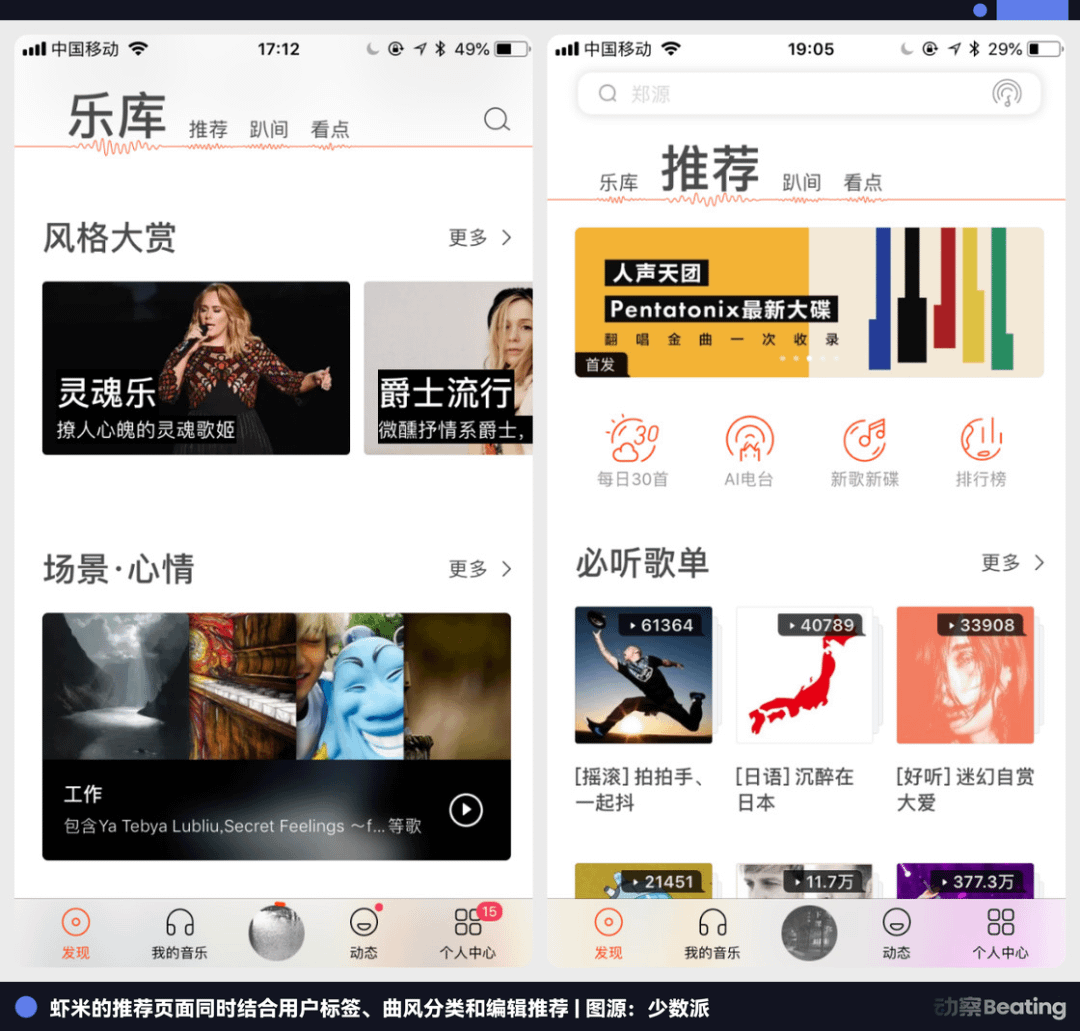
There was a user named “Qing,” who usually listened to Japanese visual kei and hardcore music. One day, Xiami's daily 30-song recommendation suddenly slipped in a very warm English song, (The High Road), something that looked nothing like her taste. In the end, after listening to it, she put it on repeat for three days.
Another user, Acid Rare, was once obsessed with black metal for a while. Xiami stuffed a German band, Empyrium, into her “similar artists” list. But when she clicked in, it was folk music. A week later, she became a fan of Empyrium. Looking back further, she discovered that this band had indeed played black metal in its early days before turning to unplugged folk. The form of the music changed, but that secluded, world-withdrawing quality never did. Later, Acid Rare recalled that in the next year or two, her taste was deeply influenced by that recommendation.
That is probably what old Xiami's understanding of algorithms was. It would guess what you liked, but it also allowed itself to be a little less rule-bound from time to time.
On Xiami there was a group of users who liked to call themselves Diggers. They would follow a record's producer, label, and genre all the way down.
In 2014, a Xiami user named Pao Pao accidentally heard a piece by an Italian musician and thought the sound was strange, but also fresh. Following the information down, he learned for the first time that this kind of thing had a name: vaporwave.
He kept listening, and later simply started making it himself. Pao Pao applied to become a Xiami musician and uploaded his works. Several songs were discovered by editors one after another, and a few times they appeared on Xiami's homepage.
This kind of thing was not uncommon at Xiami. The Xiami editorial department called its work “music navigation.” Every day, editors listened to large amounts of new music, made themed recommendations, wrote reviews and recommendation blurbs, and selected sounds that had not yet entered the public eye. By 2020, they were still making columns like (Desert Island Records) and (Universal Music Map).
The editor in charge of (Desert Island Records), Feng Xia, used to take a two-hour bus ride by herself to the city center Livehouse to see shows when she was in university. After joining Xiami, her job became listening to music every day, and then figuring out how to pass what she had dug up to other people.
In July 2013, the “Xiami Musician” platform launched. Independent musicians and independent labels could upload their own works, set their own prices for legitimate downloads, and receive 100% of download revenue. In the first year, more than five thousand musicians joined.
The next year, Xiami launched the “Search for Light” plan again. At first, the plan was meant to select musicians from the platform and help them continue developing their demos. If they lacked a producer, Xiami would help contact one; if they had no studio, Xiami would pay for the studio; mastering, album release, music videos, touring—Xiami helped arrange all of it. In the earliest public proposal, they even planned to make fifteen albums or EPs a year, an output already comparable to a professional record label.
In the first season, 13 groups of musicians and 14 albums remained, with a cumulative total of about 160 million plays.
Cheng Bi was one of them. She later described Xiami as her own “talent scout.” Her first three albums all debuted on Xiami, and when the first Search for Light plan began, she also became one of the musicians in the program. Only later did people get the chance to know the Cheng Bi behind (A Poem Meets a Song) and (I Want to Waste Time with You).
Stories like this kept increasing. By later years, Xiami had attracted more than 40,000 original musicians to join. Its library held 30 million songs, more than 1,000 genres and styles, and users had created more than 500 million playlists. In an industry data report from February 2018, Xiami had 9.685 million daily active users. The scale was already sizable, but compared with the biggest music platforms, it still looked like the same little shrimp it had been at the beginning.
The Last Night
Then the times changed.
The copyright war grew fiercer and fiercer. Tencent Music and NetEase Cloud Music spent huge sums to buy exclusives, and Xiami's library turned gray in batch after batch. Music became ammunition in the traffic war. In 2015, the “Iron Triangle” of Gao Xiaosong, Song Ke, and He Jiong took control of Alibaba Music; the next year they turned Xiami into AliPlanet to do fan economy, moving staff away from Xiami and slowing product updates more and more.
In January 2016, Wang Hao left the Xiami he had founded and moved to Alibaba DingTalk. He said the music industry was absurd to an outrageous degree.
He said this while Xiami was still operating. Five years later, it shut down. By 2020, Xiami still had about one million daily active users. From 9.68 million to 1 million, it only took a few years.
On January 5, 2021, Xiami announced that it would stop service one month later, giving users time to export playlists, which could be saved as static web pages or Excel files.
Two days after the announcement, Wang Hao gave an interview to PingWest and said:
“I don't think there's anything worth missing.”
February 4, 2021. Xiami had only one day left.
On this day, the daily recommendation list lost its private character for the first time. Every user who opened Xiami received the same playlist. For twelve years, this column had selected songs for people every day; on the final day, the editorial team selected thirty songs for themselves.
(Long Time No See) (You Were Always There) (I Don't Want You to Be Alone) (When Love Has Become the Past) (At Last I Lost You) (Goodbye). The song titles were already explicit enough, and above each song there was also a short recommendation blurb. Thirty passages linked together in sequence became the last letter Xiami wrote to its users. There was even a very Xiami-style joke left inside: “Although in the end we still couldn't buy Jay Chou's copyright (lol).”
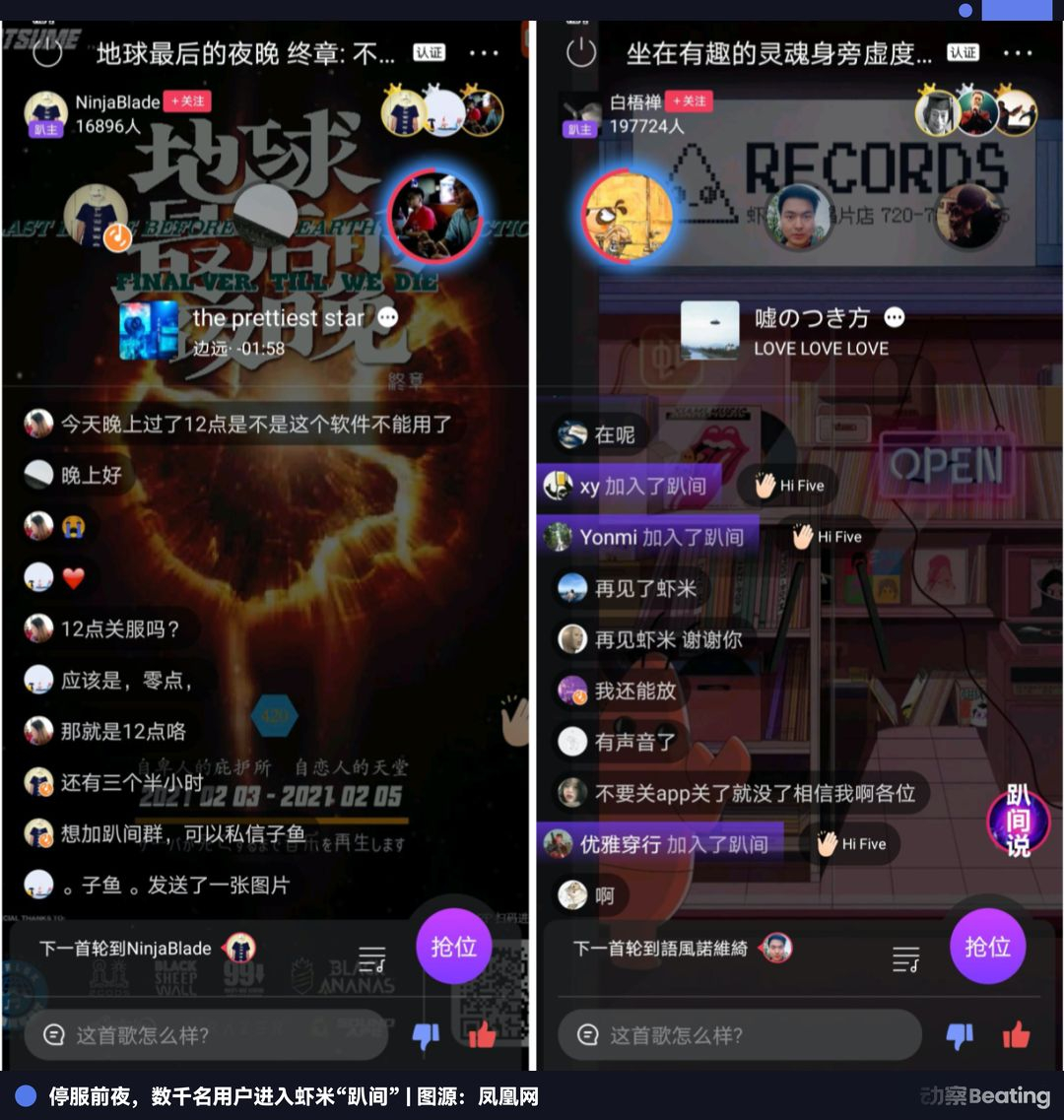
The real farewell began at 8 p.m.
At the time, the Xiami app had a feature called “party room,” which you can think of as a music livestream room: someone hosted and played music, others came in to listen, request songs, and chat on the screen. Several Xiami user groups connected in advance, agreeing to open party rooms together that night and naming the room “The Last Night of Xiami Planet.” The event intro said: “Perhaps we cannot reverse the course of events, but we can still keep you company as we count down to the final second.”
Thousands of people squeezed in.
Some people requested songs, some left messages, some did nothing at all and just kept the app open. The Xiami editorial team came too. Editor A-Gu bid farewell one by one in the livestream, first thanking users, then thanking the editors who had once worked at Xiami. He said that over the years, several dozen people in total had worked as editors at Xiami. Many users only then, for the first time, were in the same room with the people who had made those playlists.
Everyone was waiting for midnight on February 5.
The official announcement had already made it very clear: from this moment on, song previews, downloads, comments, and profile exports would all stop. Some people took leave in advance; some got off work, went home, closed the door, and listened alone all night; others refused to exit the app, feeling that as long as the page was still open, the music might play a little longer.
When midnight arrived, Xiami did not fall silent instantly like a plug being pulled.
Some people's songs were still playing. So those who had originally been waiting to say goodbye became excited instead, and messages on the screen came one after another:
“Do you still have sound?”
“I can still listen.”
Some people tried to disconnect from the internet; others reminded everyone not to close the app. Everyone was doing something a little absurd: across different cities and different phones, they were checking whether a piece of software still had signs of life. As long as there was still sound in one person's headphones, Xiami seemed not quite dead yet.
It eventually stopped anyway.
A song that someone was playing suddenly cut off, and someone's export progress stopped halfway. An hour later, there was no music left in the party room, but the screen kept endlessly showing “someone joined.”
In the month before the shutdown, users were actually moving house the whole time.
Xiami opened profile export tools, and QQ Music and NetEase Cloud Music also added playlist migration entrances. Some people spent six hours rescuing more than 6,000 songs from their collection one by one; some took screenshots of their profile pages to save how many minutes and how many songs they had listened to; others organized Xiami's almost obsessive genre classification into Excel, giving the file a very solemn name: “The Legacy of Saving Xiami.”
Some people were more direct. After the shutdown news spread, several users went to the Alibaba office building in Wangjing, Beijing and hung up two banners:
“Don't leave Xiami.”
“Don't shut down Xiami.”
The last thing Dao Cao, a member of Xiami's founding team and former product director, wrote on social media was: “The best farewell now is silence.” On that same day, founder Wang Hao posted five Weibo posts, none of which mentioned Xiami. He had already left Alibaba years earlier, and had already completed his own farewell.
But the users did not.
Two years later, in February 2023, someone even wrote a special “Second Anniversary Memorial for Xiami Music.” An app that no longer existed was still being commemorated in the way people commemorate a person: first anniversary, second anniversary, death anniversary, memorial writing.
The Xiami people later missed was actually already dying many times before it shut down. Copyrights were taken down batch by batch, the founder left, management changed, entrances were moved, and users grew fewer and fewer. The Xiami that was still alive finally had only one million daily users opening it each day, and in the copyright wars that was no longer much of a bargaining chip.
But once it really died, that one million people suddenly had a name.
They called themselves “music refugees.”
After Xiami died, the two characters “Xiami” did not disappear with it. Seven months after the player was shut down, Damai established “Xiami Music Entertainment.” The old slogan, “Hear the Different,” was changed to “See the Different”; the Xiami once packed into headphones began moving into theaters, stages, and music festivals.
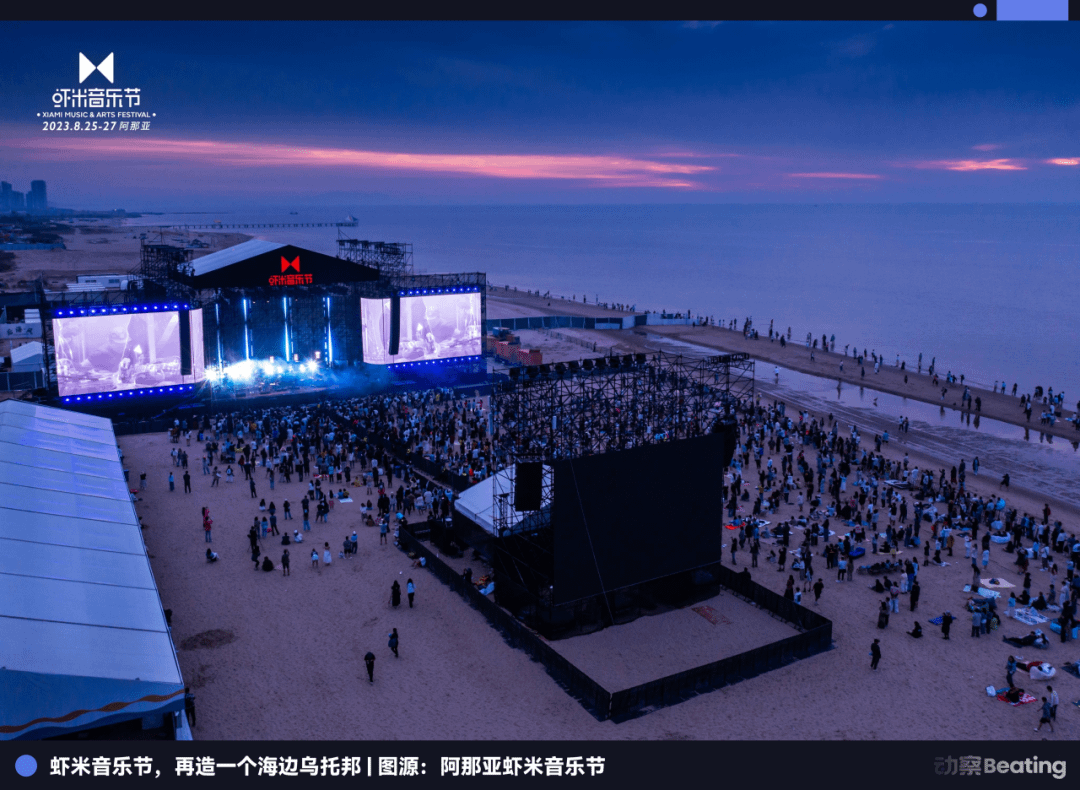
In 2022, the first Anaya Xiami Music Festival was held by the sea in Qinhuangdao, with the theme “Swim Until the Sea Turns Blue.”
People gathered again under the name “Xiami,” only this time they were no longer listening through a player; they were really standing by the sea, watching the band take the stage and watching the sun go down. By the fourth festival in 2025, six international musicians had already made their mainland China debut here.
So Xiami gained a strange kind of “afterlife.” The product died, but the name remained. The original team dispersed, while new businesses kept using it. The little shrimp that had once curled up inside the player icon was scooped up by Alibaba from one place and put into another.
By 2026, this name appeared for the third time. This time, there was neither player nor stage; it was placed onto an AI music model.
HappyShrimp, Happy Xiami.
Ten years ago, the person who founded Xiami left Alibaba and even went far away to Phuket; ten years later, Alibaba picked up the name he left behind again. Only this time, the people making Xiami had already changed, and even music itself had changed.
A New Body
HappyShrimp is still very young. In version 1.0, the vocals occasionally still sounded machine-like, complex Chinese lyrics came out muddled, and phrasing control was not as fine as professional production software. But these are probably just matters of time. What now takes repeated card draws more than ten times to get may only require changing a few words in the next version.
What is truly worth noting is that writing a song is suddenly becoming too easy.
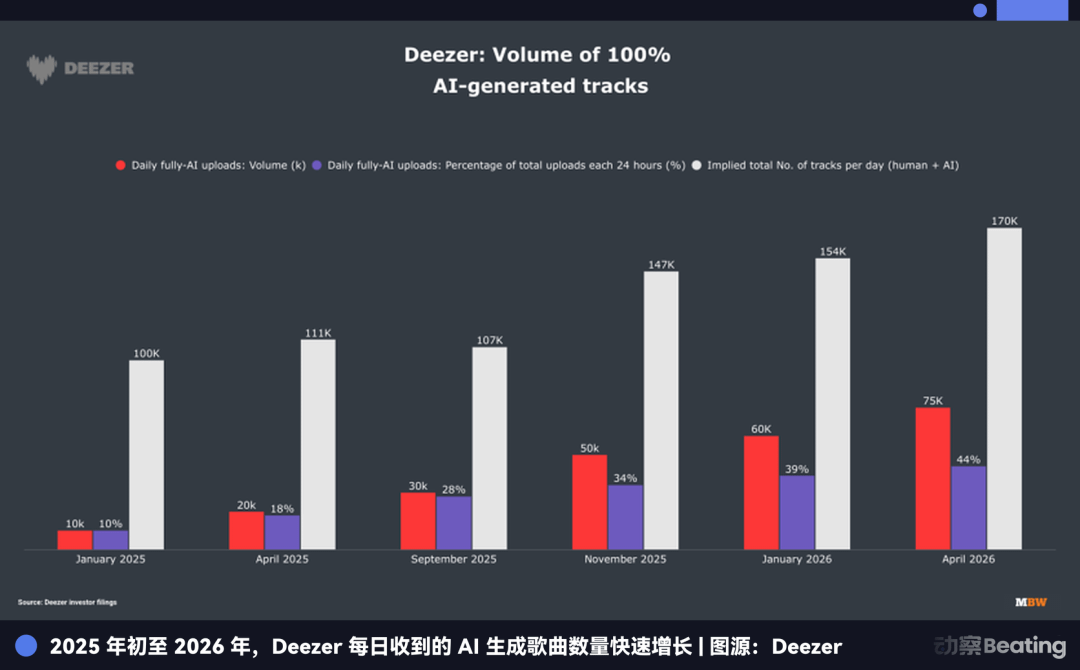
Suno can already generate more than 7 million songs a day. During Deezer's peak this June, it received nearly 90,000 fully AI-generated tracks per day, the first time it exceeded half of the platform's total new music.
The music industry has rarely had to worry about “too many songs” in the past.
When old Xiami was born, the internet certainly did not lack MP3s, but a truly wanted song was still hard to come by. It might be hidden on some obscure album, under a band nobody knew, or you might not even know what genre it belonged to. So Xiami spent a lot of effort on one thing: finding.
Back then, music platforms feared good things sinking out of sight; the world Xiami lived in was exactly the opposite.
You want a song for a rainy day, and it can be made on the spot; you want a female vocal, a slower tempo, something like summer ten years ago, and it can keep being adjusted. If a short video needs BGM, an ad needs a demo, or a game needs a piece of background music, in the past you had to search the catalog first or find someone to write it; now you can just generate one directly.
So music first slowly changed from “finding a suitable song” to “making a suitable song.”
These two actions look like they differ by only one character, but the worlds behind them are completely different.
When looking for songs, there was always a stranger at the other end. Maybe an Italian musician you had never heard of, maybe a college student who had just uploaded their first demo, maybe a German band that had broken up decades ago. Xiami was responsible for taking you there.
When generating music, there is no need for a human at all. You describe an emotion, and the model gives you a melody; if you are not satisfied, you make another one. Music becomes something that can be produced instantly on demand. It does not need to belong to anyone first, nor wait to be discovered by anyone.
That is also why the name HappyShrimp sounds a little strange here.
Eighteen years ago, Wang Hao named that website EMUMO, Earn Music & Money. One of the problems he originally wanted to solve was how music should be paid for on the internet, and how the people making music could get more of it.
But the problem HappyShrimp faces today is different. Whether good music already exists is no longer even important.
The copyright problem thus came back again, only in a different form. In the past, the dispute was about who should get paid when a song was uploaded to the platform without permission; now the question became whose songs the model had learned from, and whose the new music it generated belonged to.
On August 17, the day HappyShrimp was released, the American independent music publisher Round Hill Music sued Suno, accusing it of using the lyrics of hundreds of songs without authorization to train its model.
Old Xiami helped people find songs; HappyShrimp helps people make songs.
In the earlier world, an unfamiliar song might change a person's taste; the listener would follow it all the way, and in the end even become a musician themselves. In the later world, people only need to say what they want to hear.
Then wait a minute, and the song will come.
Swim Until the Sea Turns Blue
When writer Yu Hua was a child, he lived in Haiyan, Zhejiang, and the sea he saw was always yellow. Yet the textbooks said the sea was blue.
He wanted to know where the blue really was, so he swam into the sea. The shore grew farther and farther away, the water deeper and deeper, but he kept moving forward. Children believe in very concrete things, like if you swim far enough, you can reach the kind of blue written about in textbooks.
In the end, of course not. But many years later, he still remembered that he had once swum in that direction.
I always feel that what old Xiami left behind is a little like this too.
In the era when it existed, many things were still kept at a distance. A song you truly liked was not necessarily one you liked the first time you heard it. A name you had never seen before would not immediately become part of your taste. People kept moving forward because of a chance sound they happened to hear; if they did not understand it today, they would come back to it months later; from one person to another, from one kind of music to another.
Looking back later, one realizes that many of people's preferences were born precisely during these detours.
In recent years, the internet and AI have kept shortening this distance. Search makes songs easier to find, and recommendations bring unfamiliar music to your ears. With generative AI, things have gone one step further: people no longer even need to wait for the right song to appear; they can describe a mood and have it written for them.
One minute later, the music arrived.
Of course, this changed many things.
In the past, there was a very long road between listeners and creators. Some wrote songs, some recorded, some released, some organized, some recommended, and only then did someone happen to hear them. Xiami spent twelve years building many signposts along this road, making it easier for people to move toward music they otherwise would never have encountered.
Today, that road is getting shorter. Sometimes, listeners themselves can even walk to the other side of the road. Someone who does not play an instrument and does not understand music theory can also try, for the first time, to turn the vague emotions in their head into a song. Maybe it is not mature, maybe there are still obvious machine traces in it, but the act of “creating music” has never been this close to ordinary people.
This may also be what is interesting about HappyShrimp and old Xiami.
Eighteen years ago, Xiami tried to let more music be heard. Eighteen years later, another Xiami began trying to let more people make music. They were already facing a different music world, and there was no need to answer the same question.
When Yu Hua was a child, he never swam to the blue sea. People later may not need to swim that far anymore. Technology keeps pulling distant things closer, bringing in front of more people the things that only a few could once do.
But people still have to decide where they want to swim.
HappyShrimp takes about one minute to generate a song.
Only some things may grow precisely outside that one minute.
Original link