
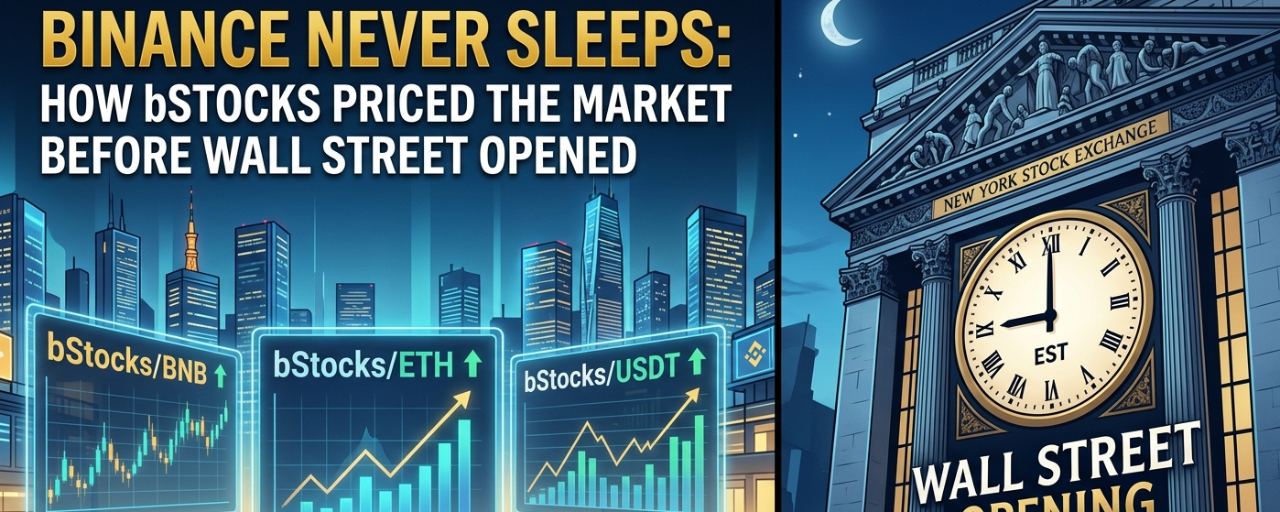
Wall Street has opening and closing bells. Crypto doesn't.
That difference is becoming increasingly important as traditional financial assets move onto 24/7 digital infrastructure. When Nvidia reports earnings after the U.S. market closes, when a major economic announcement arrives before Monday's opening bell, or when geopolitical news breaks over the weekend, traditional equity markets may be closed—but investors don't suddenly stop forming opinions.
They still want to know one thing:
What is this news worth?
That is where 24/7 markets begin to challenge the traditional structure of price discovery.
The Market Doesn't Wait for the Opening Bell
For decades, investors had to wait for traditional exchanges to reopen before expressing their view on most stocks. A company could announce major news at 6 p.m. on Friday, but the broader equity market wouldn't fully process that information until Monday morning. The information was continuous.
The market wasn't.
Crypto infrastructure has changed that relationship. Platforms operating around the clock can allow users to react to market-moving information whenever it happens. Binance's expansion into tokenized equities through bStocks is part of this broader convergence between traditional assets and crypto-native market infrastructure. Instead of treating the trading day as a fixed window, the emerging model treats markets as continuously accessible.
What Are bStocks?
bStocks are tokenized representations of equities and other traditional financial assets made available through blockchain-based infrastructure.
The concept is important because it connects two previously separate worlds.
On one side is traditional finance, with established equity markets, exchanges, brokers, and market hours. On the other is crypto infrastructure, where markets operate 24/7 and users are accustomed to immediate settlement and continuous access.
Tokenized stocks attempt to bring some of the accessibility and programmability of blockchain infrastructure to traditional assets. For users, the appeal isn't simply being able to own exposure to a familiar company. It's the possibility of interacting with traditional-market exposure through financial infrastructure that doesn't stop when the traditional market closes.
Nvidia Doesn't Stop Making News at 4 p.m.
Imagine Nvidia reports earnings after the U.S. market closes.
The company's results immediately become public.
Analysts start interpreting the numbers. Traders begin discussing guidance. Social media reacts. Investors reassess expectations. But the traditional stock market is closed.
Under the conventional system, many investors must wait until the next session to express their view directly in the equity market.
A 24/7 venue changes that dynamic. The market can begin incorporating new information immediately, potentially producing an early indication of how traders are interpreting the event before the next traditional session begins.
The same principle applies to weekend developments. A major announcement on Saturday doesn't wait until Monday to affect expectations. The information travels instantly.
Increasingly, markets can too.
Binance vs. Hyperliquid: Where Does Price Discovery Happen First?
This is where the comparison with Hyperliquid becomes particularly interesting. Hyperliquid has established itself as one of the most important crypto-native venues for perpetual trading and has demonstrated that decentralized infrastructure can support significant trading activity.
Binance approaches the same structural opportunity from a different direction.
Rather than starting with a decentralized derivatives venue, Binance is connecting its enormous existing trading ecosystem with traditional financial assets, tokenization, and 24/7 market infrastructure.
The important question isn't simply which platform has the larger volume.
It's:
When new information arrives, where do traders first express their updated expectations?
That is the essence of price discovery.
A useful way to evaluate Binance and Hyperliquid is therefore to examine specific market events rather than make blanket claims.
Take an earnings announcement, for example.
If traditional markets are closed when the announcement occurs, researchers can compare how quickly Binance's relevant bStock pricing responds against other crypto-native venues and then compare those prices with the next official opening price.
The question becomes measurable:
Which venue incorporated the new information first, and how closely did its price correspond with the subsequent traditional-market move?
That's a much more meaningful benchmark than simply comparing headline trading volume.
From Price Following to Price Discovery
There is an important distinction between following a market price and discovering a market price.
If a venue simply mirrors prices established elsewhere, it is primarily providing access.
But if traders use that venue to continuously process new information and establish expectations before traditional markets reopen, its role becomes more significant.
It can become part of the price-discovery process itself.
That is the structural shift worth watching.
As more traditional assets become available through crypto infrastructure, the question may gradually change from:
"When does the stock market open?"
to:
"Which market is already trading the information?"
Why This Matters for Global Investors
The 24/7 model is particularly relevant outside traditional financial centers.
A trader in Africa doesn't necessarily operate on New York's schedule.
A major economic announcement might occur during their evening. A geopolitical event might happen on a Sunday. A company's earnings report might arrive while their local banks and traditional brokers are closed.
Digital markets don't have to follow those geographic constraints.
This creates the possibility of a genuinely global market where information can be acted upon whenever it becomes available.
That doesn't mean every investor should trade every event.
In fact, continuous access can increase the temptation to overtrade.
But the infrastructure itself represents a major change.
The Bigger Story: Markets Are Becoming Continuous
The rise of bStocks is part of a much larger transformation.
Tokenization is gradually bringing traditional assets onto blockchain-based infrastructure, while crypto exchanges are increasingly expanding beyond cryptocurrencies into commodities, equities, and other financial instruments.
At the same time, investors are becoming accustomed to markets that operate around the clock.
The result is a financial system where the boundaries between crypto and traditional markets become increasingly difficult to define.
Gold can trade alongside Bitcoin.
Tokenized equities can exist alongside crypto assets.
AI can analyze markets continuously.
And investors can respond to information without waiting for an exchange to ring its opening bell.
Binance's Advantage Is the Ecosystem
The significance of Binance isn't simply that it offers another way to access traditional assets.
Its potential advantage is the ecosystem surrounding that access. Millions of users already interact with Binance for crypto trading, payments, earning, and other financial services. Adding tokenized traditional assets to that environment creates the possibility of a unified marketplace where different asset classes can be accessed through the same digital infrastructure. That could make Binance increasingly relevant to the evolution of 24/7 finance.
But the real test will be data.
As more major market events occur outside traditional trading hours, researchers can compare Binance's bStocks with other venues including Hyperliquid and examine which markets respond first, how accurately they anticipate the next traditional session, and where liquidity concentrates.
The results will tell us more than marketing claims ever could.
The Market Is Already Moving
The traditional financial system was designed around business hours.
The internet wasn't.
Crypto was built around the idea that financial infrastructure could operate continuously.
Now tokenization is bringing traditional assets into that environment.
That creates a fascinating new question for financial markets:
If information moves 24/7, why should price discovery stop at 4 p.m.?
Binance's bStocks are one experiment in answering that question.
And as tokenized equities, commodities, and other real-world assets become increasingly liquid, the venues that remain open when traditional markets are closed may play an increasingly important role in determining what the market thinks happens next.
The opening bell may still matter.
But increasingly, the market may have already started moving before it rings.