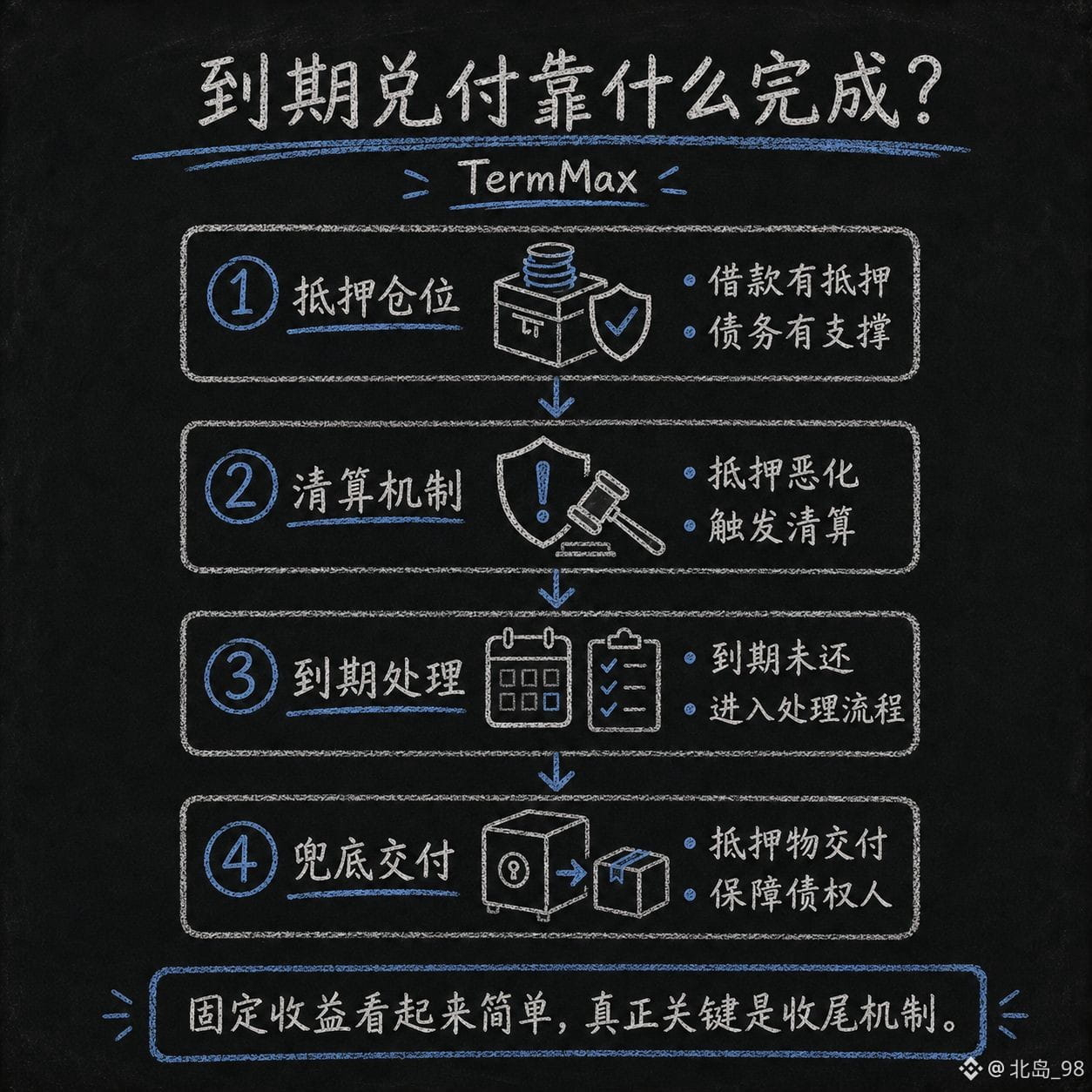
After studying @TermMax until the next day, I realized that what makes fixed-rate products truly difficult may not be “locking in the rate,” but rather how to safely convert the receivable back into an asset after maturity.
TermMax’s borrowing position is supported by collateral; if the collateral ratio deteriorates, liquidation is triggered. Even more interestingly, if it isn’t repaid normally at maturity, it doesn’t simply turn the FT into a “bad debt document”—the protocol also includes subsequent liquidation and collateral delivery mechanisms.
This design solves a very real problem:
Fixed income can be determined in advance, but final settlement can’t rely on just one line—“redeem at maturity.”
That said, I also keep a close eye on risk.
In extreme market conditions, what really matters isn’t how smoothly things liquidate day-to-day, but:
whether collateral can be handled promptly when it collapses;
what creditors ultimately recover when liquidity is insufficient;
and whether maturity settlement remains stable over the long run.
So when I look at @TermMax now, I don’t just look at APY.
I’m more interested in its ability to “wrap things up” in the worst-case scenario.
Fixed-income products look great when they’re making money; the real gap shows up when something goes wrong—who can actually get the books settled.
In your view, is the most important aspect of DeFi fixed-rate lending the yield, or the ability to ensure stable settlement at maturity?
#termmax
TermMax’s borrowing position is supported by collateral; if the collateral ratio deteriorates, liquidation is triggered. Even more interestingly, if it isn’t repaid normally at maturity, it doesn’t simply turn the FT into a “bad debt document”—the protocol also includes subsequent liquidation and collateral delivery mechanisms.
This design solves a very real problem:
Fixed income can be determined in advance, but final settlement can’t rely on just one line—“redeem at maturity.”
That said, I also keep a close eye on risk.
In extreme market conditions, what really matters isn’t how smoothly things liquidate day-to-day, but:
whether collateral can be handled promptly when it collapses;
what creditors ultimately recover when liquidity is insufficient;
and whether maturity settlement remains stable over the long run.
So when I look at @TermMax now, I don’t just look at APY.
I’m more interested in its ability to “wrap things up” in the worst-case scenario.
Fixed-income products look great when they’re making money; the real gap shows up when something goes wrong—who can actually get the books settled.
In your view, is the most important aspect of DeFi fixed-rate lending the yield, or the ability to ensure stable settlement at maturity?
#termmax