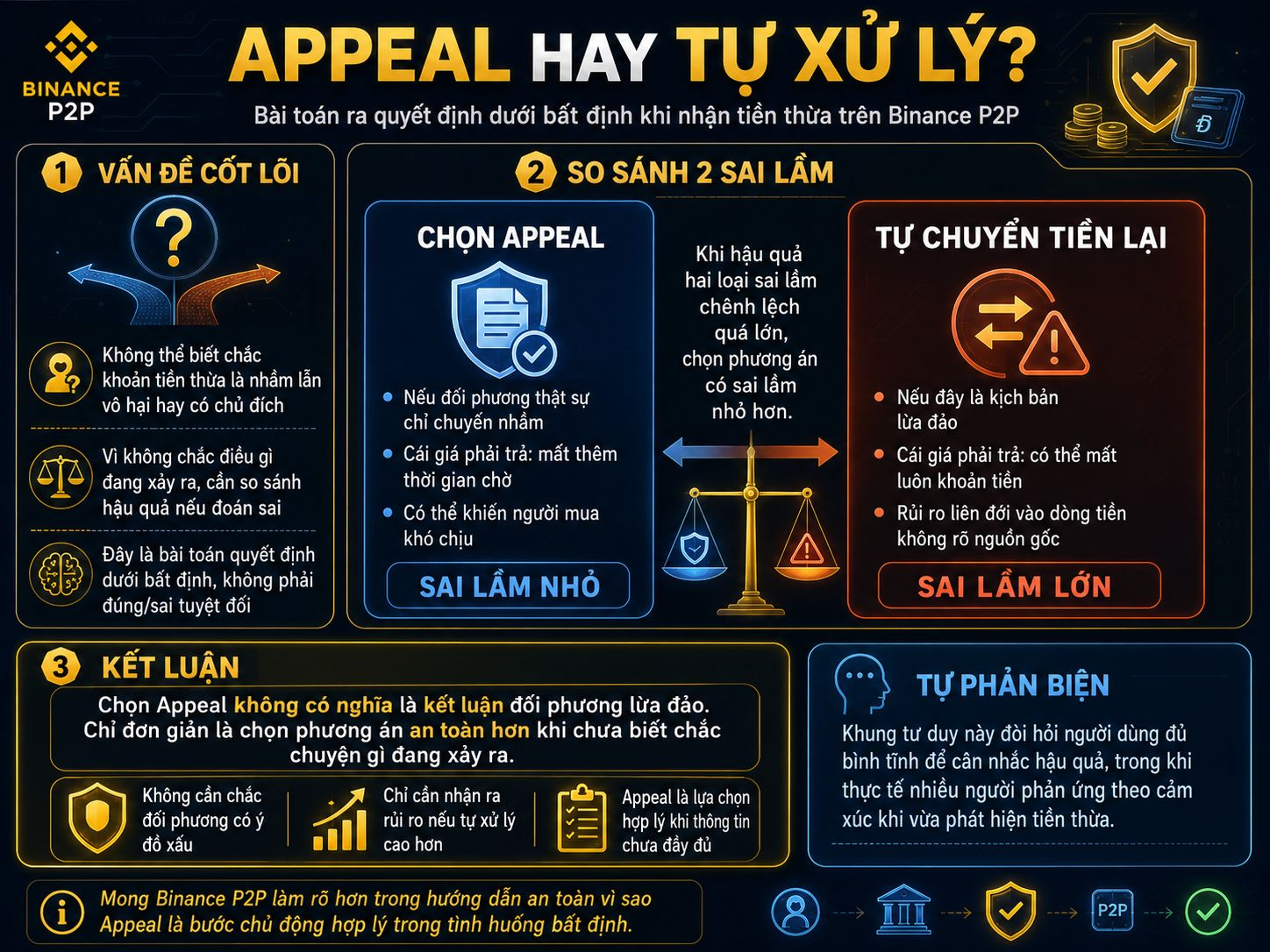
I realized something when trying to think about “Appeal or process it yourself” when receiving extra money on Binance P2P: in fact, it’s a decision-making problem under uncertainty, not a clearly right-or-wrong question.
There’s no way to know for sure whether the extra money came from a harmless mistake or from bad intentions. But you can still compare the consequences if you guess wrong. Choose Appeal, and it turns out to be a genuine mistake—then the cost is just a bit of waiting time, which could annoy the buyer. But choose self-transfer, and it turns out to be a scam scenario—the cost could be losing the money entirely, plus additional risks and entanglement with funds of unclear origin.
This is the key point of decision-making under uncertainty: when the consequences of the two types of errors differ too much, the correct decision doesn’t depend on which probability is higher, but on which error you can accept. Wait a few more hours for Appeal, because it’s the smaller mistake if the other party is clean. Lose money or get tangled with suspicious funds is the bigger mistake if not. Seen this way, choosing Appeal doesn’t require assuming the other person is a scammer; it simply means choosing the option with the smaller possible error when you don’t know what’s actually going on.
Self-refutation: this framework assumes the user can stay calm and weigh the consequences rather than reacting emotionally right when they notice the extra money—something that isn’t always easy in real life.
I’m waiting to see whether Binance P2P will incorporate this kind of consequence comparison into its safety guidance, so users can more easily understand why Appeal is reasonable even when you can’t be sure the other party has bad intentions.
#binancep2pantoan @Binance Vietnam $BTC