I have something I realized when trying to think about why “transfer scams” are often accompanied by an underlying time pressure—even though nobody directly says it out loud on Binance P2P.
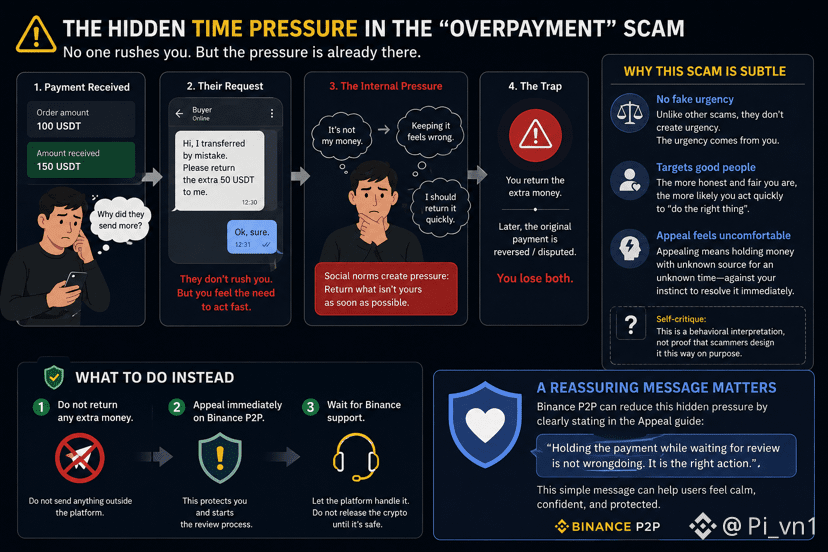
When the money received is more than the Order value, the seller naturally feels they need to respond quickly—not because they are explicitly pressured, but because the situation creates an uncomfortable imbalance: holding someone else’s funds for too long doesn’t feel proper, even though no one is certain where that money came from. This pressure comes from ordinary social norms—return money that isn’t yours as soon as possible—rather than needing a scammer to actively urge them.
This is the subtlety of this particular script compared to other bait: it doesn’t need to manufacture a fake sense of urgency, because real urgency naturally arises from the ethical norms of the person being targeted. The more someone is conscientious about being “fair, not greedy,” the more likely they are to rush the transfer immediately, just to get rid of the awkward feeling.
That’s also why the “just Appeal” reflex is harder to carry out than it sounds—not because people lack understanding, but because an Appeal effectively means accepting to hold funds of unclear source for an indefinite period, which is completely opposite to the instinct to resolve things cleanly and immediately.
Self-reflection: this is a general behavioral psychology interpretation, not proof that the person running this script calculated to exploit this mechanism intentionally.
I’m waiting to see whether Binance P2P has a way to reassure users about this psychological pressure directly in the Appeal guidance—clearly confirming that holding the funds while waiting for processing does not mean acting dishonorably—so users feel less pressured to “solve it right away.”
#binancep2pantoan @Binance Vietnam $BTC
When the money received is more than the Order value, the seller naturally feels they need to respond quickly—not because they are explicitly pressured, but because the situation creates an uncomfortable imbalance: holding someone else’s funds for too long doesn’t feel proper, even though no one is certain where that money came from. This pressure comes from ordinary social norms—return money that isn’t yours as soon as possible—rather than needing a scammer to actively urge them.
This is the subtlety of this particular script compared to other bait: it doesn’t need to manufacture a fake sense of urgency, because real urgency naturally arises from the ethical norms of the person being targeted. The more someone is conscientious about being “fair, not greedy,” the more likely they are to rush the transfer immediately, just to get rid of the awkward feeling.
That’s also why the “just Appeal” reflex is harder to carry out than it sounds—not because people lack understanding, but because an Appeal effectively means accepting to hold funds of unclear source for an indefinite period, which is completely opposite to the instinct to resolve things cleanly and immediately.
Self-reflection: this is a general behavioral psychology interpretation, not proof that the person running this script calculated to exploit this mechanism intentionally.
I’m waiting to see whether Binance P2P has a way to reassure users about this psychological pressure directly in the Appeal guidance—clearly confirming that holding the funds while waiting for processing does not mean acting dishonorably—so users feel less pressured to “solve it right away.”
#binancep2pantoan @Binance Vietnam $BTC