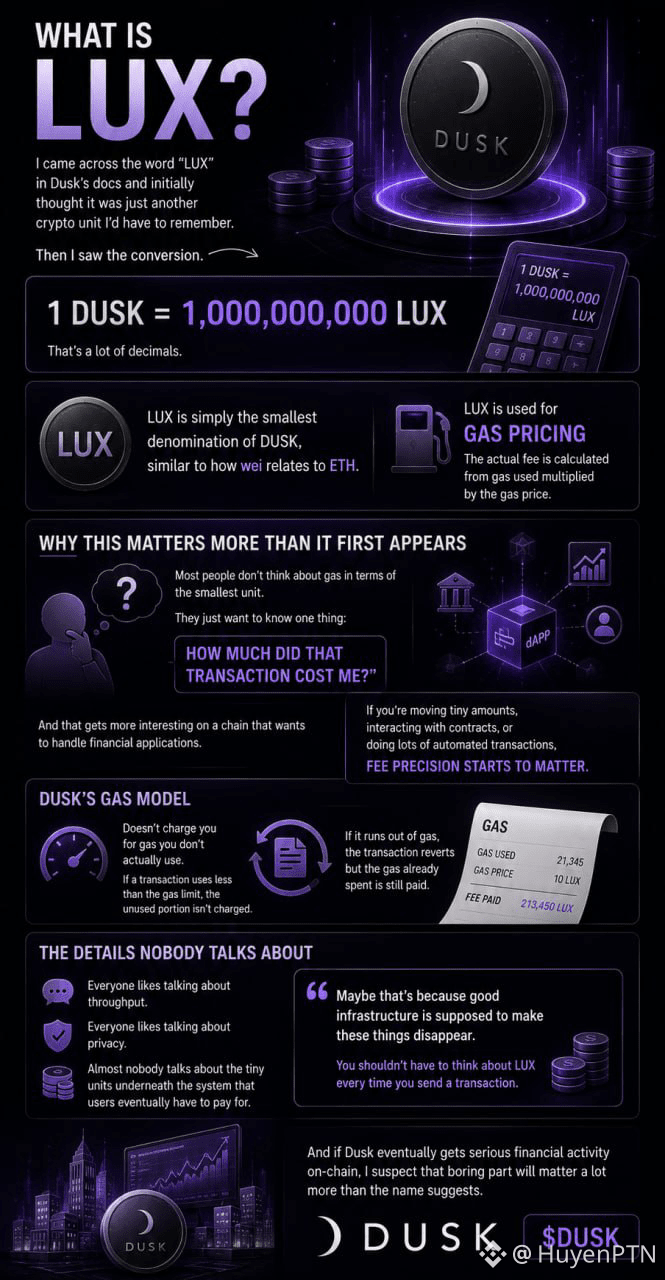
I came across the word “LUX” in Dusk’s docs and initially thought it was just another crypto unit I'd have to remember.
Then I saw the conversion.
1 DUSK = 1,000,000,000 LUX.
Okay.
That’s a lot of decimals.
LUX is simply the smallest denomination of DUSK, similar to how wei relates to ETH. Dusk uses LUX for gas pricing, with the actual fee calculated from gas used multiplied by the gas price.
Nothing groundbreaking there.
But I started thinking about why this matters more than it first appears.
Most people don't think about gas in terms of the smallest unit.
They just want to know one thing:
“How much did that transaction cost me?”
And that gets more interesting on a chain that wants to handle financial applications.
If you're moving tiny amounts, interacting with contracts, or doing lots of automated transactions, fee precision starts to matter.
Dusk's model also doesn't charge you for gas you don't actually use. If a transaction uses less than the gas limit, the unused portion isn't charged. If it runs out of gas, the transaction reverts but the gas already spent is still paid.
That sounds like a boring implementation detail.
It probably is.
But these are the details I find myself paying more attention to lately.
Everyone likes talking about throughput.
Everyone likes talking about privacy.
Almost nobody talks about the tiny units underneath the system that users eventually have to pay for.
Maybe that's because good infrastructure is supposed to make these things disappear.
You shouldn't have to think about LUX every time you send a transaction.
And if Dusk eventually gets serious financial activity on-chain, I suspect that boring part will matter a lot more than the name suggests.
#dusk $DUSK @Dusk
Then I saw the conversion.
1 DUSK = 1,000,000,000 LUX.
Okay.
That’s a lot of decimals.
LUX is simply the smallest denomination of DUSK, similar to how wei relates to ETH. Dusk uses LUX for gas pricing, with the actual fee calculated from gas used multiplied by the gas price.
Nothing groundbreaking there.
But I started thinking about why this matters more than it first appears.
Most people don't think about gas in terms of the smallest unit.
They just want to know one thing:
“How much did that transaction cost me?”
And that gets more interesting on a chain that wants to handle financial applications.
If you're moving tiny amounts, interacting with contracts, or doing lots of automated transactions, fee precision starts to matter.
Dusk's model also doesn't charge you for gas you don't actually use. If a transaction uses less than the gas limit, the unused portion isn't charged. If it runs out of gas, the transaction reverts but the gas already spent is still paid.
That sounds like a boring implementation detail.
It probably is.
But these are the details I find myself paying more attention to lately.
Everyone likes talking about throughput.
Everyone likes talking about privacy.
Almost nobody talks about the tiny units underneath the system that users eventually have to pay for.
Maybe that's because good infrastructure is supposed to make these things disappear.
You shouldn't have to think about LUX every time you send a transaction.
And if Dusk eventually gets serious financial activity on-chain, I suspect that boring part will matter a lot more than the name suggests.
#dusk $DUSK @Dusk