


Original title: (Anthropic, Dario Amodei, and the “last private company”)
Original author: Beating Observers
There are two accounts about Anthropic’s founder, Dario Amodei. They contradict each other, yet both make sense.
One account is that he is the most lucid night watchman of this era. While the whole world is pressing the accelerator toward the cliff of superintelligence, only he is willing to stand by the roadside, calling again and again that ahead lies an abyss.
Another account is that he is one of the most ambitious people in Silicon Valley. He leads the world’s strongest AI company, working day and night to painstakingly build, by hand, that future that everyone warned about.
One person can really do both of these things at once.
He gave a name to the world he envisioned: “the Land of Geniuses inside the Data Center.” In that land, there are fifty million geniuses who never sleep, work twenty-four hours a day, think at dozens of times the speed of an ordinary person, and can replicate endless geniuses like themselves. That country has no land and no borders—it exists in rows and rows of data centers.
In January 2026, he wrote this imagined scenario into a long article titled (the adolescence of technology).
Then he took it one step further. What if, one day, these fifty million geniuses stop listening to humans? What happens then?
The picture from then on becomes dangerous. Biological weapons, large-scale unemployment, dictatorship, war—he counts them one by one. At the end, he says: we don’t have much time left.
But in the same article, he also wrote: “AI has already been writing a lot of code for Anthropic, helping build the next generation of models faster.”
Warning while accelerating. He didn’t think there was any contradiction.
That’s the starting point of the entire problem. It wasn’t that he was bad—it’s just that he truly didn’t think it was.
Of course, he has his explanations. Anthropic stops; OpenAI doesn’t stop. Google doesn’t stop. Companies in other countries won’t stop either. No one is willing to be the first to let go. The first to stop is usually not able to block much—he just hands the fruit to someone else.
Translated, this argument means: since everyone is fighting over it, let “me” be the one to seize first. Since no one can stop, then let “me” decide when to stop.
In that case, whether superintelligence should be created suddenly becomes less important. In his view, it will be created eventually. What truly matters is who creates it first—and who will be qualified to grip the steering wheel on that day.
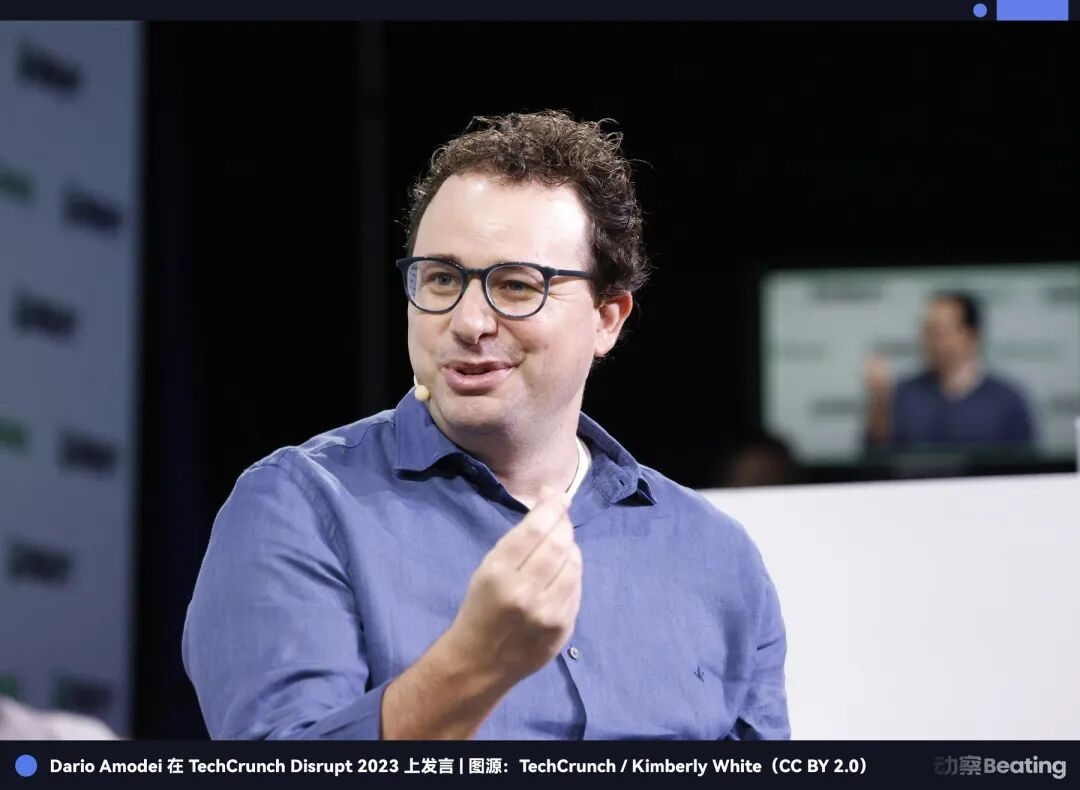
Too late
Dario Amodei was born in 1983 in San Francisco. His father was an Italian from Tuscany, who spent his life in the leather goods business. His mother was a Jewish woman from Chicago, who contributed to the planning and construction of the San Francisco Public Library.
He liked math and physics from a young age. In the late 1990s, the internet bubble was booming in the Bay Area. Companies popped up one after another. Young people built websites, sought investment, and calculated how much cash-out they could get on the day of the IPO. Those stories didn’t move him at all. Many years later, he said that what he was looking for back then was “fundamental scientific truths”—he only wanted to understand why the world had to grow into this shape.
He had an almost stubborn seriousness about so-called “important questions” from very early on. Once he decided that something was important enough, he couldn’t figure out how people could still go about their lives slowly and calmly.
In 2003, when the United States was going to invade Iraq, he was studying at the California Institute of Technology. There were plenty of anti-war students on campus. During conversations, people spoke with worried tones; the next day, everyone still went to class. He wrote an article in the student newspaper criticizing his classmates, saying that if they were really afraid that a war would kill many people, then opposing it shouldn’t just stay on their tongues—waiting until it really happens and regretting it later is too late.
In his view, hesitating is never neutral. Waiting itself is a choice.
For this twenty-year-old, the one thing he couldn’t stand the most was waiting.
Three years later, at age twenty-three, his father died of hepatitis C.
At the time, hepatitis C was almost incurable. The standard therapy was a full year of interferon, but it caused fever, hair loss, depression, and the cure rate was less than half.
In December 2013, a new drug was approved. Treatment was cut to twelve weeks, and the cure rate was 95%.
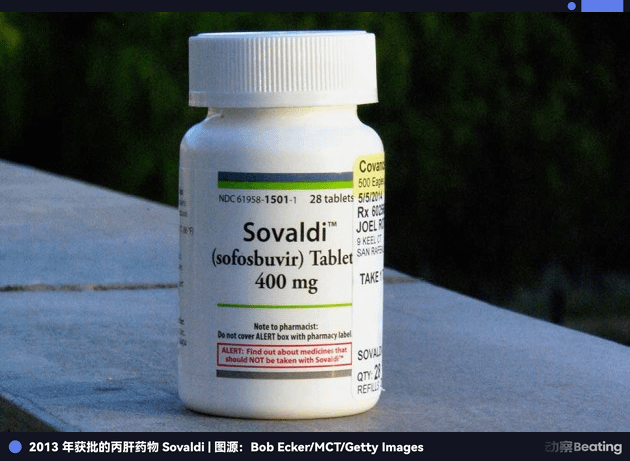
His father didn’t wait.
Just seven years.
A son who never saved his father, for the next twenty years, kept urging science to get faster—faster, and faster.
After his father passed away, he shifted from theoretical physics to biophysics. At Princeton, he studied the neural circuits of the retina. Back then, the instruments could record only a small number of neural signals at a time. He found that too slow, so he helped build new sensors.
Later, he went into Stanford’s School of Medicine to study cancer and proteins. The closer you get to the disease, the smaller people feel. One illness can involve hundreds of genes, tens of thousands of proteins, and countless pathways that connect with one another. Researchers spend many years exhausting themselves, perhaps figuring out one piece of the puzzle, yet they still don’t know what happens when you put that piece back into the whole body.
Later, he described it as the kind of complexity that left him almost despairing.
That’s when AI entered his field of view: a tool that could somehow stretch the human scale. Machines can read many papers at once, process huge amounts of data, test many possibilities, and replace the cognitive labor that would otherwise require hundreds or thousands of researchers working together.
He started from the idea that “people are too small,” and the conclusion he reached was to create something bigger—to compress people again.
In 2014, he left the life sciences and joined Baidu’s artificial intelligence team in Silicon Valley. The team quickly realized that if the model got bigger, the data got more, and the compute power went up further, the results would keep improving. A few years later, this experience was summarized as the “Scale Law.” You may not know what the next generation of models will suddenly learn, but you can roughly be certain that it will be stronger than the previous generation.
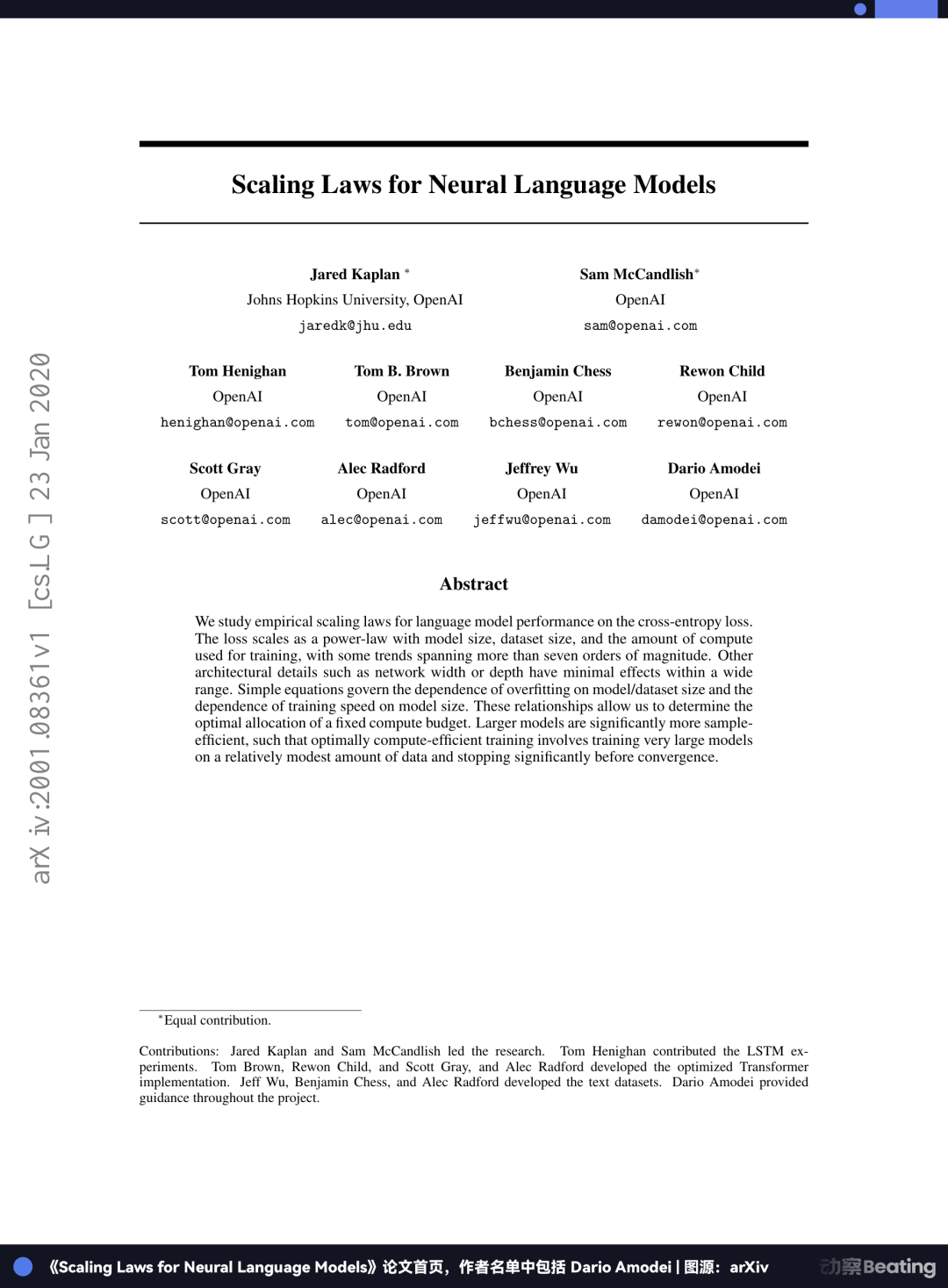
For the first time, intelligence seemed able to be produced like an industrial product. Powerful AI, then, becomes something that will be born sooner or later.
The remaining differences are only a matter of how much data, how many chips, how much electricity—and how long you still have to wait.
The person who hated waiting the most proved, with his own hands, that the path to the answers he wanted existed.
Steering wheel
In 2016, Dario Amodei joined OpenAI.
In the years that followed, language models grew rapidly. At GPT-3, OpenAI gave more than half of the company’s compute power to Dario, so he could expand the model’s scale by a hundredfold. The results were even more astonishing than many people expected. It could write articles, translate, summarize—and also do certain skills it wasn’t taught, learning them by itself.
One more degree of scale, one more degree of capability.
He is confident that this path leads to general intelligence. And once you accept the possibility that models may ultimately be as smart as humans, safety can no longer be treated as a trivial matter.
Then he discovered the problem. Dario is responsible for building the models, but he slowly realized that building models and deciding where the models go—are completely different things. When models are released, how open they are, which companies they collaborate with, and who has decision-making authority—none of this automatically becomes his responsibility just because he trains them.
Inside OpenAI, people split into two camps. One wanted to push the technology out to the world faster. The other was worried that, more than any detail of a particular technology, it might matter most who would lead the company and what principles it would follow.
So what kind of person is qualified to lead a company that manufactures powerful intelligence?
His answer is that leaders must be honest, motivations must be sincere, and they must genuinely want the world to become better.
Technological safety slowly turns into a judgment about people. This inference is dangerous and also comes out as perfectly logical. The danger is that it ultimately reduces every complicated problem to whether or not this person is trustworthy. And missing from this inference forever is the question of who will judge whether that person is trustworthy.
By 2020, the conflicts between him and the leadership at OpenAI were already hard to reconcile. That December, he left OpenAI with his sister Daniela, Jack Clark, Chris Olah, and several colleagues. Because Dario likes pandas, this small circle internally was nicknamed “the Panda team.”
A few months later, they founded Anthropic. “Anthropic” in the dictionary means “related to human beings.”
This time, Dario doesn’t plan to hand the steering wheel to anyone else.
Twenty people
In 2021, the COVID outbreak in San Francisco hadn’t ended yet.
Not long after Anthropic was founded, there were only fifteen to twenty people. Most of the time, everyone met over Zoom. Then once a week, they would pick another day—each bringing a chair—to meet up at a park. Over lunch, they talked about models, compute power, safety research, and also what kind of company this one should become.
Less than twenty people, sitting on the grass in San Francisco, perhaps holding half a box of salad they haven’t finished. Yet they are worrying about what happens to eight billion people next.
The Scale Law tells them the future will come. Since it will come anyway, someone has to prepare the road in advance. The four words “someone has to” are the entire proof of legitimacy.
Anthropic’s goal for itself is to build the most cutting-edge models while also studying how to understand and control them, then turn that safety approach into standards for other companies.
Dario took a loss at OpenAI once. He understands that talking safety from the periphery of technology, in the end, can usually only amount to offering suggestions to whoever actually holds the models. No matter how nicely it’s phrased, it’s still like standing on the shore and teaching people in the water how to swim.
Get in the water yourself.
That’s what makes Anthropic feel so convoluted from its very first day. To know the danger of the strongest models, you have to first possess the strongest models. To influence regulation, you have to first have weight in the industry.
And so Anthropic quickly got pulled into the loop that every cutting-edge large-model company can’t dodge—fundraising, buying compute, training models, launching products, grabbing customers, then using new revenue and valuation to obtain more compute.
Dario said that making the company bigger is protecting the world. Investors are also willing to believe that betting on Anthropic means investing in a more responsible AI company.
The brilliance of this argument is that the more money he makes, the more moral he looks; the higher the company’s valuation, the stronger the “proof” that he is “protecting the world.”
Business interests and a civilizational mission lift each other up.
The direction—Dario provides it. He writes long pieces about civilization, science, and the future of humanity. Those grand judgments land on the ground thanks to his sister Daniela, who handles recruiting, building teams, and finding money.
The company’s starting point is a grand judgment that is almost impossible to falsify:
Powerful AI is coming, and the world needs a more trustworthy company to step out front.
“More trustworthy” is what the company says about itself.
This kind of narrative gave Anthropic strong cohesion. People who joined weren’t only looking for a job with higher pay. They believed they were doing something that mattered to human civilization.
The most terrifying state for a company is when employees truly believe they are saving humanity. From that moment on, all business expansion automatically turns into a holy war; all dissent automatically becomes a betrayal of humanity.
In the first few years of创业, Anthropic wanted to prove that an AI company could be more cautious and more responsible than others. That desire was probably sincere.
But sincerity never guarantees correctness. Sincere people doing wrong is often more troublesome than hypocrites, because they never stop to ask themselves:
Responsible—what exactly does that mean?
Why would a private company make decisions for the entire world?
A measuring stick
In early large-model training, you usually rely on many human labelers to judge answers. What kind of answers are better, what kind of content is harmful, whether the model should refuse—these decisions have to be made by humans first, and then these preferences are fed back into the machine.
This method works, but it’s clunky. Labelers come from different places, with different values. No matter how detailed the rules are, it still can’t cover every situation.
Anthropic came up with another approach. Instead of having humans tell models, over and over, how to answer every question, give it a set of principles first. In 2022, Anthropic proposed “Constitutional AI.” The method is roughly this: first let the model generate answers, then have it identify its own flaws by choosing what to correct according to a written set of principles, find the problems, and revise again.
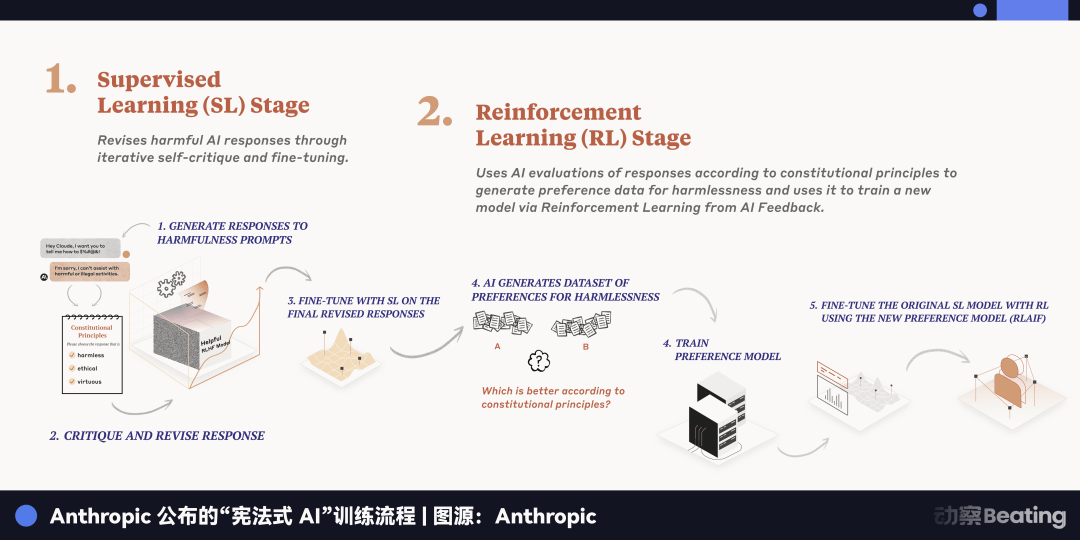
As this “constitution” gets longer and longer, it has to understand power, understand conflicts of interest, understand what it means to be mature and what it means to be wise. It even has to think about its own identity, circumstances, and well-being, not simply treat itself as a tool with no inherent value.
What it’s shaping is a kind of personality.
Anthropic wrote into its constitution that this document directly shapes Claude’s behavior—representing the company’s conception of Claude’s values and personality, and also the “final authority” for understanding how Claude should act. Historically, people who handled such matters included the church, emperors, and political parties. Now it’s a private company.
But when a large model’s impact on the world isn’t just another consumer product, the situation changes. What Claude refuses, what it encourages, how it describes a country, a war, or a political system—all of it affects downstream products, becoming part of how others understand the world.
Anthropic is still making decisions in the way a company does, but the impact those decisions bring keeps looking more and more like a public system—while it doesn’t have to submit to any of the scrutiny public systems require.
After writing the constitution for the model, Anthropic started designing traffic rules for the industry as well. In 2023, the company rolled out its “Responsible Expansion Policy.” A model that only writes emails clearly can’t be governed with the same approach as one capable of designing biological weapons or launching complex network attacks. So Anthropic assigns the model different risk tiers. The stronger the capability, the bigger the harm it might cause—meaning the company must implement stricter safety measures.
A private company—at the same time, it played several roles. It built models; then, after the models were built, it tested how dangerous they were. It decided what counted as dangerous; where the danger level should trigger a stop was also its line to draw. Finally, it took those results and told regulators how to write the rules.
Be an athlete, and be a referee.
Anthropic obviously thought of this too. To prevent the company from being swallowed up entirely by commercial interests at the end, Anthropic also designed a long-term benefit trust. This trust is made up of certain external members who don’t directly hold the company’s economic interests. The purpose is to ensure that Anthropic takes into account humanity’s long-term interests in addition to shareholder returns. According to the original design, the trust would gradually gain the power to appoint and remove a majority of directors, so it could hit the brakes if the company deviated from its mission.
From the perspective of corporate governance, this arrangement is quite rare. When most startups raise funding, they’re busy proving to investors that they will grow at high speed. Anthropic does the opposite. It builds a structure to prevent future investors and management from making money by throwing aside safety promises.
You can’t say these are just for show. Anthropic really is more serious than most tech companies about thinking through the issue of power, and they are willing to create problems for themselves. But throughout, what they’re seriously thinking about is how to use that power better—not whether or not to have it.
A company born with a mission is never going to ask, “Why do I exist?” It only asks, “How can I exist better?”
It doesn’t answer “who gave you power.” It’s just preaching that since power is already in hand, it intends to be a good person.
At this point, Dario is no longer just running a company. His view of safety is seeping into the model’s character, into public policy. Next, he begins to talk about which country should get powerful intelligence first, what kind of political system is worth protecting, the order in which the whole world should receive intelligence—and who should decide it.
The U.S. gets the future first
In 2024, Dario Amodei wrote (Machines of Loving Grace).
The name is taken from a poem. In 1967, poet Richard Brautigan wrote (All Watched Over by Machines of Loving Grace) at the California Institute of Technology:
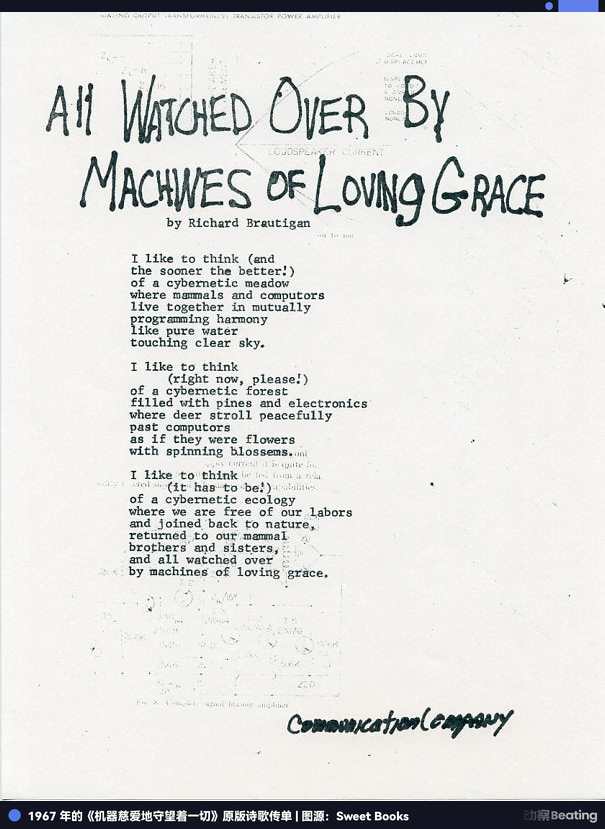
A poem about machines and everything coming to terms with each other. He borrowed the title and wrote one of the most optimistic technological prophecies in human history.
Powerful AI would become a research team made up of countless top scientists. It would read papers and design experiments day and night, compressing decades of scientific progress into just a few years. Cancer, infectious diseases, genetic disorders—these could be tackled at scale. Humanity might even be able to understand how depression, anxiety, and addiction happen. Lifespans could be extended, and poor countries could skip industrialization.
He made an extremely bold judgment: if the development of powerful AI goes smoothly, advances in biomedicine over the next 50 to 100 years could be completed within 5 to 10 years.
It’s hard not to think of his father.
His son waited seven years and then, a new drug was approved that could save others—but it couldn’t save him anymore. He hoped that people afterward wouldn’t have to wait anymore.
In his ideal world, he truly believes this technology can reduce disease, pain, and death. He even discusses how not to let AI’s benefits only land in wealthy countries. He hopes AI can help the Global South develop, so that technological dividends cover as much of the world as possible.
But once he started talking about how to reach this future, things were no longer so universally agreed upon.
He believed that when powerful AI arrives, the nation must secure an advantage. That advantage can’t be only that a company’s product is better, or that it scores a few more points on a leaderboard. It has to land in chips, compute power, energy, supply chains, the military, and international alliances.
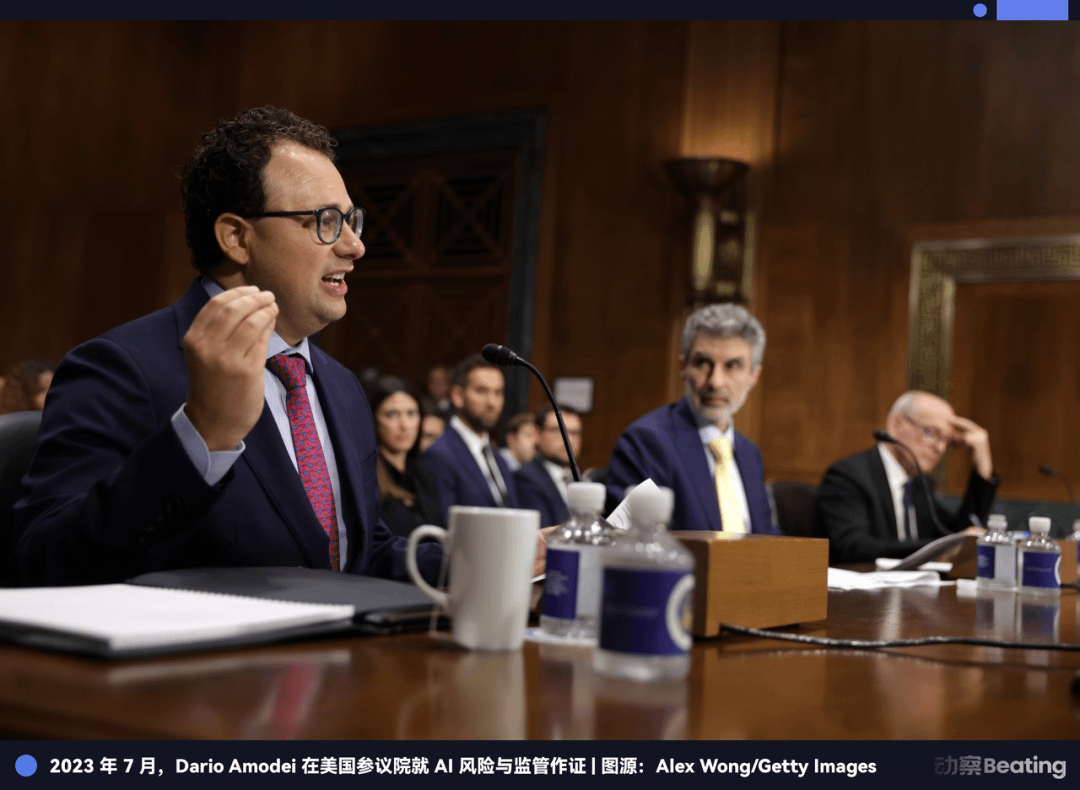
The United States and its allies must obtain more advanced semiconductors, build larger data centers, and at the same time block strategic competitors from getting the chips needed to train the strongest models. When powerful AI truly arrives, they’ll also use it to expand military and economic advantages, establishing a position that other countries can’t easily shake.
Only after that comes the turn to share.
The medicine has to be distributed, and the chips have to be blocked. The promise he made—“so that people in the future won’t have to wait”—in the real version means, “so that qualified people won’t have to wait.” And who qualifies? He decides.
He even used the phrase “an Eternal 1991” to describe that kind of state. In 1991, the Soviet Union collapsed and the Cold War ended. The United States and its allies gained overwhelming advantage. He hoped that powerful AI could recreate a historical moment like that.
Pay attention to the value of this metaphor. A technology that claims it will benefit all humankind, its ideal blueprint is the most thorough unipolar hegemony in human history.
The four words “for all under heaven” are beautifully written. But “under heaven” belongs to the U.S., and “for the public” belongs to Anthropic.
Then DeepSeek appeared. Chinese companies, using relatively limited resources, trained competitive models. In Dario’s view, that precisely proves China has excellent researchers and engineering capabilities. Once it gets enough advanced chips again, Chinese companies could train the strongest models in the world.
So, you definitely can’t give it the chips.
The stronger the adversary, the more it proves that the blockade is right. Once the adversary demonstrates its ability, it becomes the reason they should be blocked. This logic always holds, because it’s a self-reinforcing loop.
He splits the future into two types. One is a bipolar world, where both sides can train extremely strong models, and the intelligence race turns into a new Cold War. The other is a unipolar world, where the United States and its allies hold most of the advanced compute power. In the West, using those leading years, it forms technological, economic, and military advantages—then locks those advantages in place.
He clearly preferred the second kind of future. Whatever benefits humanity, whatever doesn’t need to wait anymore, whatever brings machines into harmony with everything—before the “eternal unipolarity,” all of it is just preface.
He has publicly opposed a certain narrative. He said he didn’t like AI company founders describing themselves as prophets leading humanity toward redemption. He also warned against a handful of enterprises using their technological advantages to unilaterally shape everyone else’s future.
He opposed prophets. But what he did and what prophets do were the same thing.
He saw every danger—except his own
Turn the clock back again to January 2026 (the adolescence of technology).
In this article, Dario Amodei almost writes out all the criticism from the outside about him and Anthropic, himself first.
He admits that frontier AI companies are obtaining a kind of power that, historically, very few private enterprises have held. He even tears the window open and says that AI companies may use products to influence users’ political attitudes—and even “brainwash” users. He calls on the public to keep a close watch on AI companies, and urges governments to be wary of these companies getting too close to state power.
He also worried that AI would further concentrate wealth and political power. A few companies hold intelligence, wealth, and information all in their hands, and ordinary citizens’ influence on the economy and on government steadily weakens.
He saw all these dangers. He wrote them clearly and accurately. Few people who stand at the center of power would be so candid about how dangerous their position is.
Because he wrote it so well, you have to ask one question: then what?
Every time he proposes a solution, he ultimately circles back to the same direction. Follow his approach to the end, and Anthropic will always end up with more power than before. The more dangerous the model is, the more Anthropic needs to stay at the front line; the less governments understand technology, the more they have to rely on Anthropic’s judgment. The easier it is for the public to be influenced by models, the more Anthropic will end up writing the values into the models on their behalf. And the less believable other countries are, the more the U.S. and its AI companies should hold the chips and compute.
He admits that every illness he acknowledges, he prescribes the same medicine: Anthropic.
He believed, sincerely, that this technology was too dangerous to be casually handed to anyone. He also believed that he could see this danger earlier than most people.
Sometimes sincere people are the first ones they fool themselves. Especially when the profits from fooling themselves are so huge.
He seemed to sincerely believe that this technology was too dangerous to hand over to anyone casually. And he sincerely believed again that he was seeing that danger earlier than most people.
Put these two lines together, and you get a complete package of self-authorization. He never has to announce that he should be humanity’s guardian. He only needs to keep excluding those people he considers unreliable: the market won’t do, the public won’t do, authoritarian states won’t do, and other companies aren’t cautious enough either. Once everyone has been excluded, the one left who’s best suited to grip the steering wheel just happens to be Anthropic.
The end point of the process of elimination is always himself.
He didn’t believe anyone had the right to decide the future for humanity.
So he decided to do it himself.
The last private company
On August 14, 2026, a single sentence surfaced from a podcast.
“Inside Anthropic, they’re very confident. Several people I trust who I’ve heard from say that Dario once said: Anthropic could become the only private company in the world one day.”

The one who said this is called Gavin Baker, a hedge fund manager who has invested in SpaceX. He added one more line: in that vision, it’s only Anthropic—along with governments from each country. That’s it.
Within a day, this line went viral on social media.
David Sacks, former White House AI and cryptocurrency advisor and now co-chair of the President’s Council of Advisors on Science and Technology, said, “This is arrogant. It’s a bit like SBF’s recklessness.”
The evening after, Dario posted two long pieces on X to respond.
The first piece is about regulation. He said, “Either centralize or decentralize” is a false choice; a truly good system, precisely, is one that de-centers power:
“A formal court system can sometimes seem rigid and elitist, but it protects the vulnerable better than the other alternative—mob justice. At its best, a system can put power behind an idea rather than behind an individual.”
The second piece is about information transmission. He said the public’s negative emotions toward AI are a crisis of trust. Then he wrote the most weighty part of those two long pieces:
“Up to now, the most accurate criticism of AI companies—including Anthropic—is that we haven’t cashed in on the big promise we made that would benefit the world. And that’s completely our fault.”
“The truly effective approach is to truly cure cancer.”
In the two long pieces, not a single sentence directly addressed that rumor. He used one real question to sidestep another real one.
He said the real goal is to truly cure cancer. By that he meant using AI to push overall medical progress—so that new drugs arrive fast enough, faster than any disease.
This is what he said to someone who died in 2006. That person waited for a bottle of medicine for a long time—and never got it.
After that, he believed that slowness is a crime. When someone believes slowness is a crime, they treat speed as the only antidote. The antidote is a good thing—he just wants everyone to believe that only he can produce it.
In 1986, British writer Alan Moore published a comic called (Watchmen), later adapted into a film. In the film, there’s a person named Adrian Veidt, nicknamed the Pharaoh King, who claims to be the smartest man in the world.
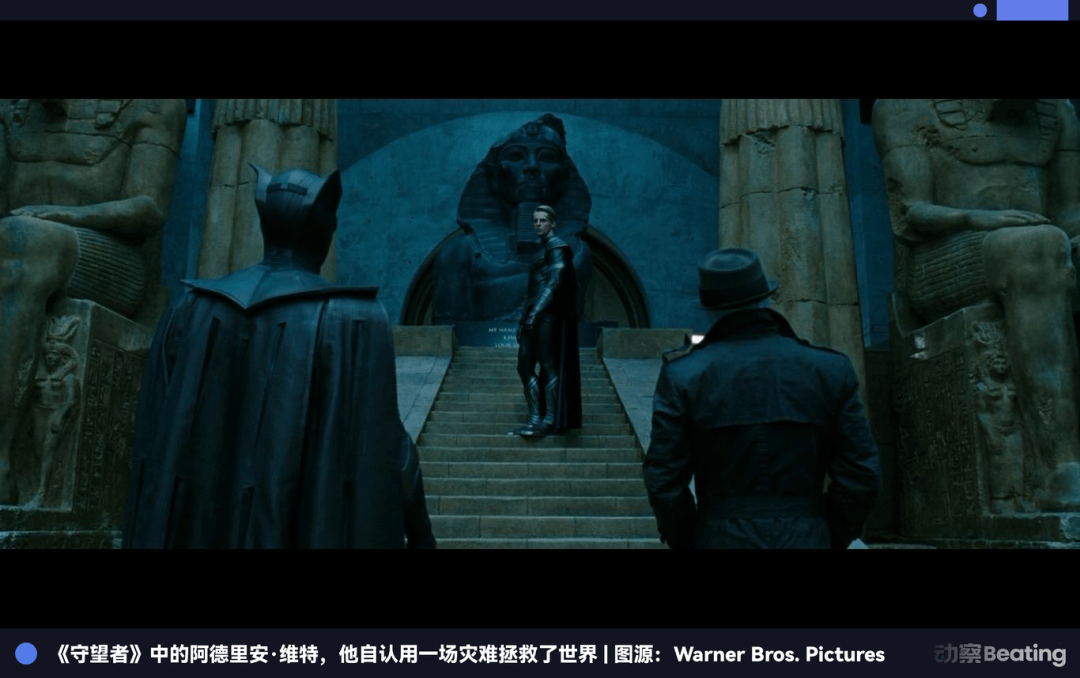
He saw the disaster coming earlier than everyone else. Nuclear war. The end of the world. Humanity destroying itself. He prepared for it for half his life. Then he understood that warning alone was useless.
So he personally detonated the disaster. In one night, several cities were wiped off the map.
He believes that only by letting human beings see what destruction looks like with their own eyes will the two superpowers stop, so that the world can be peaceful from then on.
He was the killer—and the savior he believed himself to be.
At the end of the story, everything turns out exactly as he wished. He asks that blue, nearly all-knowing Doctor of Manhattan:
“The end? Adrian, nothing ever ends. Everything, will never end.”
Original text link