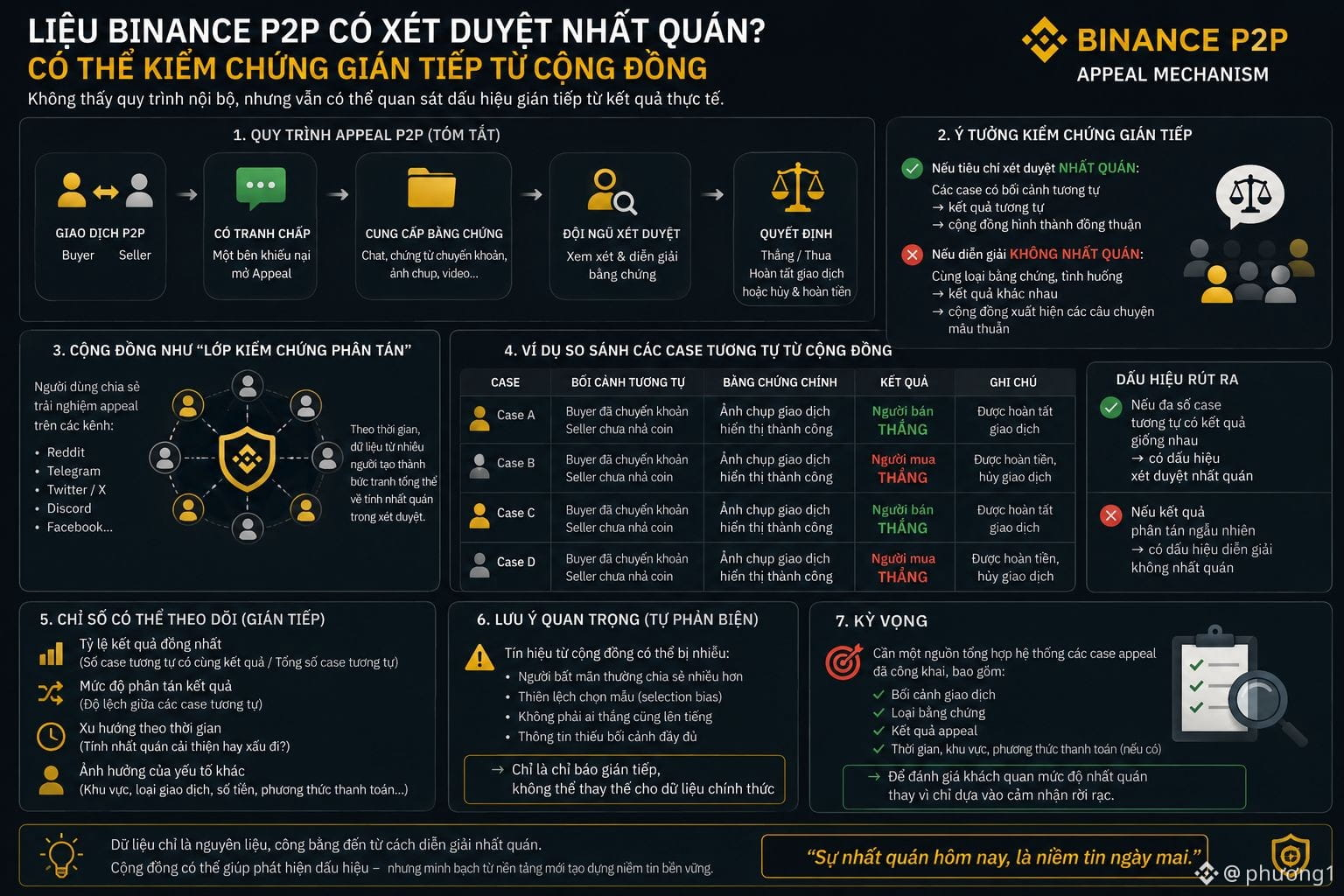
I have noticed something when trying to think about whether consistency in Binance P2P’s review process can be indirectly verified, even when the internal procedures are not publicly detailed.
I don’t have access to how the review team operates, but there is still a notable indirect signal—the degree of dispersion in users’ responses after the appeal result is issued. If the evaluation criteria are truly consistent, cases with similar contexts should receive similar outcomes, and over time the community could form a fairly reasonable consensus about how “certain situations are usually handled.”
Conversely, if the interpretation is inconsistent, users will share stories that seem to contradict one another—same type of evidence, same type of scenario, but different results depending on the time. This is a kind of signal that can be observed from the outside, though it cannot fully replace actually seeing the real internal process. Seen this way, the user community inadvertently acts as a layer of distributed verification—informal, without authority.
Self-refutation: signals from the community are prone to noise because users tend to share more when they’re dissatisfied than when they’re satisfied, so it’s hard to use this to draw a certain conclusion about how consistent things truly are.
I’m waiting to see if anyone has compiled, in a systematic way, appeal cases that have been publicly shared on Binance P2P, to try to assess this consistency more objectively rather than relying only on scattered impressions.
#binancep2pantoan @Binance Vietnam