

Many Web3 projects actually don’t lack for news.
The product was updated, and the mainnet launched
Added a new chain and signed a partner
TVL is up, and trading volume is up
Received new funding and added an important customer
The number of developers increased, and protocol revenue hit a new high
Inside the team, it looks like every single thing is important. So the most common approach is:
Whatever happens, publish it.
But from the perspective of managing market expectations, we usually ask another question first:
What exactly can this information change in the market?
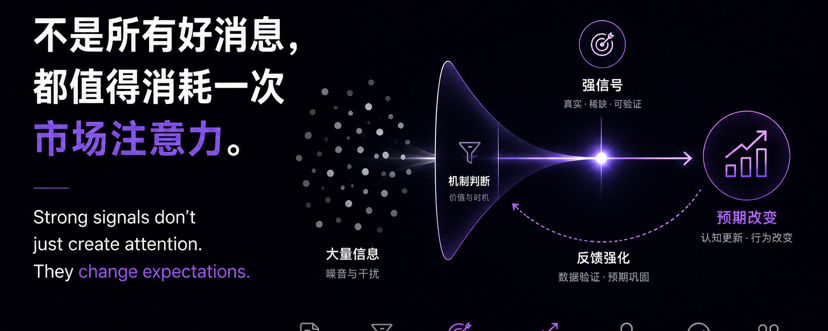
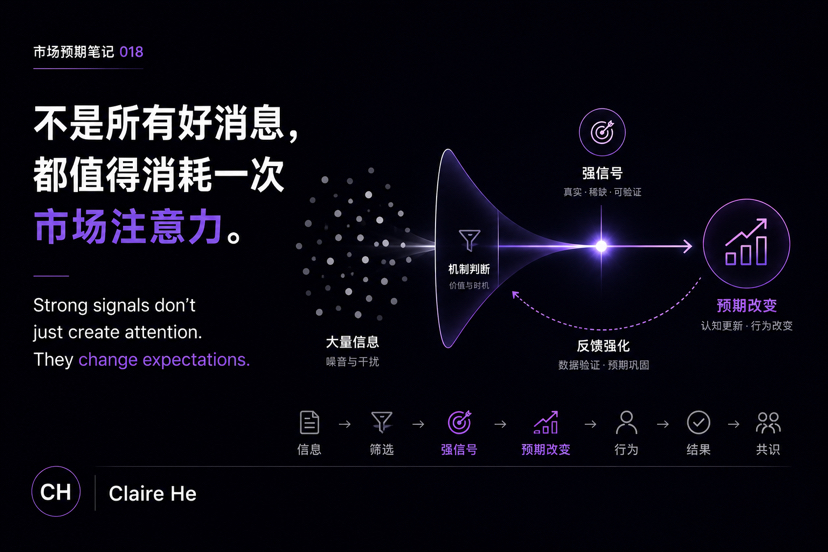
Because market attention is limited, not all real information is worth using the same amount of promotional resources. And not all “good news” has the ability to change market expectations.
⸻
1. Information Value ≠ Market Influence
This is a very important issue we discovered through long-term practice.
A piece of information may be extremely important internally to a project. But for the market, it may add almost no new information.
For example: The project完成了 a major technical upgrade that took several months. For the development team, this is a huge milestone. But ordinary market participants may have no idea at all: What problem does this upgrade solve? Why couldn’t it be done before? After the upgrade, who would change their behavior because of it? And what would ultimately be affected?
If these questions aren’t answered, even if the technical value is real, it’s still hard to enter the market’s judgment.
So we separate the two questions:
Is this itself important?
And:
Is this enough to change the market’s original judgment?
These are two different things.
⸻
2. What we truly look for is the “expectation gap”
For any mature project, the market usually already has a baseline judgment in place.
For example: This project grows very slowly; this protocol has no value capture; this ecosystem only has existing users; this product has great technology but no adoption; this project relies on incentives to sustain growth;
These judgments together form the market’s current:
Expectation Baseline
Then where does a piece of information truly have market value—not in how “big” it sounds. But rather:
Does it provide enough new evidence for the market to re-examine its original judgment.
Truly strong signals often come from:
A gap appears between reality and the original expectations.
⸻
3. So we won’t simply split messages into “big positives” and “small positives”
Market Expectation Systems focuses more on several dimensions.
First: Novelty
Does the market already know? If something has already been sufficiently expected, then even if it finally happens formally, the incremental understanding it creates may be very limited.
Second: Expectation Gap
How different is it from the market’s previous judgment? Information that can truly change market expectations usually, to some extent, breaks old assumptions.
Third: Relevance
Is this related to the market’s current most pressing concern?
It may be completely true, yet it hasn’t entered the market’s current decision variables.
Fourth: Credibility
Who proves this? The same information, different levels of evidence—will receive completely different weighting from the market.
Fifth: Behavioral Potential
This is the layer we pay special attention to. Once this information is understood:
Who will change their behavior because of this?
If a single piece of information can only generate views but almost can’t change any participants’ behavior, its long-term value is usually limited.
4. A strong signal doesn’t necessarily require a large amount of dissemination
This is an easy question to overlook. Many projects think: the more important the message is, the more KOLs they should get to publish at the same time.
But not necessarily. If the information itself has a very strong expectation gap and credible evidence, the most important first step probably isn’t “amplifying it.” Instead, it’s:
Build the right explanation.
How the market understands a new signal the first time will affect the entire subsequent dissemination path.
Signal recognition must happen before dissemination.
5. Some messages should be amplified, and some should be accumulated
Not every progress update should independently become a campaign.
Some information by itself is not enough to change the market’s judgment. But if it accumulates continuously for three months, it may suddenly become very important.
The market will think: this isn’t a one-off event—it’s a trend.
Therefore, we don’t just judge: what is worth saying now. We also judge: what should be accumulated temporarily; what needs to be validated; what needs to be combined with the next signal; and what should become the core evidence for the next round of market expectation updates.
6. What’s truly scarce isn’t news, but the market’s attention
This is a point we emphasize a lot. The market has to process too much information every day, and no project can expect the market to stay focused on every single update. If you keep using low-intensity messages to consume attention, the market will gradually form the view: “This project keeps posting messages, but nothing meaningful actually changes.” This will reduce the market’s sensitivity when truly important signals arrive in the future.
So market expectation management, in essence, also includes:
Attention Allocation
When should things stay quiet?
When should we start preheating?
When should interpretation be concentrated?
When should third parties validate it?
When should the discussion be expanded?
When should we drive action?
These choices themselves are part of the strategy.
7. This is also what makes Market Expectation Systems different from typical content services
For typical content services, the first question is: “How much content needs to be posted this month?”
We first ask: “Over the next 90 days, what facts could truly change the market’s judgment?”
For typical KOL placement, the first question is: “How many KOLs are needed?”
We first ask:
“At which stage of expectation formation is this signal right now, and what type of people need to complete what function?”
Typical dissemination focuses on: impressions, views, likes, shares.
Of course, we observe these data as well, but we’ll keep looking further: Has the market formed a new explanation? Have the discussion topics changed? Have users started actively searching? Have community issues changed? Have product behaviors changed? Have on-chain behaviors changed? Is there any new developer, user, partner, or capital entering?
Because ultimately we need to answer:
Has this signal changed market behavior?
8. We’re turning this kind of experience into a system
In the past, many judgments relied on experience.
What information is important?
When to publish?
Start with whom?
How might the market react?
What should be done next?
These problems have often existed in the experience of a small number of long-term practitioners.
Now we’re further structuring these experiences. We hope to gradually form a set of:
Signal Scoring System
It’s not simply predicting prices.
Instead of helping projects judge what different information may have:
Attention Impact
Expectation Impact
Credibility Strength
Behavioral Potential
Timing Sensitivity
It ultimately helps the project answer a very practical question:
With so much information in our hands, where should we invest limited market resources?
9. For Web3 project teams, this may be more important than “more dissemination”
Market Expectation Systems truly aims to help projects build, not:
The ability to “generate more messages.”
Instead, it’s about:
Identify valid signals → Design the explanation → Form the expected outcome → Drive action → Get feedback → Identify the next wave of signals.
So we don’t think that market expectation management means constantly manufacturing noise. On the contrary, mature market expectation management should first know:
When it’s worth talking about
what to say
Who says it
When should the market start speaking for itself.
Because truly strong market signals are not information with the loudest volume.
But rather:
Information strong enough to make the market rethink the future.
————
Market Expectation Systems
Market expectation management system
Claire He
Email: clairehe0706@gmail.com
#Web3 #MarketExpectation #NarrativeStrategy #Signal #Crypto #BinanceSquare#BTC #ETH #aave #uniswap #Hyperliquid