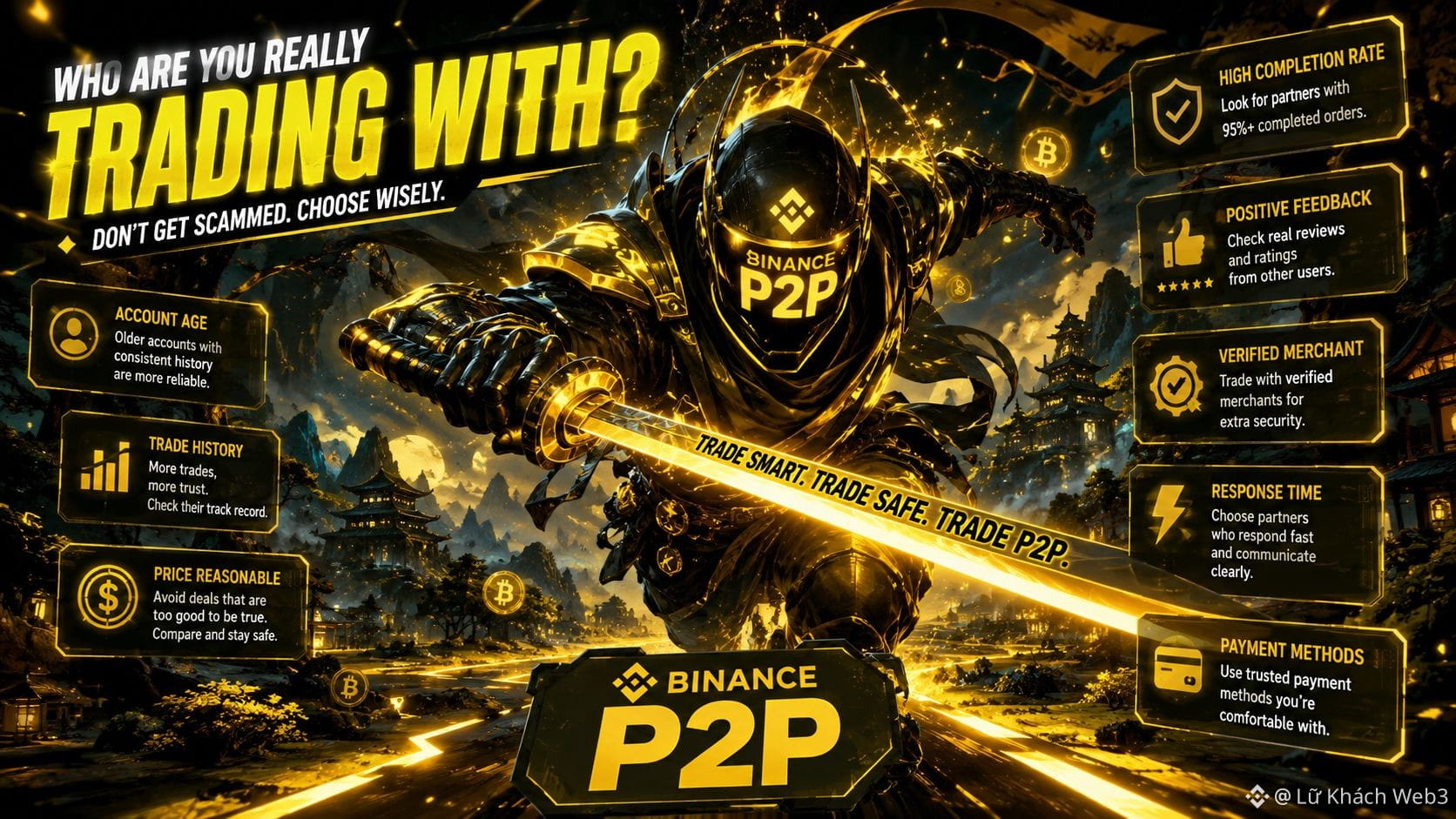
There is a fairly simple situation that made me change the way I think about choosing a counterparty on Binance P2P.
Suppose I need to buy 1,000 USDT and I see two ads with almost the same price. Ad A has completed around 2,800 trades, with a completion rate of 99.6%. Ad B, although it offers a slightly better price, has only 45 trades and a completion rate of 91%.
If I only look at the price, I could choose either one. But when I read Binance’s guidelines, I see that the platform recommends checking the completion rate, the total number of completed trades, and the counterparty feedback before making a trade.
I started looking at the two ads differently.
2,800 trades do not prove that A is definitely free of issues, but it gives me a larger amount of historical data to assess. Conversely, 45 trades and a lower completion rate give me less basis to trust the counterparty’s reliability.
Binance also shows data such as the number of trades in the past 30 days, the 30-day completion rate, and the average release time.
But hold on—these numbers are only signals, not a guarantee for the next trade.
I won’t treat the completion rate or the number of trades as a ticket that guarantees safety. They only provide me with more grounds for choosing, while the specific verification of the trade still depends on me.
#binancep2pantoan @Binance Vietnam $BTC
Suppose I need to buy 1,000 USDT and I see two ads with almost the same price. Ad A has completed around 2,800 trades, with a completion rate of 99.6%. Ad B, although it offers a slightly better price, has only 45 trades and a completion rate of 91%.
If I only look at the price, I could choose either one. But when I read Binance’s guidelines, I see that the platform recommends checking the completion rate, the total number of completed trades, and the counterparty feedback before making a trade.
I started looking at the two ads differently.
2,800 trades do not prove that A is definitely free of issues, but it gives me a larger amount of historical data to assess. Conversely, 45 trades and a lower completion rate give me less basis to trust the counterparty’s reliability.
Binance also shows data such as the number of trades in the past 30 days, the 30-day completion rate, and the average release time.
But hold on—these numbers are only signals, not a guarantee for the next trade.
I won’t treat the completion rate or the number of trades as a ticket that guarantees safety. They only provide me with more grounds for choosing, while the specific verification of the trade still depends on me.
#binancep2pantoan @Binance Vietnam $BTC