

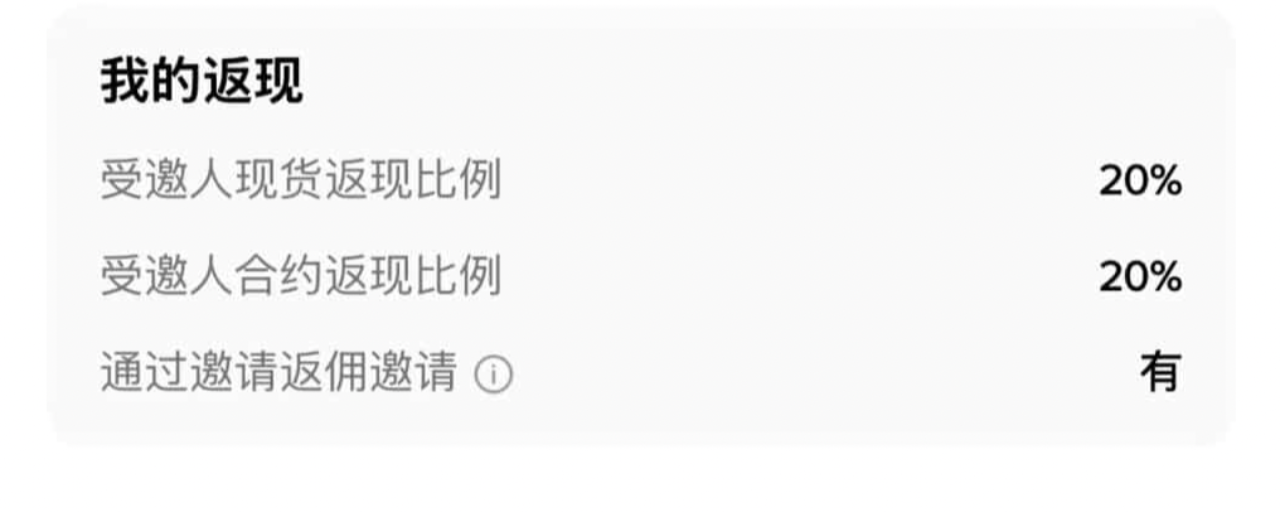
One-sentence conclusion: On Binance spot, maker/taker fees are both 0.1%. For USDⓈ-collateral (U) perpetual futures, maker fees are 0.02% and taker fees are 0.05%. This price is not necessarily the final price you must pay—using BNB to pay fees can get you a further discount, and entering the correct invitation code during registration can return 20% of the fee you’ve already paid, with lifetime automatic settlement. With these two layers stacked, your actual spot cost can drop from 0.1% to 0.06% (saves 40%), and contract taker fees can drop from 0.05% to 0.036% (saves 28%).
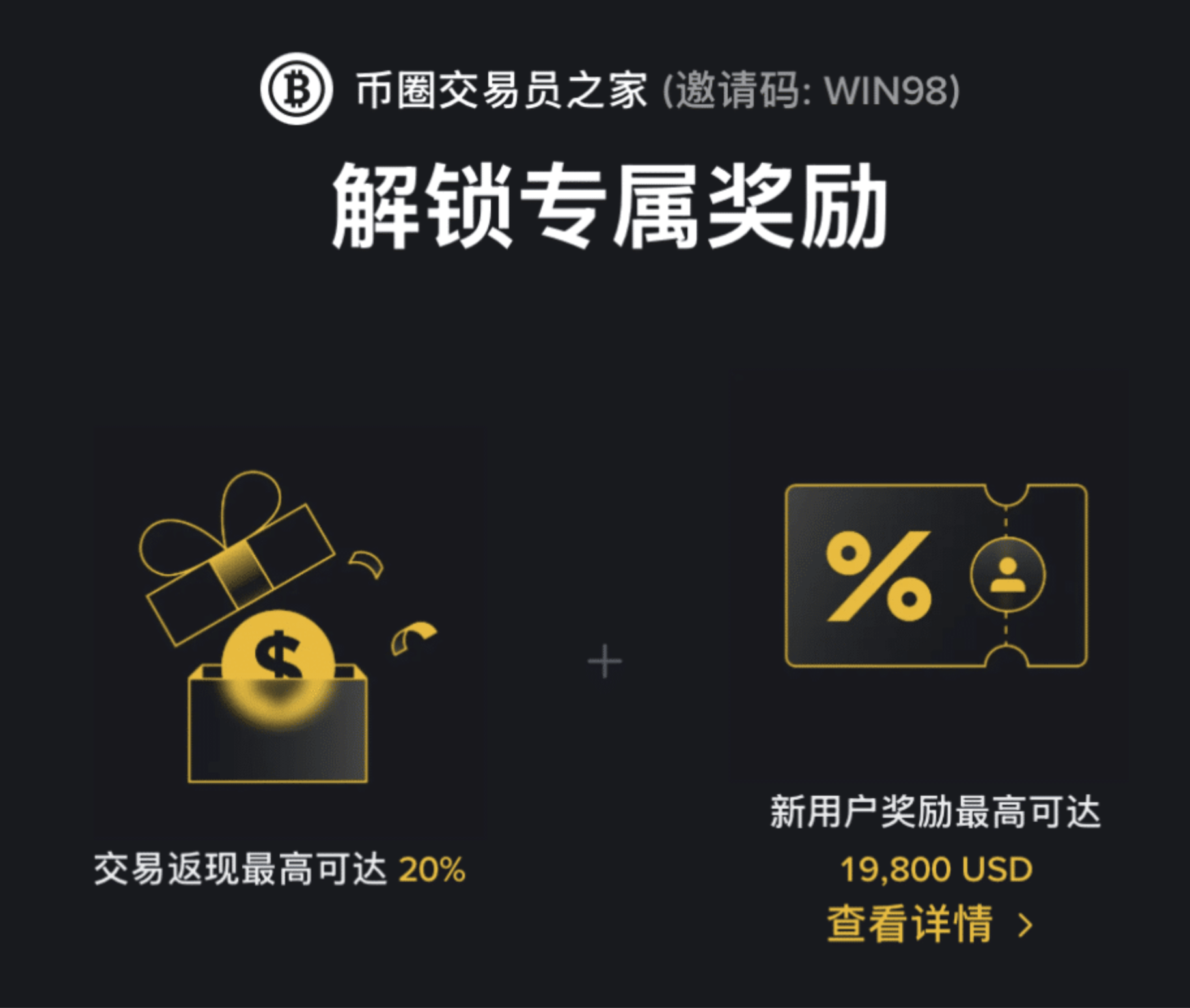
🔥 Home for Crypto Traders · Binance Rebate Invitation Code
Invitation code: WIN98
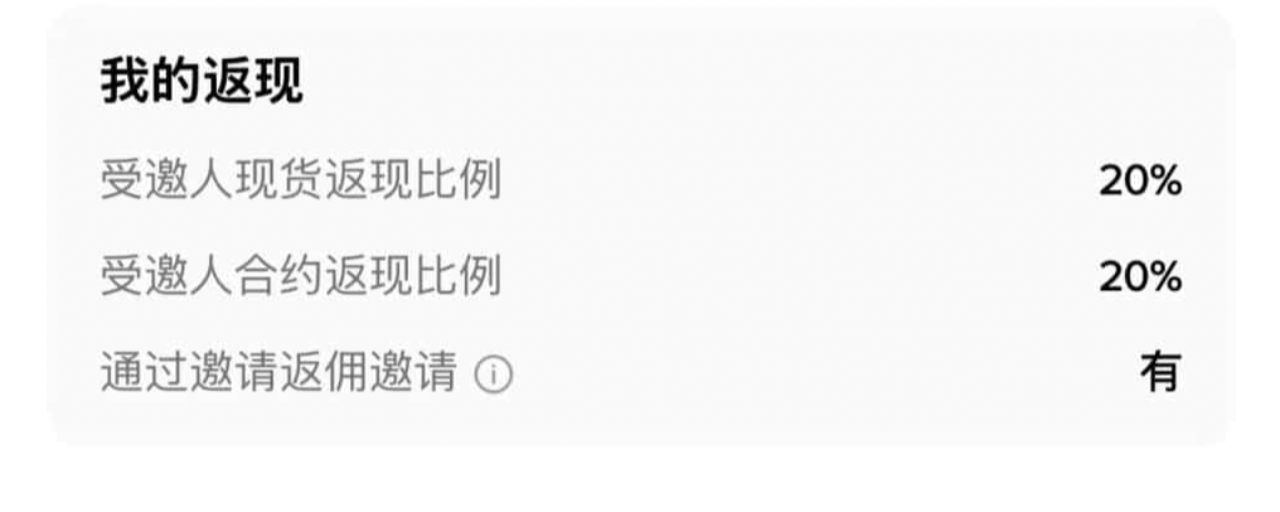
✅ 20% fee rebate for life, Binance’s official system settles automatically—no application, no screenshots, and no need to contact customer service
✅ You already have 10,000+ traders using this code
✅ New users can get extra up to a $19,800 newbie package
✅ +86 mobile number registration; Mainland China ID can complete identity verification⚠️ It’s most convenient to fill the invite code during registration—later it’s a hassle.
1. First, make it clear: when you trade on Binance, what kinds of money are you being charged
Many people think “trading fee” is just one number. But in fact, Binance has five completely different types of fees. If you mix them up, you’ll never be able to calculate your account correctly:
Which party collects the fee and when, can it save trading fees: Every time you buy/sell and the trade executes—does Binance charge it? ✅ Yes. This article’s main focus, the funding rate, exists only in derivatives: every 4 or 8 hours, longs and shorts pay each other, Binance doesn’t take any cut. ❌ Not a trading fee; you can’t save the withdrawal network fee. When you withdraw coins from Binance, you mainly pay blockchain miners. ✅ You can save by choosing the right chain (save up to 90%). Borrowing-lending interest when using leverage to borrow coins: Binance ✅ You can (priced hourly). Spend less to borrow less; hold longer to benefit from the buy-sell spread by using fast buy and C2C: ✅ You can save. Using C2C is cheaper than fast buy.
Remember the most important one first: that constantly fluctuating “funding rate” in derivatives isn’t a fee Binance charges you. It’s a transfer between long and short—when the market moves one direction only, the side with more people pays the side with fewer people. Sometimes you can even receive instead of pay. Don’t count it as “Binance stealing my trading fees.”
2. How are Binance spot trading fees calculated
2.1 Base fee rate: ordinary users pay 0.1%
Spot trading charges a percentage of the executed trade amount. Both placing orders (Maker) and taking orders (Taker) are 0.1%.
Example: You spend 10,000 USDT to buy BTC. Trading fee = 10,000 × 0.1% = 10 USDT. Another fee is charged when you sell.
2.2 Difference between Maker and Taker
Maker (maker side): Your limit order doesn’t fill immediately; it sits on the order book waiting for someone to take it—so you “provide” liquidity to the market;
Taker (taker side): You place a market order, or a limit order whose price immediately takes out the counterparty’s order—then you “take” liquidity.
For spot, both of the above are the same for VIP0 (both 0.1%), but derivatives are 2.5× higher—that’s the key to saving money later.
2.3 Use BNB to pay: spot gets a 7.5× discount
Hold a little BNB in your Binance account, and turn on the switch “Use BNB to pay trading fees.” Spot trading fees are reduced by 25% now:
0.1% × 75% = 0.075%
This is a discount tier everyone can use and it takes effect immediately. Turn it on once and it stays. Switch location: App →【Wallet】or【Settings】→ find “BNB fee deduction / Use BNB to pay trading fees” → turn it on.
2.4 VIP fee rate table (spot)
VIP level is determined jointly by your spot trading volume in the last 30 days and your BNB holding amount; both conditions must be met:
Tier 30-day trading volume BNB holding Maker Taker BNB deduction (Taker) then return 20% after VIP 0< 1M USD ≥ 00.100%0.100%0.075%0.060% VIP 1≥ 1M USD ≥ 5 BNB0.090%0.100%0.075%0.060% VIP 2≥ 5M USD ≥ 25 BNB0.080%0.100%0.075%0.060% VIP 3≥ 20M USD ≥ 100 BNB0.040%0.060%0.045%0.036%
Once you understand this table, you’ll find a painful truth: moving from VIP0 to VIP2 takes 30 days of 5 million USD trading volume + locking in 25 BNB, but your taker fee rate doesn’t drop even a cent (still 0.1%). Meanwhile, filling in an invitation code costs 0, with 0 barrier, and directly cuts your cost by 20%—the biggest discount retail users can get simply isn’t in the VIP system.
3. How Binance derivatives trading fees are calculated (focus for derivatives players)
3.1 U-based contract base fee rate
Type Maker (place order) Taker (take order) BNB deduction U-based contracts (USDⓈ-M) 0.020% 0.050% ✅ Deductible, 10% Coin-based contracts (COIN-M) are close to U-based—close to U-based ❌ BNB deduction not supported
⚠️ Note: In derivatives, BNB deduction is only 10%, not 25% like spot. Nearly all tutorials get this wrong.
3.2 Derivatives trading fees are charged based on the “notional value,” not your principal
This is where beginners lose the most money unfairly.
Derivatives trading fees are calculated on your position’s notional value, i.e., “margin × leverage,” not the money you put in:
You have 1,000 U principal, start 20× leverage → notional value = 20,000 U
incur spot-opening trading fee = 20,000 × 0.05% = 10 U
close out and do it again = 10 U
In one round of open-and-close, your 1,000 U principal is deducted by 20 U, which is 2% of the principal.
Which means: with 20× leverage, if you do 5 rounds per day and do nothing else, just fees alone will eat up 10% of your principal. The real enemy of high-frequency, high-leverage players is never market movement—it’s trading fees.
This is also why referral commissions are worth more to derivatives traders—more than 10 times the value for spot players.
3.3 Place orders instead of taking (save 60%)
Look back at the table above: Maker 0.02%, Taker 0.05%—a difference of 2.5×.
Same for the 20,000 U position above:
All market orders (Taker) open-and-close: 10 + 10 = 20 U
All limit orders (Maker) filled: 4 + 4 = 8 U
Save 12 U in one round, saving 60%. Do 100 rounds in a month and that’s 1,200 U. This is the biggest “single-trade” money-saving action in this article—more ruthless than VIP level and BNB deduction combined.
The trade-off is that limit orders might not get filled, and you can miss the move. So practical advice: open positions as limit orders as much as possible (you can wait), and use market orders for stop-loss/emergency close (you can’t wait).
3.4 Funding rate: one more time, it’s not a trading fee
Who collects it: both long and short sides pay each other; Binance doesn’t take a cut;
How often: commonly once every 8 hours or every 4 hours; the exact schedule is shown by the countdown displayed on each derivatives page;
How to judge: if the rate is positive, longs pay shorts; if negative, shorts pay longs;
Key point: it’s charged only if you still hold a position at the settlement moment. If you close before settlement, you don’t pay;
In extreme market conditions, Binance may temporarily shorten the settlement cycle.
So if you do intraday scalping, you basically don’t need to worry about the funding rate; if you hold overnight/long-term positions, you need to include it in your costs.
4. These three fees are easiest to overlook
4.1 Withdrawal network fees—pick the wrong chain and overpay by 90%
Deposit to Binance for free; withdrawing charges network fees (mainly paid to blockchain miners). If you withdraw USDT, choosing different chains can change the cost by dozens of times:
Chain cost suggestion: TRC20 (Tron) is very low, almost constant ✅ transfer to others / transfer to other exchanges preferred BSC / BNB Chain are very low ✅ go into DeFi, best to play on-chain with Arbitrum / Optimism / Base; low. Play L2 using ERC20 (Ethereum mainnet) is high, and gas fluctuates wildly ❌ unless the other party only charges ERC20, don’t use it
⚠️ Before withdrawing, you must confirm the recipient supports the chain you choose. If you pick the wrong chain, the coins will be lost directly, and recovering them is extremely difficult. This loss is 10,000× bigger than the trading fee.
4.2 C2C no trading fees; quick buy doesn’t
C2C (P2P) fiat buy/sell: Binance doesn’t charge a trading fee; the cost shows up in the merchant’s quoted price spread → deposit via C2C is the preferred option;
Quick buy / one-click buy: easy to operate, but the fee rate is clearly higher;
Conclusion: As long as you can accept doing a couple extra steps, by depositing via C2C in the long run you can save a lot of money.
4.3 Leveraged borrowing interest
Spot leverage accrues interest by the hour. If you don’t repay, it keeps rolling. Use it and repay right after you finish the trade—don’t carry it overnight.
5. Finally, what exactly is referral commission?
5.1 Where does the money come from? Not a subsidy—it’s Binance’s customer-acquisition budget
Every exchange needs to bring in new users. Instead of putting money into advertising platforms, it’s better to give it to the people who can bring users. So Binance has an official “referral reward program”:
For every trading fee generated by the referred user, Binance refunds the inviter a portion of it.
This is a feature in Binance’s official system—not any third-party action—so there’s no issue of “running away” or “not paying.” Binance calculates it by day and credits it to your account automatically.
So the essence of referral commission is: Binance pays out of its own customer-acquisition budget, not out of your principal. It doesn’t affect your execution price, order book depth, or any trading experience.
5.2 The key question: why do some people get cash back while others don’t, even with the same invitation code filled?
Because the referral commission ratio can be allocated by the inviter.
Binance lets the inviter set a distribution ratio in the backend, then gives the invited party a portion of the referral commission they receive. That’s why you see two completely different outcomes:
The invitation-code type you filled in: the inviter uses your code to get results, then your friend casually gives you a code / a code someone copied online at random—20%0% means you’re letting others earn for free, you get nothing. If you don’t fill any code—0%—Binance keeps the money directly; nobody gets any professional referral channel code (e.g., WIN98) to split out 20% of the fees, and the fee refund is real—returned to your wallet
⚠️ Highlight: Don’t fill in a code, or fill in a code that doesn’t return referral commissions—your trading fees won’t be reduced by a single cent. This money won’t become cheaper just because you “didn’t find someone to recommend you.” It’s only that someone else takes it instead.
That’s why veteran traders always find a referral code before registering: with the same trade and the same price, the only difference is whose pocket that 20% actually goes into.
5.3 Three pitfalls of referral commission—must know
The invitation code must be entered at the moment you register. On the registration page, “Referral code (optional)” is collapsed by default, and most people don’t even notice it before clicking Next. After registering, trying to bind a code again can only be supplemented in very few cases (see FAQ at the end of the article);
Referral commission is calculated based on the “actual fee paid.” After you use BNB to deduct, the fee base becomes smaller, so the referral commission amount also becomes smaller accordingly. But even after stacking both, the total cost is still the lowest. Don’t turn off BNB deductions just to get more commission—that’s trading sesame for a watermelon;
Zero-fee trading pairs don’t generate referral commission—no fee paid means no commission to get. This is very reasonable.
5.4 How does referral commission get credited, and how do I check it?
Settlement method: Binance settles automatically in the system—you don’t need to apply, take screenshots, or contact customer service;
Where it lands: directly to your spot wallet;
Query path: Binance App → 【More】or【Personal Center】→ 【Invitation Rewards】→ 【My Referral Commission】→ you can see details of each commission payment;
Validity period: for life. As long as the account exists and the code is bound, the rewards keep coming back.
6. Push costs to the lowest: the four-layer stacking money-saving method
Everything discussed earlier, combined, becomes this combo attack. All four layers can work at the same time:
How much each layer saves in terms of fees and barriers: 1st layer—place orders instead of taking (Maker). Derivatives contracts save 60% (0.05% → 0.02%). 0. Change your order habit. 2nd layer—enable BNB deduction for spot and save 25%. Keep a little BNB in the account. 3rd layer—fill the referral commission invitation code WIN98 and save another 20%, automatically for life—0 cost. But only fillable at registration. 4th layer—push VIP level by trading volume. Retail users usually can’t reach the 30-day multi-million USD trading volume.
the real cost after stacking
Spot (VIP0, Taker):
0.100% — (BNB deduction 25%) → 0.075% — (referral commission 20%) → 0.060%
save 40% in total
U-based contracts (VIP0, taker):
0.050% — (BNB deduction 10%) → 0.045% — (referral commission 20%) → 0.036%
save 28% in total
U-based contracts (VIP0, maker order):
0.020% — (BNB deduction 10%) → 0.018% — (referral commission 20%) → 0.0144%
This is already the floor price for what retail users can get on Binance.
7. Let’s do the math: how much can you get back in a year
Calculate by taking a U-based contract Taker fee of 0.05% and referral commission of 20%:
Monthly derivatives trading volume (notional) Monthly trading fee Monthly referral commission Annual referral commission 500k U 250 U 50 U 600 U 2M U 1,000 U 200 U 2,400 U 500k U 2,500 U 500 U 6,000 U 10M U 5,000 U 1,000 U 12,000 U 3,000 万 U 15,000 U 3,000 U 36,000 U
Don’t think “several million in monthly trades” is exaggerated. Assume 10,000 U principal and 10× leverage: one time opening has a notional value of 100,000 U. Do 3 rounds per day = 600,000 U (open/close each counts once). In a month, that’s a trading volume of 18,000,000 U.
Applied to this table: this trader can get back nearly 20,000 U in referral commission per year.
And all he needs to do is add 5 extra characters when registering.
8. Common Questions (FAQ)
Q: Will referral commission affect my execution price or slippage?
A: Absolutely not. Referral commission happens in the trading-fee settlement stage and has nothing to do with matching, order depth, or execution price. Your trading experience is identical to someone who didn’t use a code—only difference: 20% of the fee gets refunded back.
Q: Do I need to do tasks or reach a trading volume to get referral commission?
A: No. If you fill in the code during registration, it stays effective permanently. You get back whatever percentage applies to whatever you trade—no thresholds, no caps, and you don’t need to apply.
Q: I’ve already registered. What if I forgot to fill in the invitation code?
A: First confirm you truly haven’t bound any codes (App →【Invitation Rewards】→【My Referral Commission】→ check whether the “Referred user cashback” ratio is 0). If you haven’t bound anything, the following three situations still allow you to supplement:
New accounts: registered less than 30 days, no deposits, no trades → open Binance self-service invite-code supplementary binding page, fill in WIN98, submit. No trading-volume tasks at all;
Small-amount old accounts: trading volume in the last 90 days ≤ 5,000 USD + already identity-verified → on the same supplementary binding page, fill in WIN98 (corresponding fee discount: 20% off). Note that after applying, you must complete 150,000 USD trading volume within 30 days;
Accounts with no activity for 90 days: no trades in the last 90 days → go via invitation link and log in for the first time, then bind according to the prompts.
You’ve already bound someone else’s invitation code; the system doesn’t allow changes.
Q: Is BNB deduction in conflict with referral commission? Which should I choose?
A: They don’t conflict—turn both on. The order is: first use BNB deduction to reduce the trading fees, then return 20% on the actual fee paid. Even though the absolute referral commission amount becomes smaller, your total spending is still the lowest after stacking both. This is just math—no need to overthink.
Q: What currency are the fees deducted in?
A: For spot, the default is that it’s deducted from the coins you bought; if BNB deduction is enabled, BNB is deducted first (so you should keep a little BNB in your account—if it runs out, it will automatically revert to the default method). For derivatives, fees are deducted from your USDT margin.
Q: Can I enjoy both VIP level and referral commission at the same time?
A: Yes. The two systems don’t interfere with each other. But for the vast majority of retail users, VIP level basically can’t be reached—referral commission is the only discount you can actually get.
Q: How can I check my actual current fee rate?
A: Binance App →【Personal Center】→【VIP & Fee Rates】, where you can see the real-time fee rates for each product line you use.
9. Finally, summarize it in three sentences
Fees aren’t fixed—if you trade on Binance, some people pay 0.05%, others pay 0.036%. It’s not luck; it depends on whether you made the right settings;
Referral commission money isn’t money falling from the sky—it’s Binance’s customer-acquisition budget. If you don’t claim it, it belongs to someone else, and your cost won’t drop by a single cent;
The invitation code can only be filled in at the moment of registration—this is the only action in the whole article that expires and can never be fixed again.
The fee-rate data in this article is verified for August 17, 2026, sourced from Binance’s official fee-rate page. Binance may adjust fee rates and promotion rules from time to time. Before trading, please rely on what’s shown in the App under 【VIP & Fee Rates】. This article does not constitute investment advice. Crypto trading involves high risk, and derivatives trading may result in the complete loss of your principal.