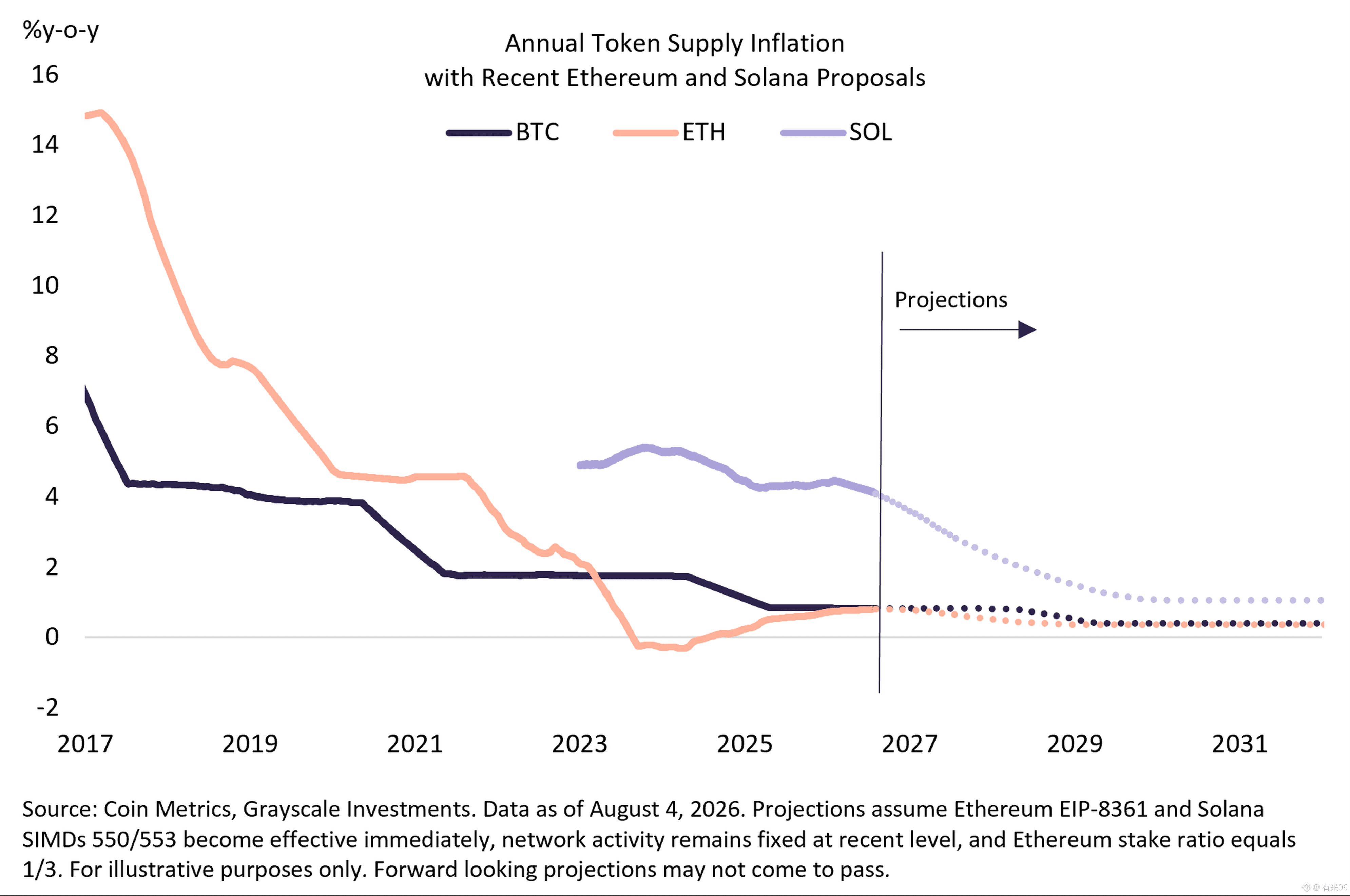
Both Ethereum and Solana are considering issuing fewer coins. If the proposal passes, then by the end of 2031 the yearly newly issued proportion could be lower than gold; if it doesn’t pass, it will remain the current setup.
In August, the asset management firm Grayscale published a note that extrapolated their own assumptions to the end of 2031. It estimated that the annualized increase in newly issued supply for Bitcoin and Ethereum would be about 0.4%, and for Solana about 1.1%. This is the token supply growth rate of the network tokens ETH and SOL—not a stock ticker. Gold’s annualized rate of about 1.8% for 2015 to 2025 based on above-ground holdings comes from the World Gold Council; US inflation annualized at about 3.3% through June 2026 for the past 10 years comes from the Bureau of Labor Statistics, and it’s not the same measure as the roughly 3.5% figure for the most recent 12 months. Ethereum is a draft proposal about burning verifier rewards that hasn’t been queued for an upgrade yet; Solana is SIMD-0550, which doubles the speed at which annual inflation declines from 15% to 30%, plus SIMD-0553 to burn more transaction fees—the voting window is set through August 18.
$ETH $SOL
In August, the asset management firm Grayscale published a note that extrapolated their own assumptions to the end of 2031. It estimated that the annualized increase in newly issued supply for Bitcoin and Ethereum would be about 0.4%, and for Solana about 1.1%. This is the token supply growth rate of the network tokens ETH and SOL—not a stock ticker. Gold’s annualized rate of about 1.8% for 2015 to 2025 based on above-ground holdings comes from the World Gold Council; US inflation annualized at about 3.3% through June 2026 for the past 10 years comes from the Bureau of Labor Statistics, and it’s not the same measure as the roughly 3.5% figure for the most recent 12 months. Ethereum is a draft proposal about burning verifier rewards that hasn’t been queued for an upgrade yet; Solana is SIMD-0550, which doubles the speed at which annual inflation declines from 15% to 30%, plus SIMD-0553 to burn more transaction fees—the voting window is set through August 18.
$ETH $SOL