I understand why Dusk Network wants obfuscated order books.
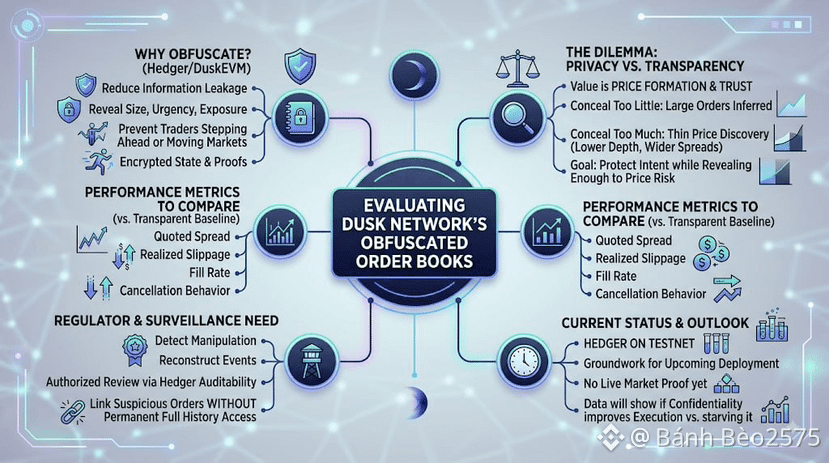
Publishing every institutional order can reveal size, urgency, and exposure before execution. Other traders can step ahead of that intent or move the market against it. Hedger's roadmap uses encrypted state and proofs to reduce that leakage on DuskEVM.
Still, an order book is not valuable because it is hidden. It is valuable because participants can form prices and trust the matching process.
If Dusk conceals too little, large orders remain easy to infer. If it conceals too much, traders may struggle to judge depth, spreads, and execution quality. A venue can protect intent while also making price discovery thinner.
The regulator has a third need. Market surveillance must detect manipulation and reconstruct events without publishing every participant's position. Hedger's auditability can support authorized review, but the key question is what the reviewer can see and when.
This is why I would not evaluate an obfuscated book by privacy alone.
I want to compare quoted spread, realized slippage, fill rate, and cancellation behavior against a transparent baseline. I also want to know whether authorized surveillance can link suspicious orders without gaining permanent access to every trader's full history.
Hedger remains on testnet, and Dusk describes obfuscated books as groundwork for an upcoming deployment. That status matters. The design is promising, but there is no live market yet proving that confidentiality improves execution rather than simply reducing visible information.
Dusk's target should be a market where an order can hide its owner and size before execution while the market still reveals enough to price risk.
Privacy can protect price formation. It can also starve it. The trading data will show which side Dusk reaches.
@Dusk $DUSK #dusk
$ACE $CYS
Publishing every institutional order can reveal size, urgency, and exposure before execution. Other traders can step ahead of that intent or move the market against it. Hedger's roadmap uses encrypted state and proofs to reduce that leakage on DuskEVM.
Still, an order book is not valuable because it is hidden. It is valuable because participants can form prices and trust the matching process.
If Dusk conceals too little, large orders remain easy to infer. If it conceals too much, traders may struggle to judge depth, spreads, and execution quality. A venue can protect intent while also making price discovery thinner.
The regulator has a third need. Market surveillance must detect manipulation and reconstruct events without publishing every participant's position. Hedger's auditability can support authorized review, but the key question is what the reviewer can see and when.
This is why I would not evaluate an obfuscated book by privacy alone.
I want to compare quoted spread, realized slippage, fill rate, and cancellation behavior against a transparent baseline. I also want to know whether authorized surveillance can link suspicious orders without gaining permanent access to every trader's full history.
Hedger remains on testnet, and Dusk describes obfuscated books as groundwork for an upcoming deployment. That status matters. The design is promising, but there is no live market yet proving that confidentiality improves execution rather than simply reducing visible information.
Dusk's target should be a market where an order can hide its owner and size before execution while the market still reveals enough to price risk.
Privacy can protect price formation. It can also starve it. The trading data will show which side Dusk reaches.
@Dusk $DUSK #dusk
$ACE $CYS