#dusk @Dusk $DUSK
What if privacy and verifiability were never actually opposites — just poorly implemented together?
I came across XSC while digging into confidential computing for smart contracts, trying to understand why "private" and "auditable" almost never appear in the same sentence. What caught me wasn't the cryptography itself, but how casually the industry has accepted that you must choose one.
That's the trade-off nobody questions: transparency for trust, or privacy for protection. Pick a side.
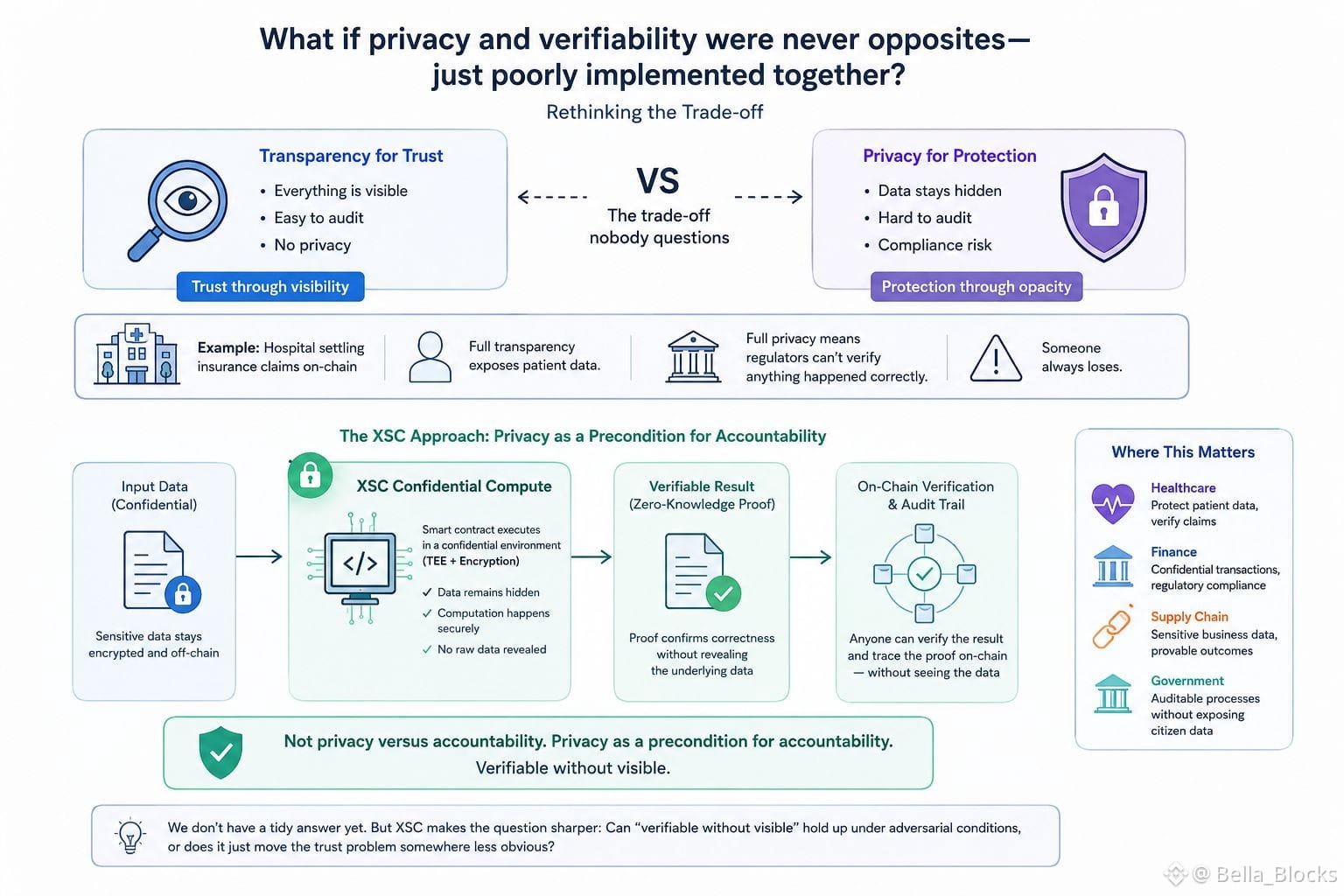
Think of a hospital settling insurance claims on-chain. Full transparency exposes patient data. Full privacy means regulators can't verify anything happened correctly. Someone always loses.
XSC's approach is to let contracts prove correctness without revealing the underlying data — computation happens confidentially, but the result carries a verifiable trail. Not privacy versus accountability. Privacy as a precondition for accountability.
It's a small reframe, but it unsettles a default that's been treated as physics rather than design choice.
And this shows up everywhere in tech, not just crypto: we keep building systems that force a binary between visibility and protection, then act surprised when neither side is satisfied.
So where does this leave the standard use case — a shared ledger between parties who don't fully trust each other, but who also don't want to expose everything? Does "verifiable without visible" actually hold up under adversarial conditions, or does it just move the trust problem somewhere less obvious?
I don't have a tidy answer. But XSC made the question sharper than it was before.
$KII
$AIO
What if privacy and verifiability were never actually opposites — just poorly implemented together?
I came across XSC while digging into confidential computing for smart contracts, trying to understand why "private" and "auditable" almost never appear in the same sentence. What caught me wasn't the cryptography itself, but how casually the industry has accepted that you must choose one.
That's the trade-off nobody questions: transparency for trust, or privacy for protection. Pick a side.
Think of a hospital settling insurance claims on-chain. Full transparency exposes patient data. Full privacy means regulators can't verify anything happened correctly. Someone always loses.
XSC's approach is to let contracts prove correctness without revealing the underlying data — computation happens confidentially, but the result carries a verifiable trail. Not privacy versus accountability. Privacy as a precondition for accountability.
It's a small reframe, but it unsettles a default that's been treated as physics rather than design choice.
And this shows up everywhere in tech, not just crypto: we keep building systems that force a binary between visibility and protection, then act surprised when neither side is satisfied.
So where does this leave the standard use case — a shared ledger between parties who don't fully trust each other, but who also don't want to expose everything? Does "verifiable without visible" actually hold up under adversarial conditions, or does it just move the trust problem somewhere less obvious?
I don't have a tidy answer. But XSC made the question sharper than it was before.
$KII
$AIO