#binancep2pantoan @Binance Vietnam
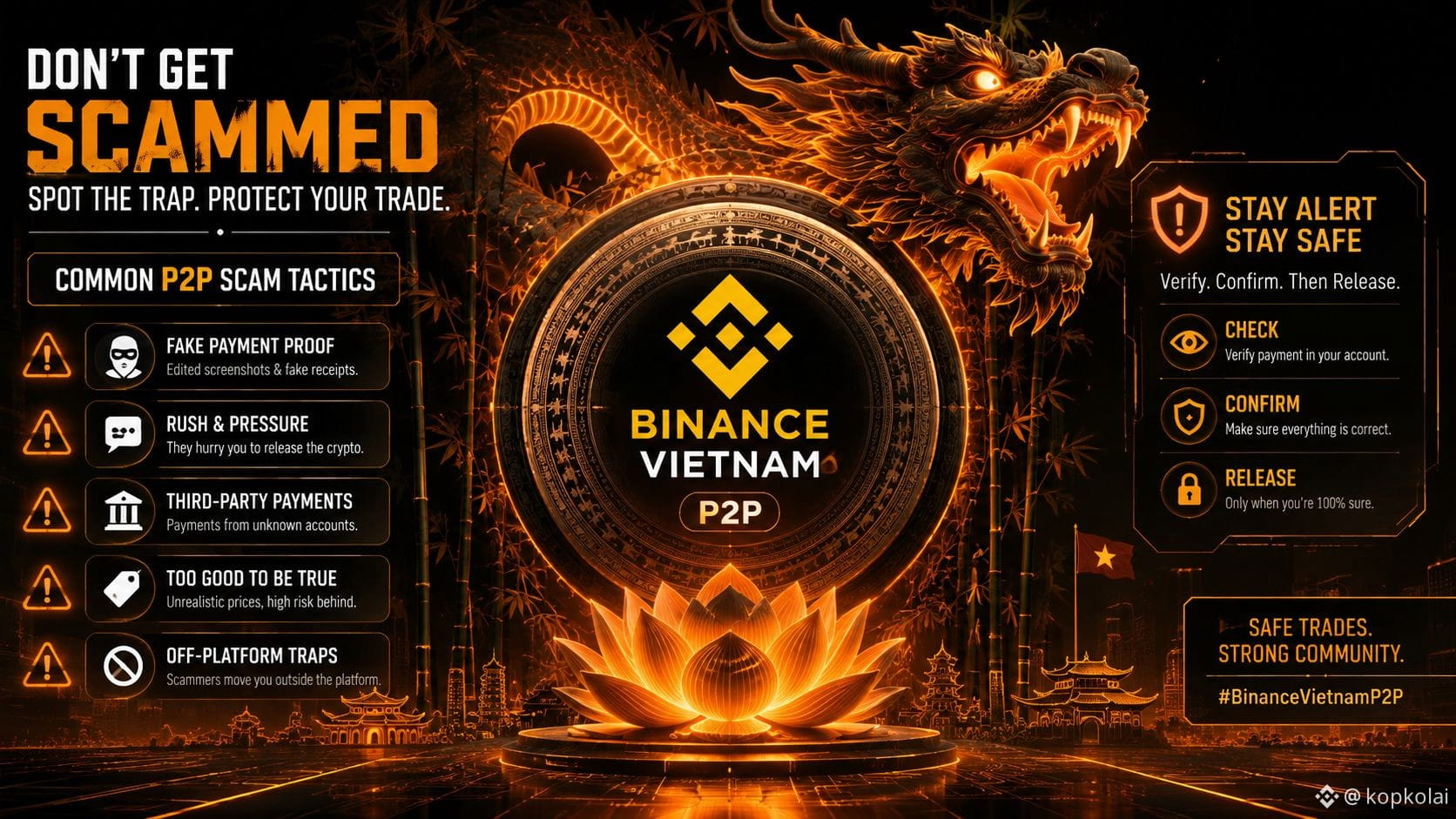
I realized quite late that in crypto, scams usually don’t start with something overly suspicious. They start with something very ordinary: an urgent message, a buyer who appears reputable, a screenshot of a transaction, or a reminder like “just confirm and it’s done.”
The core issue doesn’t seem to be that users lack vigilance. They’re being placed in situations that force them to check things in a hurry. The criminals don’t necessarily need to break the system—they only need to make themselves skip a step.
It seems that current systems have added quite a few layers of protection, but humans are still the final link. That’s the part I keep coming back to.
Common tactics revolve around impersonation, time pressure, fake evidence, and psychological manipulation. It’s not that X is safe, but rather Y: information must be verified independently.
Some projects also seem to be trying to solve the trust problem by reducing reliance on the other party’s word. But in the end, everything still has to be verified through real usage.
At least from how I see it, this is the part I’m still keeping an eye on.
I realized quite late that in crypto, scams usually don’t start with something overly suspicious. They start with something very ordinary: an urgent message, a buyer who appears reputable, a screenshot of a transaction, or a reminder like “just confirm and it’s done.”
The core issue doesn’t seem to be that users lack vigilance. They’re being placed in situations that force them to check things in a hurry. The criminals don’t necessarily need to break the system—they only need to make themselves skip a step.
It seems that current systems have added quite a few layers of protection, but humans are still the final link. That’s the part I keep coming back to.
Common tactics revolve around impersonation, time pressure, fake evidence, and psychological manipulation. It’s not that X is safe, but rather Y: information must be verified independently.
Some projects also seem to be trying to solve the trust problem by reducing reliance on the other party’s word. But in the end, everything still has to be verified through real usage.
At least from how I see it, this is the part I’m still keeping an eye on.