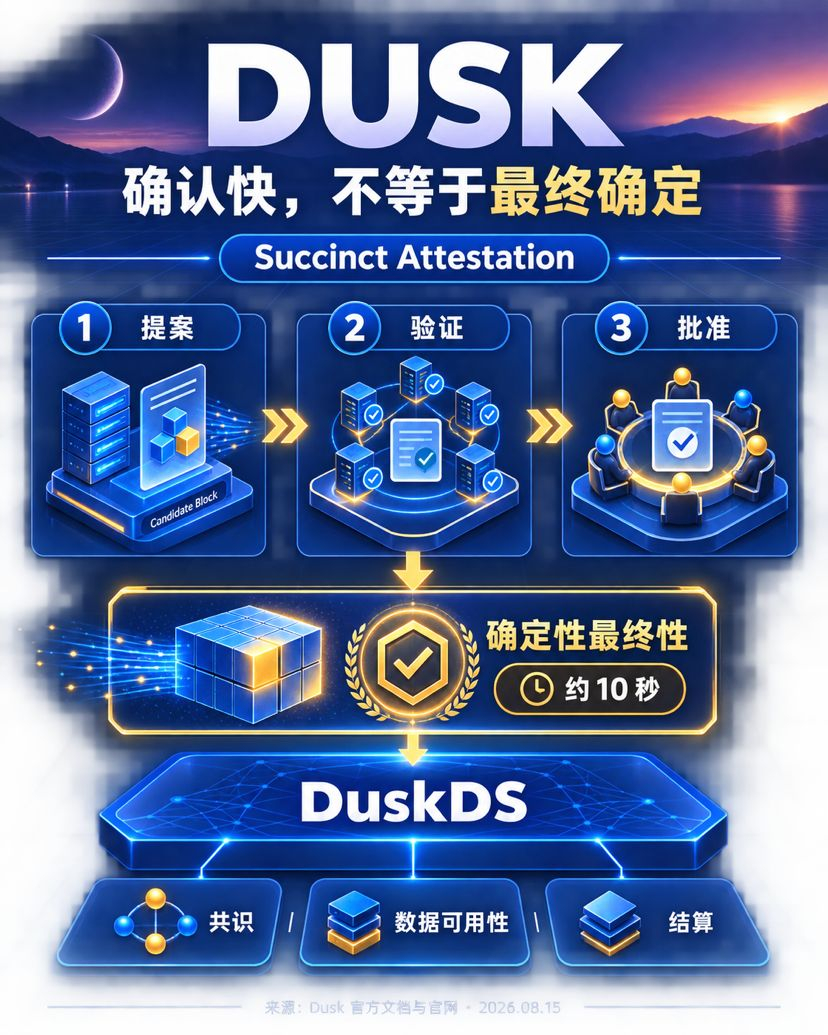
Block confirmations aren’t unusual—what’s truly scarce is that you won’t regret it after confirmation.
When I used to look at public chain performance, I focused only on TPS. Later I realized that securities settlement fears another thing more: transactions can show as successful, but the ledger can still be rolled back. Dusk hands this problem to Succinct Attestation, or SA consensus.
SA isn’t decided by a single validator. Instead, a provisioner is randomly selected to produce the proposal, then a committee verifies it. A separate committee approves and finalizes the block. After the block is finalized, it gains deterministic finality. On Dusk’s official website, the finality time is currently about 10 seconds. It’s more like stamping an irrevocable seal on a delivery order—not that the screen turns green first, while the backend still keeps room to change its mind.
For tokenized securities, value isn’t just measured in seconds. It’s that the asset leg and the funds leg can coordinate in a deterministic state, reducing reconciliation and settlement risks caused by chain reorganizations. DuskDS simultaneously handles consensus, data availability, and settlement, so SA’s finality directly serves financial market workflows.
That said, I won’t equate deterministic finality with institutional adoption. Node distribution, software security, network stability, and real-world load still need long-term validation. SA answers whether the outcome can be trusted; Dusk still needs ongoing transactions and settlement to answer whether the market is willing to use it.
@Dusk
#dusk $DUSK