

Some people bought the dip after Giga-Micro 2327 went down the other day.
Continuing to update MLCC today.
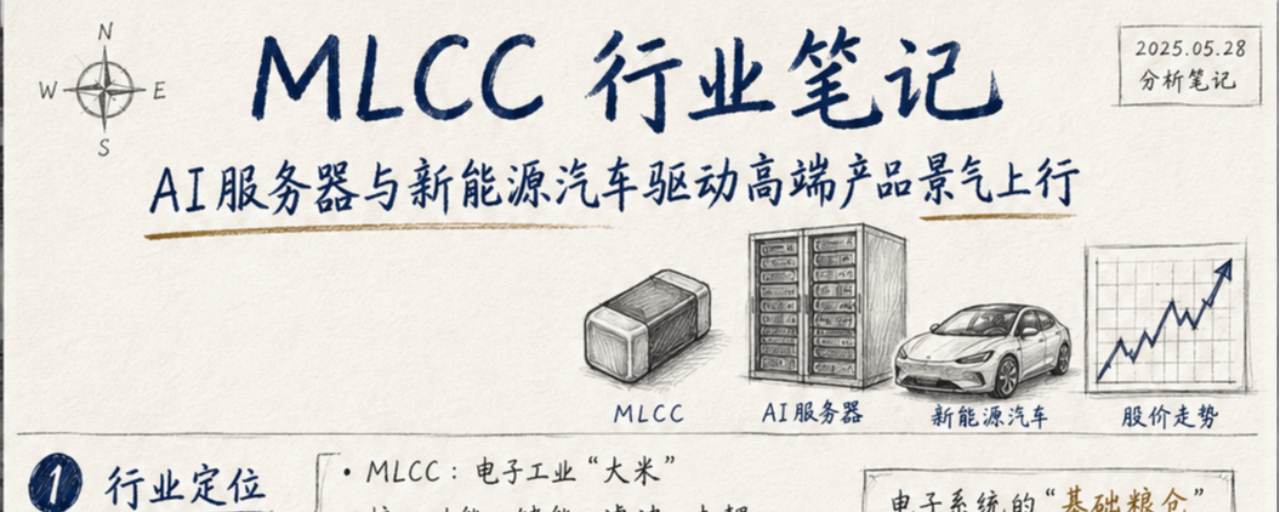
MLCC (multilayer ceramic capacitors) are widely used for energy storage, filtering, and decoupling, and are among the most widely used basic passive components in electronic devices. The global market has a relatively high concentration. Murata, Samsung Electro-Mechanics, Taiyo Yuden, Giga-Micro, TDK, Kyocera, and other manufacturers hold major shares, and high-end products have long been dominated by Japanese and Korean companies.
In the past, MLCC demand largely followed the cyclical fluctuations of consumer electronics such as smartphones and PCs. Over the past two years, AI servers and new energy vehicles have begun to become important sources of incremental demand. As AI servers’ power consumption, GPU density, and power-supply complexity continue to rise, demand for high-capacitance, miniaturized, and high-reliability MLCCs has clearly increased. The widespread adoption of new energy vehicles, ADAS, and domain controllers has also continued to drive higher MLCC usage per vehicle.
Since 2026, the improvement in industry prosperity has become even more apparent. Some South Korean and Japanese manufacturers’ high-end production lines maintain utilization rates above 90%, the order-to-shipment ratio (BB Ratio) remains at high levels, some specifications see extended lead times, and pricing for high-end products has started to rise. Meanwhile, the mid-to-low-end market still has relatively sufficient capacity expansion ability. High-capacitance, automotive-grade, and server-grade products are constrained by material supply, equipment, processes, and yields, so the release of new effective capacity is slower.
U.S.-listed stocks related.
In the U.S. market, there are relatively few pure-play MLCC stocks. Currently, exposure to the industry is mainly obtained through passive component manufacturers or Japanese-style ADRs.
Vishay Intertechnology (VSH) covers ceramic capacitors, tantalum capacitors, resistors, inductors, and discrete devices. Its customers are distributed across industrial, automotive, power, and electronic equipment fields, making it highly sensitive to the prosperity cycle of passive components.
Knowles (KN) is more focused on high-reliability specialty capacitors and RF components. Its end markets are concentrated in medical, defense, industrial, and precision electronics, with higher product added value; therefore, its correlation with the cycle of ordinary consumer-grade MLCCs is relatively lower.
If you want to increase your exposure to the MLCC industry itself, you can consider Japanese manufacturer ADRs. Murata (MRAAY) is the global MLCC leader; Taiyo Yuden (TYOYY) has higher business sensitivity; TDK (TTDKY) also has a significant passive-components business, but its overall product mix is more diversified.
Because previously representative targets such as KEMET and AVX have already been acquired, the U.S. market currently lacks highly pure-play, listed MLCC companies. Therefore, when researching industry prosperity, data from Japanese and other Asian original equipment manufacturers still has more reference value.
Why this upcycle may last longer
The improvement in MLCC conditions this round is mainly driven by changes in demand structure.
AI servers’ requirements for MLCCs are reflected not only in the increase in quantity, but also in upgrades to capacitance value, size, voltage rating, reliability, and electrical performance. As GPU power consumption rises, HBM increases, and server power-supply architectures become more complex, the per-unit value of high-end MLCCs continues to increase at the single-server level.
The pace of supply-side expansion is relatively limited. High-end MLCCs require ceramic powders with higher precision, thin-layering, and stacking processes, while also being constrained by equipment, certification cycles, and yield. Increasing general-purpose capacity does not automatically mean that effective capacity at the server-grade and automotive-grade levels increases in parallel.
Research by institutions such as Goldman Sachs, Morgan Stanley, and JPMorgan has also focused on this supply-demand structure: AI servers drive rapid growth in demand for high-end MLCCs, while expansion of effective supply lags significantly. As a result, the market has begun to raise expectations for the capacity utilization rates, product mix, and profitability of leading players such as Murata and Taiyo Yuden.
In the coming quarters, four indicators can be tracked in particular:
1. BB Ratio: whether order growth can continue to exceed shipment growth.
2. Utilization rate: whether high-end production lines can be maintained at 90% or above for the long term.
3. ASP: whether price increases can be gradually transmitted from channel spot inventories to long-term contracts.
4. Product mix: whether the share of AI server and automotive-grade high-end products continues to increase.
The MLCC industry is gradually shifting from the traditional cycle dominated by consumer electronics toward structural growth driven by AI servers, data centers, and automotive electronics.
The most elastic segments are currently concentrated in high-capacitance, high-reliability, and server-grade products. Expanding high-end capacity is difficult. Once demand continues to exceed effective supply, manufacturers have the opportunity to achieve shipment growth, ASP increases, and improvements in product mix simultaneously.
U.S. investors can gain exposure to the passive components sector through VSH and KN, or participate in the upcycle of Asian leaders through ADRs such as MRAAY, TYOYY, and TTDKY. However, factors like OTC liquidity, exchange-rate effects, and differences in overseas market valuations should be considered.
For subsequent judgments of industry prosperity strength, focus on monitoring high-end production line utilization rates, BB Ratio, contract prices, and the shipment cadence of AI servers. As long as the above indicators remain strong, there is a basis for the industry upcycle for high-end MLCCs to continue extending.