
Driven by foreign capital, South Korea’s composite stock price index (KOSPI) rebounded quickly to enter a “technical bull market” just over ten days after suffering a historic plunge in July. As of the close on August 13, the KOSPI rose 3.56% to 6,813.34 points, up nearly 20% from the July 30 low. Samsung Electronics and SK Hynix closed up 4.89% and 5.92%, respectively. In the early trading of August 14, Korean shares continued to rise, and the KOSPI briefly broke above 7,000 points.
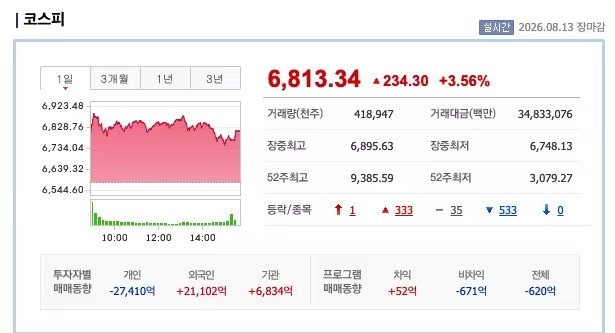
Although the index has returned above 6,800 points, the market remains cautious. Unlike the earlier scene of confidence and cheer, stock communities are now full of self-deprecating jokes: “If you go in again and get robbed, please take an intelligence test.” Someone also commented, “Struggling at 7,000 points, then going down,” adding, “I’m tired of this kind of volatility.”
After a roller-coaster of sharp surges and plunges, retail investors’ confidence—once the main force behind trading volume in Korean stocks—suffered a severe blow.
“I can’t focus on work right now. I’m most afraid that once I open my securities account, I’ll see nothing but a full screen of blue.” Pool Jae-yeon (a pseudonym), a post-90s who works in the financial circle on Yeouido, told The Age of Finance that after the market crash, the subway was unusually quiet. Even the voices discussing stocks in restaurants and coffee shops had noticeably died down. “To be frank, it wasn’t an exaggeration that on eight out of ten tables, people were talking about the stock market.”
And now, in many smoking areas, young people in suits just sit there smoking, looking utterly lost.
“Everyone acts like they’re gods of short-term trading.”
Looking back at the first half of this year, Korean stocks surged all the way. During intraday trading on June 19, the KOSPI Index rose to 9,385.59 points, setting a new all-time record. Total market capitalization once exceeded $5 trillion, surpassing India’s market and jumping to become the sixth-largest stock market in the world.
The logic is also simple and powerful: the AI wave drives a huge surge in demand for computing power. HBM (high-bandwidth memory) is the core bottleneck. Globally, only three companies can mass-produce it, and South Korea has two of them: Samsung Electronics and SK Hynix.
The “making money” effect ignited a nationwide craze for stock trading in South Korea. According to data from the Korea Financial Investment Association, as of June 24, the number of active stock trading accounts at South Korean securities firms surged to 108.77 million. With South Korea’s total population of about 51 million, that works out to roughly two stock accounts per person on average. Stocks became another “wallet” for many Korean households.
The number of accounts opened by minors has also risen significantly. At some companies’ general shareholders’ meetings in South Korea, you can even see the presence of elementary school students. Just one stock—Samsung Electronics—has more than 300,000 “small shareholders” under the age of 20.
However, the situation turned abruptly in July. The KOSPI Index fell 22.19% in a single month. The market entered a “technical bear market?” Meanwhile, ??? Samsung Electronics and SK Hynix each dropped 21.41% and 35.17% in July, respectively.
Jae-yeon Ji recalled to The Age of Finance that not long ago, there were “legends of stock gods” everywhere, and on SNS everyone acted like gods of short-term trading. In group chats, almost every day someone would share records of profits from stock investing. He had a friend facing the risk of forced liquidation and couldn’t bear the thought of contacting them proactively. There were many colleagues losing money at the company; friends who used to talk endlessly in the groups every day now have nothing to say.
“I feel like there are a lot of people losing money. Even though Korean stocks have been up for a long time, retail investors easily chase after highs, and those who use leverage aggressively just go to zero—especially among so many beginners who just entered this bull market.” He added that the FOMO (fear of missing out) mood in society had already formed at the time. Not buying stocks was considered a shame, called a “thunderous poor person.” He also said that at banks he had seen some elderly people take money out of their accounts, planning to put it into the stock market.
Investors’ deposits fall below 100 trillion won
The once nationwide stock-trading frenzy gradually cooled. Trapped retail investors can only slowly digest the losses left by this “roller-coaster” market amid volatility.
According to data released on August 13 by the Korea Financial Investment Association, as of August 11, investors’ deposits had fallen to 97.92 trillion won, the lowest level in nearly six months. That was down by about 3 trillion won from the previous day, and down nearly 30% from the peak in June, reflecting that investors’ expectations for the market have already been lowered.
Investor deposits refer to funds that investors keep in their securities accounts for trading stocks or other financial products. Since such funds may be used in the future to buy stocks, the scale of deposits is often used as an important indicator for measuring the stock market’s potential purchasing power. Higher deposit levels mean there is a large amount of money waiting to flow into the stock market.
Market analysts point out that retail investors were the main driving force behind the KOSPI Index breaking above the 9,000-point mark in the first half of this year. Therefore, the recovery of retail investors’ sentiment will be a key factor for the future rebound in Korean stocks.
“I’ve been dealing with insomnia. My principal is already down. Last month, Hynix’s stock fell to around 1.2 million won per share at its lowest. With my cost of 1.5 million won per share, I already cut my position. Even if it keeps making new highs, it won’t help. The volatility is even bigger than BTC (Bitcoin). Not many people can really hold on to the end.” A PhD-student named Sammy (a pseudonym) told The Age of Finance that he earns a salary of 2.3 million won a month from working at school, but he faces heavy living pressure, a fast work pace, and high living costs. His monthly basic expenses are roughly 600,000 to 1,000,000 won, including rent, utilities, food and dining, and transportation.
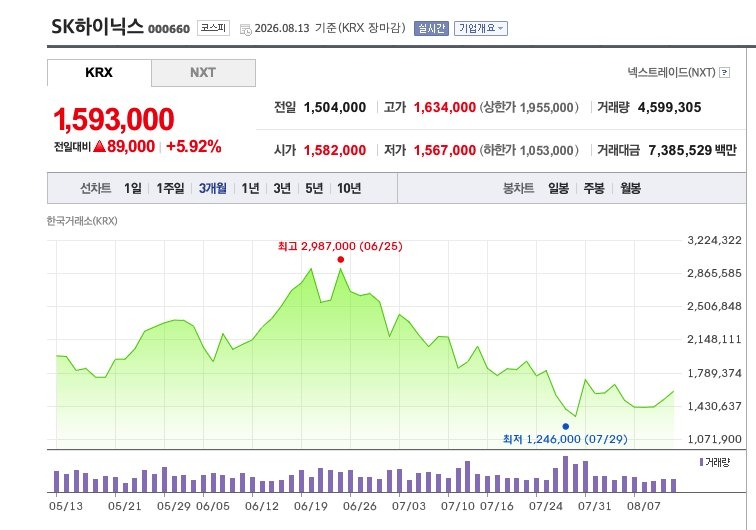
As of the close on August 13, SK Hynix rebounded to 1.593 million won per share. That is 46.67% below the phase high of 2.987 million won per share set during intraday trading on June 25.
Market chatter: is this rebound or a reversal?
This stock-market crash in the summer of 2026 was caused by multiple factors, including ??? Samsung Electronics and SK Hynix carrying too much weight in the index, continued capital outflows by foreign investors, and rate hikes by the central bank. And leveraged funds were widely seen as the main culprit: a mechanical stampede under leveraged ETFs, creating a deadly downward spiral of “falling prices and forced liquidations.”
Many retail investors piled on leverage in the frenzy of the bull market, only to end up with nothing after a brutal plunge and circuit breaker halts, even running up large debts.
According to official statistics from South Korea, as of July 13, the cumulative size of forced liquidations in July reached 344.2 billion won (about RMB 1.57 billion). More than 1.2 million leveraged retail investor accounts had touched the margin call line. Of those, about 320,000 to 360,000 accounts were forced into full liquidation by securities firms, wiping out their principal entirely. In some accounts, debts to the securities firm even appeared.
In Sammy’s view, it’s extremely difficult for young people in South Korea to buy homes. Even local new builds cost between 300 million and 500 million won. Most people rent small units long term, so using stock leverage to gamble is also a helpless choice. “It’s not only young people who trade stocks—elderly people and even children participate too. You can often hear elderly aunties on the street talking about Samsung Electronics and Hynix. A lot of people I know around me have made money through stock investing, but plenty of them have also lost money. There are neighbors who are out of their retirement savings, and my family has been arguing nonstop lately.”
Under the twin pressures of leveraged funds fading away and retail investors withdrawing, whether the Korean stock market’s “technical bull market” is a rebound or a reversal has sparked heated debate in the market.
Fundstrat Global Advisors’ head of technical strategy said that with the strong return of Korea’s weighted memory-chip manufacturers, there is further room for a rebound in the Korean stock market. With gains in Samsung Electronics and SK Hynix, iShares MSCI Korea ETF has broken through key technical levels, improving the Korean market’s short-term outlook.
In the view of Korea Investment & Securities, the KOSPI Index needs more momentum to break through the previous high. Before the pullback, the stock prices already reflected many expectations. To break the previous high, there must be positive news that goes beyond the existing catalysts, or further upward revisions to earnings expectations.