

“$5 billion on-chain—where did the profits go?”
Securitize $SECZ.US As the first publicly listed company dedicated specifically to tokenization business in the crypto industry, it disclosed early this morning its first quarterly financial report after going public.
According to the financial report data, the on-chain asset volume issued through its platform has already nearly reached $5 billion, but quarterly revenue fell from $19.48 million in Q1 to $14.44 million, a quarter-over-quarter decline of about 26%. In Q2, the company’s adjusted EBITDA (earnings before interest, taxes, depreciation, and amortization) also swung from a profit of $830,000 to a loss of $5.46 million.
Adjusted EBITDA—one simple way to understand it—is: after temporarily excluding interest, taxes, depreciation, amortization, and some one-off expenses, roughly how much money the company’s core business made.
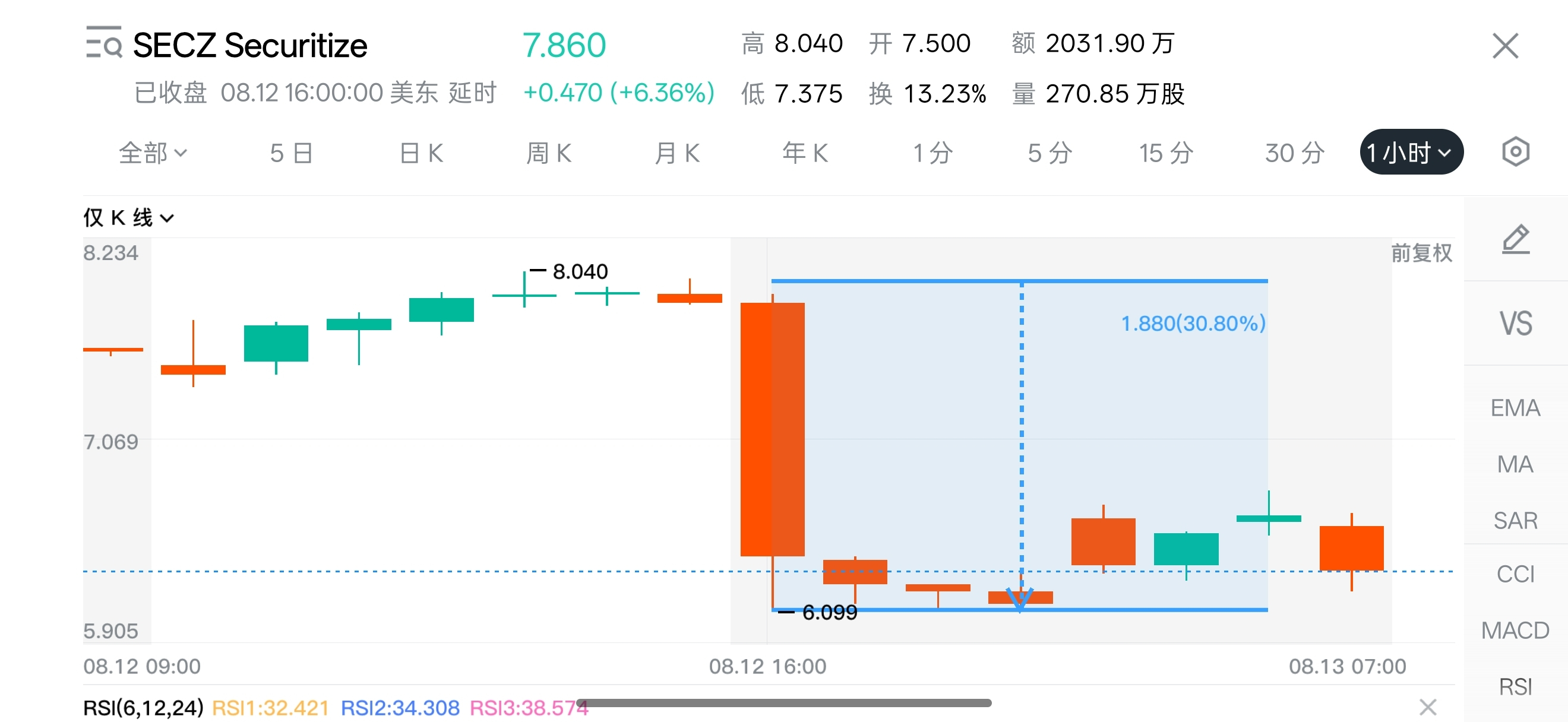
After the earnings report was released, the Securitize stock price fell by nearly 30% in after-hours trading.
In the past few years, Securitize has practically been dealt the most ideal hand in the RWA industry: institutional resources that are second to none in richness. In terms of industry standing, Securitize is an undisputed top-tier player in the RWA segment.
It is the tokenization services provider for BlackRock’s tokenized money market fund BUIDL, and it also collaborates with asset management institutions such as Apollo, KKR, Hamilton Lane, and VanEck;
In the United States, it holds licenses or has business capabilities including broker-dealer, alternative trading system, transfer agent, investment adviser, and fund administration;
Before and after going public, it also established partnerships with NYSE, Computershare, Continental, Cantor Fitzgerald, Jump Trading, and Jupiter in sequence.
I just wrote about Circle’s business model a few days ago, but based on this time’s conflict between Securitize’s earnings report data and my understanding, Securitize’s model is far less like Circle’s.
But in some aspects, its logic is similar to Circle’s: putting assets on-chain does not mean that the platform responsible for putting them on-chain can receive income proportionally. Growth in RWA scale also will not naturally convert into platform profits.
Before diving into the earnings report, I first need to explain Securitize to everyone. Although I call it a top player in RWA, I believe that whether you understand Web3 or don’t, this platform is likely somewhat unfamiliar to you.
1. What exactly does Securitize do?
What this company is doing can be understood as helping institutions move their off-chain tangible assets onto the chain. It is somewhat similar to serving as a role that “underwrites and issues.” This is not as simple as institutions coming to Securitize to ask to put their assets on-chain, transferring the assets to Securitize’s account, and then Securitize just issues tokens for that asset on-chain.
Behind it is a whole series of supporting issues, such as: does this asset restrict regions; what is the subscription and redemption mechanism; how do compliance transfers work across different chains and different addresses; how do on-chain records correspond to off-chain rights; and a whole range of other questions.
What Securitize does is these supporting service functions.
It has capabilities spanning a range of businesses under its umbrella, including broker-dealer, alternative trading system, transfer agent, and fund administration. Therefore, it can cover most of the lifecycle of a tokenized security (or other asset), from issuance, investor onboarding, and transfer registration to trading and asset services.
And it is precisely for this reason that over the past few years, Securitize has secured one of the best batches of customers in the RWA industry. In terms of institutional resources, license portfolio, and asset scale, there is no doubt that it is a top-tier player in the first echelon.
Currently, the assets it has issued on-chain include:
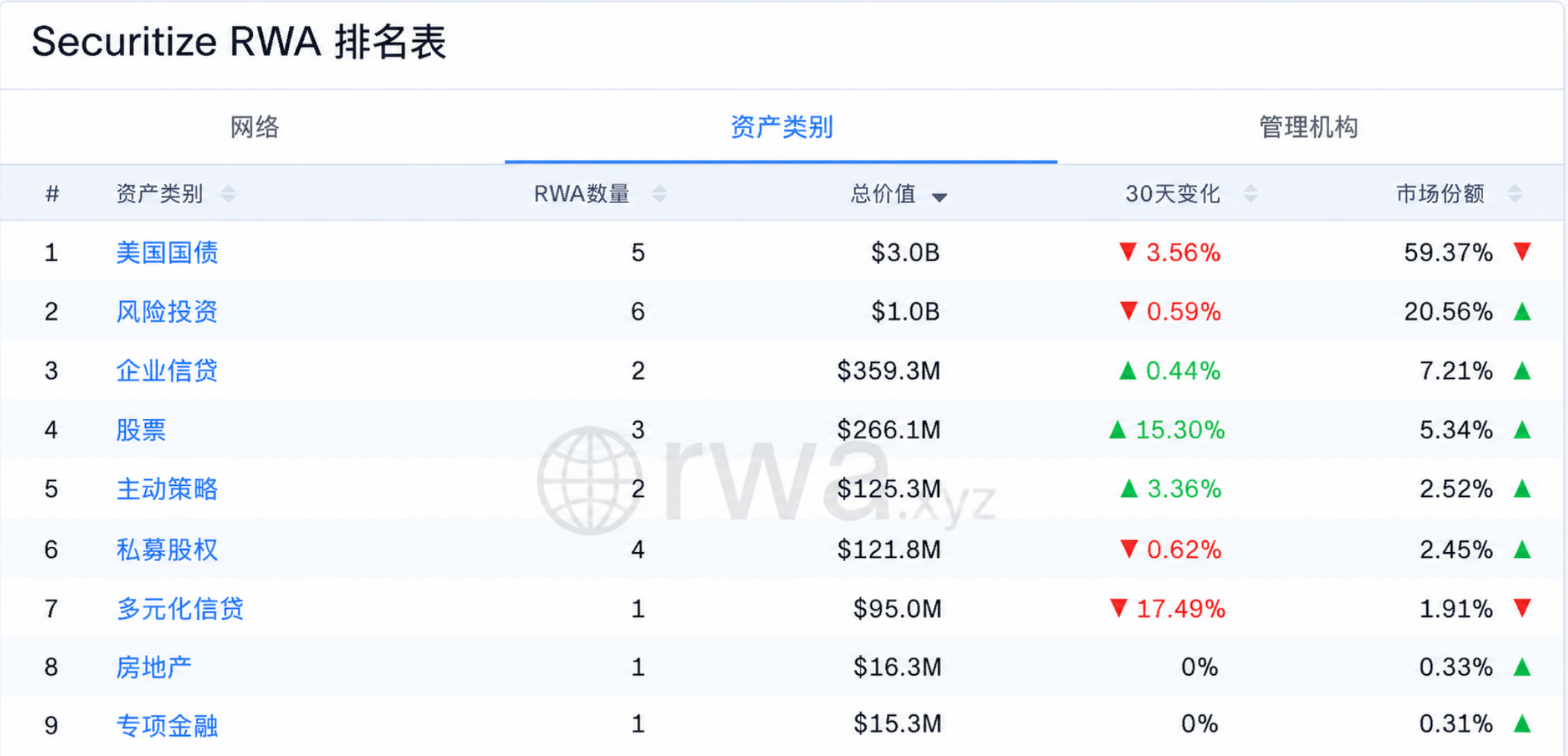
The more the fundamentals seem fine, the more this earnings report data tells us there is a problem—because: if even it cannot reliably make money while RWA scale grows, then as a top player in RWA, this is not just a Securitize problem; it means the issue is facing other companies/protocols in RWA that run similar businesses.
2. Back to the earnings report
Securitize’s core data for Q2 are as follows:
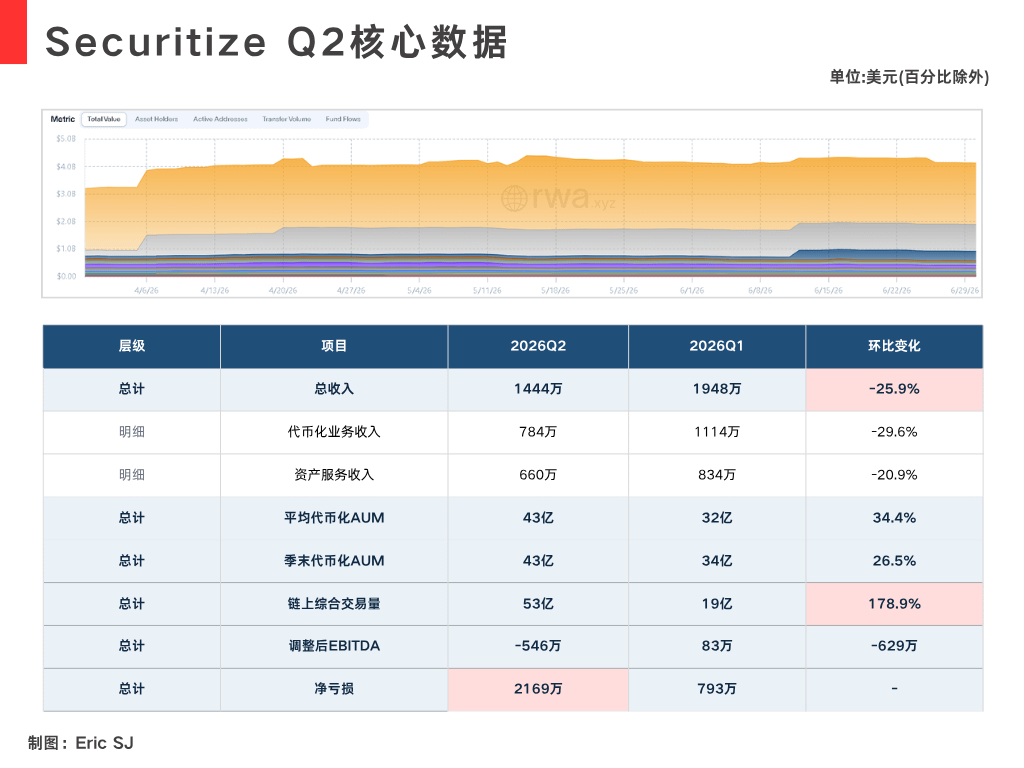
The tokenized on-chain size disclosed in the report at the end of Q2 was $4.3 billion. From Q1 to Q2, on-chain size grew by about 26.5%. If you compare average quarterly on-chain asset size, growth was about 34.4%;
Average scale growth was 34%, total trading volume growth was 179%, yet revenue fell by about 26%. This is the biggest contradiction in this earnings report.
And the answer to this contradiction lies in its business model. As Securitize itself discloses, its main revenue sources include: one-time blockchain integration fees, maintenance fees during the contract term, and service fees related to AUM......
There are seven or eight items to list—so I won’t go into all of them here. The conclusion is: the money Securitize receives comes from tokenization, transfer agency, system maintenance, distribution, or trading service revenue.
It is not the actual manager of these assets. Securitize can benefit from some fees related to the asset size and on-chain activity, but it does not have a unified, stable management fee rate. What kind of new asset is added, how the contract charges fees, and whether it generates subscription/redemption and trading activity will all affect revenue—so scale and revenue are not linearly related.
If we compare it to the circle example I mentioned earlier, everyone knows that Circle is in the reserve yield business.
For example, if you manage $10 billion in assets and the fee rate is 0.5%, then theoretically you could earn $50 million in management fees per year. As long as the asset scale grows, revenue usually grows as well.
But with Securitize, what it actually does is essentially the next step in Circle’s business. The money exists with someone else; it only helps “send” that asset onto the chain. Its management fees are not directly related to it.
As of August 13, the BUIDL asset size is approximately $2.7 billion, already more than half of Securitize’s current $5 billion tokenized total assets under management. However, BUIDL’s publicly disclosed management fee rate is 0.20% to 0.50%, and those fees are not entirely paid to Securitize as platform fees.
So Securitize is not an asset-management stock that can simply be modeled as “AUM × management fee rate.” Ultimately how much it can earn depends on what assets are added, how the contracts charge fees, how frequently this asset is traded, and how many parts of the value chain Securitize performs within this product.
If the newly added on-chain scale only comes from a single large money market fund with a low fee rate, it may bring Securitize a huge asset base, but it would only contribute relatively limited maintenance fees.
This also explains why one side—the scale—can grow significantly, while revenue may decline.
3. This earnings report also challenges Securitize’s growth expectations before listing
In its materials for the IPO, Securitize had projected that by 2026 the average tokenized on-chain size would reach $9 billion, full-year revenue would be $110 million, and EBITDA would reach $32 million.
But in the first half of this year, Securitize’s actual revenue was only $33.91 million; adjusted EBITDA loss was $4.63 million. If the company still needs to achieve full-year revenue of $110 million, then in the second half it must generate about $76.09 million in revenue.
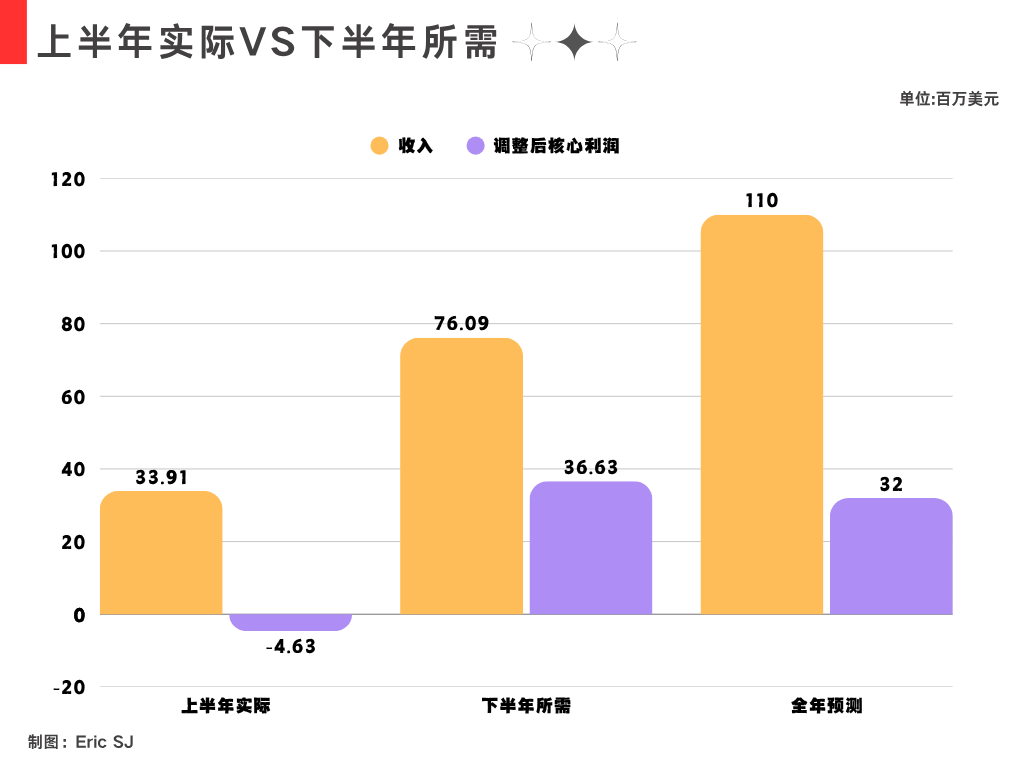
Average revenue needs to be created of about $38.05 million per quarter, while Securitize’s second-quarter revenue was only $14.44 million.
In other words, in the second half of the year, the average revenue per quarter would need to reach about 2.6 times that of the second quarter.
The difficulty for EBITDA is even higher. In the first half, it already had a loss of $4.63 million. If it still needs to achieve full-year EBITDA of $32 million, then in the second half it would need to contribute about $36.63 million. That implies average quarterly profitability of roughly $18.3 million.
In my view, if it can maintain linear growth, that’s already pretty good. To suddenly achieve leapfrogging growth, it would be difficult to infer what else could drive Securitize to such a step-change—unless the on-chain securities business really explodes and, starting from this quarter, gets incorporated into Securitize’s business structure.
So the after-hours stock drop of about 21% may not be solely because Q2 revenue missed expectations. Rather, the market, based on Q2 performance, judged that the probability of achieving the 2026 forecast in the IPO materials was too low. Unless, in the second half, the on-chain securities business gets implemented, large projects are confirmed in a concentrated way, or there is another step-change in revenue, relying only on existing business lines’ linear growth will not be enough.
So:
4. Is today’s Securitize worth buying?
Based on the current market cap of about $1 billion, after listing Securitize will have around $350 million in cash, with no debt. The enterprise value after deducting cash is roughly $650 million to $700 million.
If you project full-year revenue based on quarterly revenue, the valuation is currently around just above 10x, not particularly expensive.
But judging only from the current industry position and business structure overall, it is indeed hard to see a clear high-growth catalyst. It is not a multi-sexy type of company.
Given the actions in the industry, I believe the real high-growth potential lies in expanding the on-chain securities (stocks) business—essentially doing “an on-chain broker” for the industry’s progress. Only after assets are on-chain is it more likely to generate sustainable cash flow. From the demand perspective, the demand for on-chain securities has already been initially validated in the crypto industry.
This high-growth direction can be seen, but the兑现度 (deliverability) is not yet visible. Before then, we can’t judge—like how I wrote about Cloudflare—based on the narrative that “the business/company is very sexy” before the specifics are actually implemented, because the original business DNA can’t support it.
Putting securities (stocks) on-chain will at least require another two quarters to validate the likelihood of realizing the potential and the possible scale. Currently, Securitize indeed has strong institutional resources—an advantage that is undeniable. But based on the current competitive landscape, its progress in this area is clearly behind other participants in the crypto industry.