

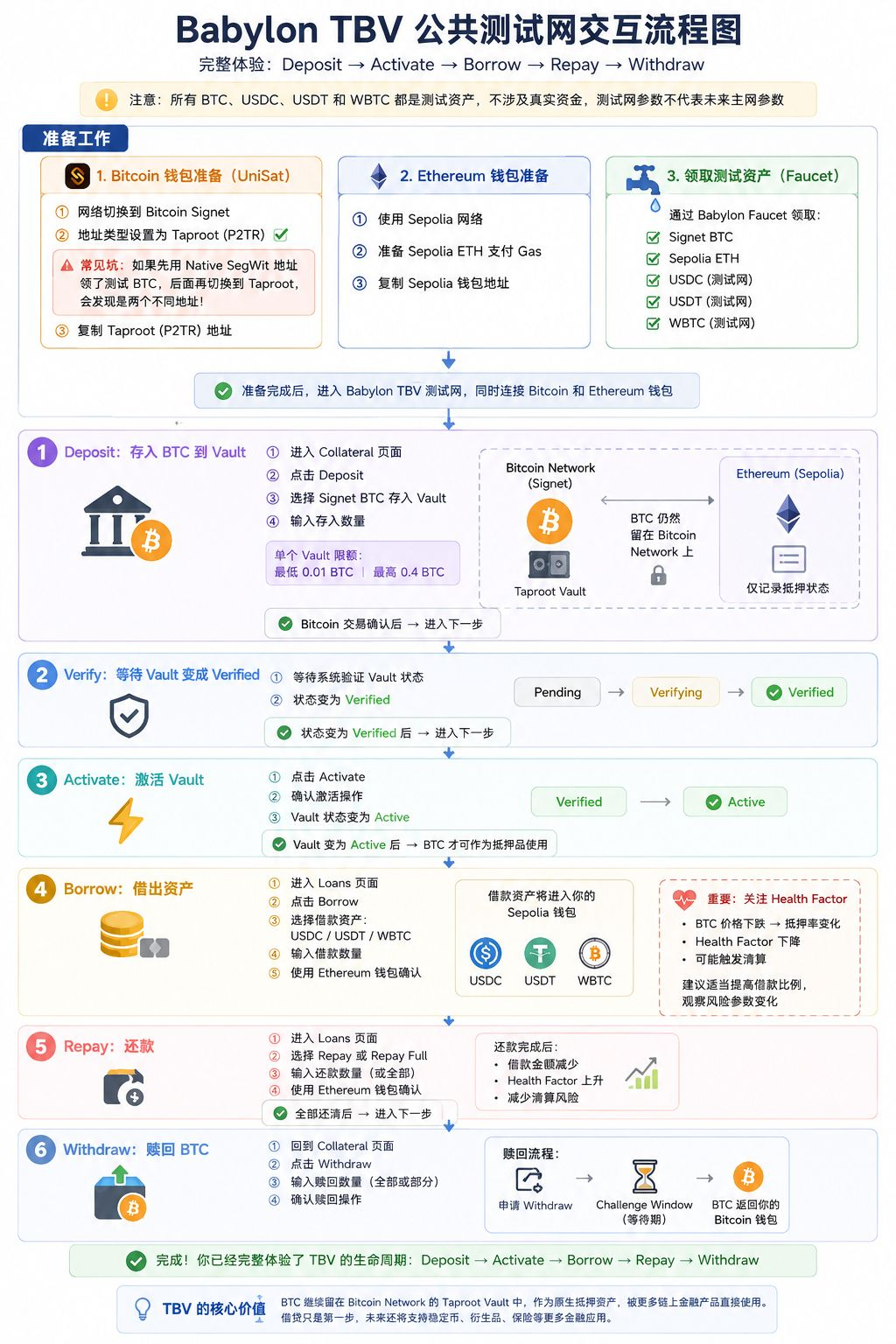
Recently, Babylon opened the public testnet for Trustless Bitcoin Vaults (TBV). I also ran through the entire process end to end myself.
To start with the conclusion, the most core thing about TBV is actually very easy to understand.
In the past, if BTC wanted to enter DeFi, most of the time it had to be converted first into a mapped asset like WBTC, or it had to go through a cross-chain bridge or a custodian. What TBV wants to do is quite different—keep BTC on the Bitcoin Network, while directly becoming collateral that other on-chain applications can use.
The first real-world deployment scenario is Aave v4.
That means in the future, you can use native BTC as collateral directly, and then borrow assets like USDC and USDT on Ethereum.
Prepare two wallets before testing
On the Bitcoin side, you can use UniSat, and switch the network to Bitcoin Signet.
Here’s a very easy place to run into trouble: it’s best to set the address type to Taproot (P2TR) from the very beginning.
The Ethereum side uses Sepolia, and you should also prepare a bit of Sepolia ETH to pay for Gas.
Test BTC and other test assets can all be claimed directly from Babylon’s Faucet.
Why do I specifically emphasize Taproot?
Because if you initially receive the test BTC using a Native SegWit address, and later switch to Taproot, you’ll find that these two addresses are not actually the same address.
So the best approach is:
Set UniSat to Taproot first → then go to the Faucet to get the test BTC.
That way, you won’t have to redo everything later due to address issues.
Deposit: first, put BTC into the Vault
Once you’re ready, enter the testnet and connect both your Bitcoin and Ethereum wallets.
Then go to Collateral → Deposit and put the Signet BTC into the Vault.
Currently, on the testnet, a single Vault:
Minimum: 0.01 BTC
Maximum: 0.4 BTC
This is also where I think TBV differs the most from ordinary cross-chain solutions.
Your BTC is not transferred to Ethereum, and it is not minted into another token.
It stays inside the Taproot Vault on the Bitcoin Network.
On the Ethereum side, it only records the corresponding collateral status.
After the Bitcoin transaction is confirmed, you still can’t borrow right away—you need to wait for the Vault to become Verified.
Then click Activate.
After completing Activate, this portion of BTC can officially be used as collateral.
Borrow: use native BTC to borrow a stablecoin
Next, go to Loans → Borrow.
The testnet can currently borrow:
USDC
USDT
WBTC
At this point, the experience is already quite close to ordinary DeFi borrowing and lending.
Enter the amount you want to borrow, then confirm with your Ethereum wallet—the borrowed assets will go directly into your wallet.
But I think what’s truly worth testing here isn’t whether you can borrow it, but the Health Factor.
Because if in the future you really use BTC as collateral for borrowing, the most important risk is liquidation.
If the BTC price drops, the collateral ratio will change, and the Health Factor will continue to fall.
If it drops to a certain level, it may enter liquidation.
So even though everything is test assets right now, I still suggest increasing the borrowing ratio a bit and actually see how the Vault’s risk parameters change.
This part is actually more meaningful than simply storing BTC and borrowing a bit of USDC.
Repay & Withdraw: run through the full TBV lifecycle
Finally, there is repayment and redemption.
After entering Loans, you can choose partial Repay, or you can directly choose Repay Full.
After everything is fully repaid, return to Collateral to apply for Withdraw.
However, you need to note that the BTC redemption on the current testnet is not completed immediately; there is a Challenge Window in between.
So from:
Deposit → Activate → Borrow → Repay → Withdraw
After running through the entire process, you can actually experience the full lifecycle of TBV.
What I think is truly worth paying attention to with TBV
I think what TBV is really worth paying attention to is not just as simple as “you can borrow USDC with BTC.”
What Babylon wants to do is more like making native BTC itself into a collateral asset that can be directly used by more on-chain financial products.
If this architecture can run properly in the future, borrowing might just be the first step.
Later, including:
Stablecoins, derivatives, insurance, and various other on-chain financial products
It’s possible to keep integrating more.
This is also one of the biggest differences between TBV and the old DeFi logic of bringing BTC to other chains.
Previously it was more like:
BTC → Cross-chain / Custody → Mapped assets → DeFi
And what TBV wants to try is:
BTC is still BTC, but it can directly participate in more on-chain financial applications.
Of course, it’s still currently a Public Testnet.
Right now, the tested BTC, USDC, USDT, and WBTC are all test assets, not real funds. Also, testnet parameters do not represent the parameters of the future mainnet.
If everyone is interested in this direction, I still strongly recommend you run the entire process yourself.
Run it once end to end—from Deposit, Activate, Borrow, Repay to Withdraw—and you’ll understand what problem TBV is solving much more easily than just reading the introduction.