
(ASTER: The New Star of Multi-Chain DeFi's Deflationary Flywheel and Ecological Game)
In the fiercely competitive field of decentralized finance (DeFi), ASTER has become the focus of recent market attention thanks to its multi-chain trading ecosystem and unique deflationary destruction mechanism.
It is the native governance and utility token of the #AsterDEX platform, and Aster is a decentralized perpetual contract exchange (DEX) formed by the merger of Astherus and APX Finance at the end of 2024, whose core competitiveness includes both the technical architecture and a deflationary model driven by transaction fees.
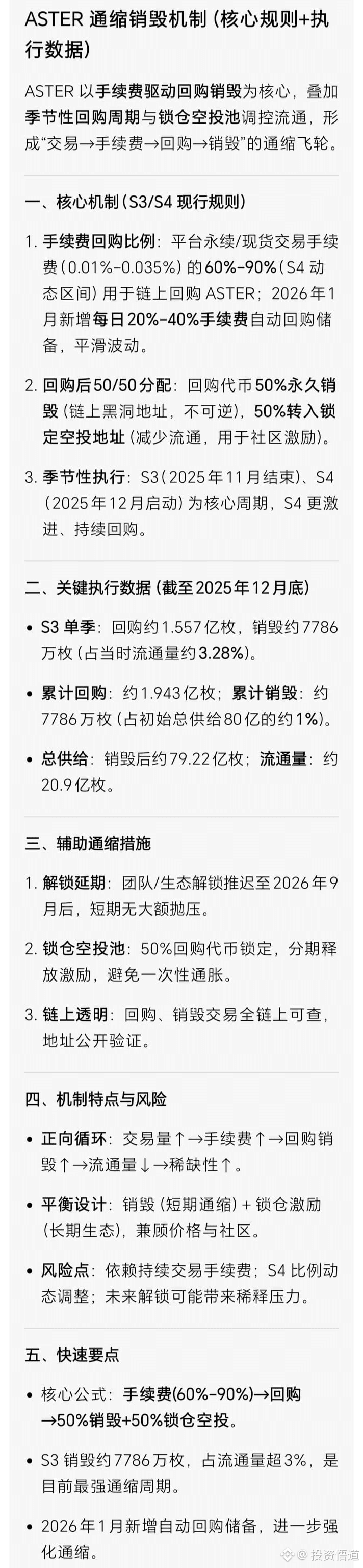
1. ASTER's Deflationary Destruction: The fee-driven 'Transaction → Buyback → Destruction' Flywheel
One of the value supports of $ASTER is its fee-centered deflationary mechanism (current S4 rules), which regulates circulation through dynamic repurchase and destruction, forming a positive cycle:
- Repurchase fee ratio: 60%-90% of the platform's perpetual/spot trading fees (0.01%-0.035%) are used for on-chain repurchase of ASTER.
In January 2026, a new daily 20%-40% fee auto-repurchase reserve will be added to smooth market fluctuations.
- Repurchase distribution rules: 50% of the repurchased tokens will be permanently destroyed (transferred to an on-chain black hole address, irreversible), and 50% will be transferred to a locked airdrop address (reducing circulation, used for community incentives).
- Seasonal execution cycle: S3 (ending in November 2025), S4 (starting in December 2025) are the core cycles, with S4 rules being more aggressive, continuously strengthening repurchase.
2. Execution data of the deflationary mechanism: Current effects and circulation patterns
As of the end of December 2025, the ASTER deflationary mechanism has been implemented and has had a real impact:
- S3 quarterly performance: Approximately 155.7 million tokens repurchased, about 77.86 million tokens destroyed (accounting for 3.28% of the circulation at that time), marking the strongest deflationary period to date.
- Cumulative data: Approximately 194.3 million tokens have been repurchased, and about 77.86 million tokens have been destroyed (accounting for 1% of the initial total supply of 8 billion);
After destruction, the total supply is approximately 7.922 billion tokens, and the current circulation is approximately 2.09 billion tokens.
- Supplementary deflationary measures: Team/ecological unlocking postponed to September 2026, no significant selling pressure in the short term;
50% of the repurchased tokens will be locked in the airdrop pool and released in phases to avoid one-time inflation; repurchase and destruction are fully transparent and traceable on-chain, enhancing market trust.
3. Technology and Ecology: Core competitiveness beyond deflation
In addition to the deflationary mechanism, the technology and ecological layout of the Aster platform are the underlying support for ASTER:
- Multi-chain and scalability: Supports mainstream chains such as BNB Chain, Ethereum, Solana, etc., using a customized ZK-Rollup solution to achieve minute-level finality and efficient fund inflow and outflow.
- Trading experience: Matching engine TPS exceeds 100,000 transactions per second, with latency below 10 milliseconds, providing CEX-level smoothness;
Shield Mode privacy mode hides user holdings through zero-knowledge proof, meeting institutional-level needs.
- Ecological data: As of January 2026, the platform's cumulative trading volume is $519 billion, with an open position of $255 million, and a total locked value of $437 million, supporting 101 trading targets with broad user coverage.
4. Opportunities and Risks: The duality of the deflationary flywheel
The deflationary mechanism and ecological layout of ASTER bring potential, but risks must also be acknowledged:
- Opportunities: Deflation creates a positive cycle of 'increased trading volume → increased fees → increased repurchase and destruction → decreased circulation → increased scarcity', combined with S4's aggressive rules and the newly added automatic repurchase reserve in 2026, the short-term deflationary effect is expected to strengthen; multi-chain layout and technological advantages support long-term ecological expansion.
- Risks: The degree of deflation heavily relies on continuous trading fees; if the platform's trading volume declines, the intensity of repurchase and destruction will weaken correspondingly.
The S4 fee ratio is a dynamic range; rule adjustments may affect market expectations; team/ecological unlocking after September 2026 may bring long-term dilution pressure.
5. Market performance and positioning
As of January 24, 2026, the current price of ASTER is $0.640872, with a 24-hour trading volume of $142.18 million and a total market capitalization of $1.57 billion (ranked 69th in cryptocurrency).
Its price reached a historical high of $2.41 in September 2025, but also fell to a low of $0.537.
Conclusion:
The core logic of ASTER is the combination of 'deflationary mechanism + multi-chain DeFi ecosystem': the deflationary flywheel boosts scarcity in the short term, while technology and ecology support value in the long term.
However, it should be clear that its deflationary effect relies on trading volume and the stability of rules, which depend on platform decisions, while the regulatory and competitive risks in the cryptocurrency market always exist.
For investors, ASTER is a representative case in the DeFi sector of 'mechanism innovation + ecological implementation', but participation requires a full assessment of one's risk tolerance and a rational view of the correlation between deflation and price.