
玖玖说Web3
617 Posts

玖玖说Web3
6年在圈子的经验,公众号:比特雷达。取每日CF资讯
8 Following
1.8K+ Followers
225 Liked
Posts
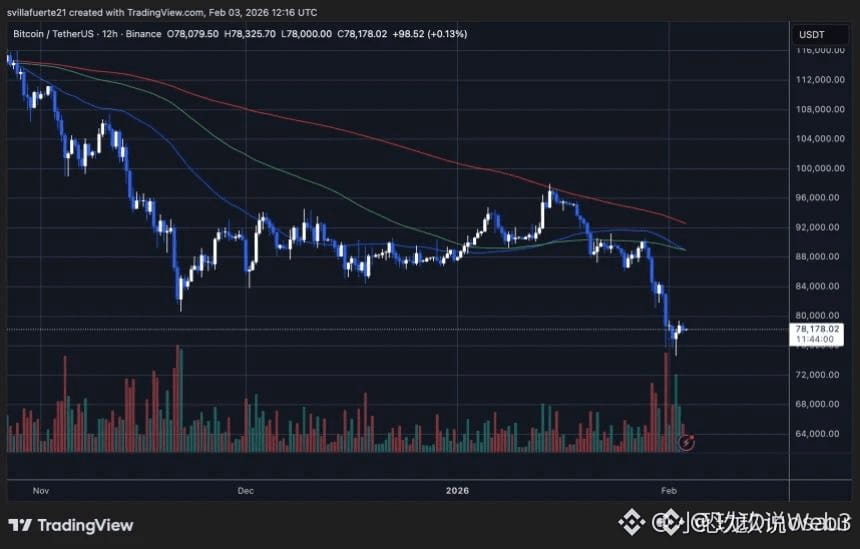
#比特币24小时跌3.4%至7.74万美元
BlackRock cuts the in-kind conversion threshold fee for IBIT by 96%—the “last mile” for institutions buying Bitcoin has been cleared
👉 贝莱德砍费,进群看
BlackRock slashed IBIT’s in-kind conversion threshold fee from $25 million to $1 million, a 96% reduction. Most people didn’t notice this news, but it may be one of the most underappreciated variables in this bull cycle.
The in-kind conversion threshold fee is one of the costs for institutions to exchange real money for BTC spot. Cutting the fee by 96% means smaller institutions and wealth management firms can configure Bitcoin via IBIT at low cost—not by buying ETF shares, but by directly swapping for BTC spot.
Think it through: Why is BlackRock cutting it now? Because it has seen demand. Large institutions are already in; now it’s about opening up the market for “mid-tier” institutions. When the world’s largest asset manager proactively lowers the allocation threshold, it suggests it’s bullish on BTC’s long-term demand—not just chasing management fees.
More importantly, ETF flows are often mentioned, but “in-kind conversion” is the real, money-on-the-table BTC buying. After the threshold is lowered, the amount of in-kind conversions could rise significantly—this is the actual bid.
Is BlackRock cutting the conversion fee a bull-market signal or just normal business practice? Let’s discuss in the comments 👇
Click the avatar to watch the live stream and join the Jiujiu chat group to get daily strategy 🚀
#比特币24小时跌3.4%至7.74万美元 #Bitcoin #BlackRock #IBIT #ETF
BlackRock cuts the in-kind conversion threshold fee for IBIT by 96%—the “last mile” for institutions buying Bitcoin has been cleared
👉 贝莱德砍费,进群看
BlackRock slashed IBIT’s in-kind conversion threshold fee from $25 million to $1 million, a 96% reduction. Most people didn’t notice this news, but it may be one of the most underappreciated variables in this bull cycle.
The in-kind conversion threshold fee is one of the costs for institutions to exchange real money for BTC spot. Cutting the fee by 96% means smaller institutions and wealth management firms can configure Bitcoin via IBIT at low cost—not by buying ETF shares, but by directly swapping for BTC spot.
Think it through: Why is BlackRock cutting it now? Because it has seen demand. Large institutions are already in; now it’s about opening up the market for “mid-tier” institutions. When the world’s largest asset manager proactively lowers the allocation threshold, it suggests it’s bullish on BTC’s long-term demand—not just chasing management fees.
More importantly, ETF flows are often mentioned, but “in-kind conversion” is the real, money-on-the-table BTC buying. After the threshold is lowered, the amount of in-kind conversions could rise significantly—this is the actual bid.
Is BlackRock cutting the conversion fee a bull-market signal or just normal business practice? Let’s discuss in the comments 👇
Click the avatar to watch the live stream and join the Jiujiu chat group to get daily strategy 🚀
#比特币24小时跌3.4%至7.74万美元 #Bitcoin #BlackRock #IBIT #ETF
BTC+0.81%
IBITETF-0.11%
#比特币受阻于81000美元50周均线
Large transfers of stablecoins into exchanges—are the stablecoins run by a political dynasty finally getting "serious"?
👉 USD1转币安,进群看
A stablecoin transfer worth $30 million was moved from a custody wallet to a major exchange. On-chain monitoring flagged the transfer immediately—but the real question is: why would the issuer’s stablecoin be sent to an exchange?
There are two possibilities: one is to start market-making/listing—meaning the stablecoin is being made officially liquid; the other is to swap assets, converting the stablecoin into BTC or something else. Either way, it shows that the stablecoin has moved from the "issuance" phase into the "use" phase.
Look at it the other way: when a family with deep political ties personally steps into stablecoins, it’s itself a huge signal—regulators’ attitude toward stablecoins can only become increasingly "friendly." That’s a long-term positive for the entire stablecoin sector.
But don’t get too excited in the short term: $30 million is small compared with the stablecoin market, and sending it to an exchange might just be testing liquidity. The real signal is whether there are ongoing large transfers afterward—if there are, then it’s truly getting "serious."
Stablecoins are getting serious now—what do you think? Let’s talk in the comments below 👇
Click the avatar to watch the live broadcast, and join the Jiujiu chat group to get daily strategies 🚀
#比特币受阻于81000美元50周均线 #stablecoin #institutions #crypto market #regulation
Large transfers of stablecoins into exchanges—are the stablecoins run by a political dynasty finally getting "serious"?
👉 USD1转币安,进群看
A stablecoin transfer worth $30 million was moved from a custody wallet to a major exchange. On-chain monitoring flagged the transfer immediately—but the real question is: why would the issuer’s stablecoin be sent to an exchange?
There are two possibilities: one is to start market-making/listing—meaning the stablecoin is being made officially liquid; the other is to swap assets, converting the stablecoin into BTC or something else. Either way, it shows that the stablecoin has moved from the "issuance" phase into the "use" phase.
Look at it the other way: when a family with deep political ties personally steps into stablecoins, it’s itself a huge signal—regulators’ attitude toward stablecoins can only become increasingly "friendly." That’s a long-term positive for the entire stablecoin sector.
But don’t get too excited in the short term: $30 million is small compared with the stablecoin market, and sending it to an exchange might just be testing liquidity. The real signal is whether there are ongoing large transfers afterward—if there are, then it’s truly getting "serious."
Stablecoins are getting serious now—what do you think? Let’s talk in the comments below 👇
Click the avatar to watch the live broadcast, and join the Jiujiu chat group to get daily strategies 🚀
#比特币受阻于81000美元50周均线 #stablecoin #institutions #crypto market #regulation
#比特币24小时跌3.4%至7.74万美元
Metaplanet transfers another 188 million USD worth of BTC to Coinbase—has it surrendered, or is it rebalancing?
👉 Ontology 突然停摆,进群看真相
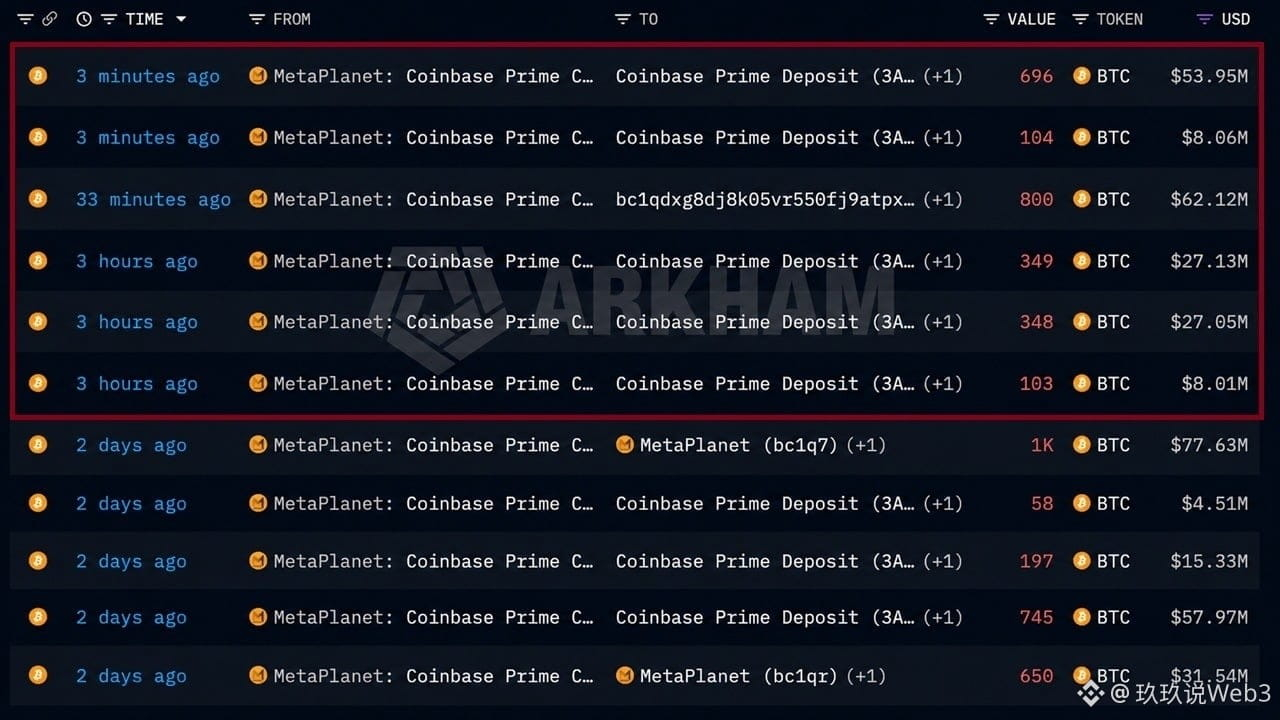
Within 3 hours, Metaplanet transferred 2,400 BTC (about 188 million USD) to Coinbase Prime again. This is already the third large transfer since August 25. The question is: the current price of BTC is already below its cost basis—so why would a “Bitcoin company” sitting at the edge of losses move coins to an exchange at this point?
If it’s going to sell, why transfer in three installments? If it’s not selling, why move to an exchange? The answers may all be off. A more plausible explanation is that Metaplanet is using Coinbase Prime for collateral financing or custody migration—swapping BTC into a liquidity instrument rather than fully liquidating.
The truth behind on-chain data is often this: people who shout “selling!” whenever they see “transferred to exchange,” and people who shout “buy!” whenever they see “purchased,” are using the same lazy logic. What you really need to watch is whether, after the transfer, it continues flowing into hot wallets—that’s the signal to sell.
This time, is Metaplanet “forced to top up margin” or “actively rebalancing”? Which do you think it is? Tell us in the comments below 👇
Click the avatar to watch the livestream, and join the Jiujiu chat group for daily strategies 🚀
#比特币24小时跌3.4%至7.74万美元 #Bitcoin #Metaplanet #GiantWhale #OnChainData
Metaplanet transfers another 188 million USD worth of BTC to Coinbase—has it surrendered, or is it rebalancing?
👉 Ontology 突然停摆,进群看真相
Within 3 hours, Metaplanet transferred 2,400 BTC (about 188 million USD) to Coinbase Prime again. This is already the third large transfer since August 25. The question is: the current price of BTC is already below its cost basis—so why would a “Bitcoin company” sitting at the edge of losses move coins to an exchange at this point?
If it’s going to sell, why transfer in three installments? If it’s not selling, why move to an exchange? The answers may all be off. A more plausible explanation is that Metaplanet is using Coinbase Prime for collateral financing or custody migration—swapping BTC into a liquidity instrument rather than fully liquidating.
The truth behind on-chain data is often this: people who shout “selling!” whenever they see “transferred to exchange,” and people who shout “buy!” whenever they see “purchased,” are using the same lazy logic. What you really need to watch is whether, after the transfer, it continues flowing into hot wallets—that’s the signal to sell.
This time, is Metaplanet “forced to top up margin” or “actively rebalancing”? Which do you think it is? Tell us in the comments below 👇
Click the avatar to watch the livestream, and join the Jiujiu chat group for daily strategies 🚀
#比特币24小时跌3.4%至7.74万美元 #Bitcoin #Metaplanet #GiantWhale #OnChainData
🚨 Rare remarks from global central bank governors: Could AI threaten the stability of the financial system? At the G20 meeting, Bank of England Governor Bailey directly named the issue—did you understand what this signals?
Group: 点击进入玖玖的粉丝群
Bailey warned the finance ministers and central bank governors of G20 countries that advanced AI, if left unregulated, could pose systemic risks to the global financial system. He urged countries to strengthen cross-agency coordination in supervision. After multiple central banks, another top-level regulator has publicly discussed AI risks—and in the highest-level setting of the G20. The weight of this is completely different.
The underlying logic is worth pondering: AI-driven algorithmic trading and quantitative strategies are taking up a larger share of the market. Once a cascading failure or model resonance occurs, volatility could be amplified by geometric progression—traditional risk controls simply won’t be able to react in time. Regulators are effectively putting up preventive measures ahead of the AI-driven financial era. This is no longer science fiction—it’s becoming real.
For the crypto market, the AI narrative remains a hotspot in the short term. But tightening regulation could increase policy uncertainty for related sectors, so projects that merely “ride the AI wave” need to be especially careful to avoid being disproven. Market moves don’t go in a straight line—timing matters more than direction. Before chasing prices higher, think clearly about your stop-loss level. News-driven moves come fast and fade fast too—don’t mistake emotion for trend.
👀 Do you think AI + finance is an opportunity or a hidden risk? If AI goes out of control and triggers systemic risk, will BTC be treated as a safe haven—or will it be the one to be sacrificed? Share your views in the comments!
Click the avatar to watch the live stream, and join the Jiujiu chat group to get daily strategies 🚀
#AI #G20 #宏观 #加密市场 #Bank of England
Group: 点击进入玖玖的粉丝群
Bailey warned the finance ministers and central bank governors of G20 countries that advanced AI, if left unregulated, could pose systemic risks to the global financial system. He urged countries to strengthen cross-agency coordination in supervision. After multiple central banks, another top-level regulator has publicly discussed AI risks—and in the highest-level setting of the G20. The weight of this is completely different.
The underlying logic is worth pondering: AI-driven algorithmic trading and quantitative strategies are taking up a larger share of the market. Once a cascading failure or model resonance occurs, volatility could be amplified by geometric progression—traditional risk controls simply won’t be able to react in time. Regulators are effectively putting up preventive measures ahead of the AI-driven financial era. This is no longer science fiction—it’s becoming real.
For the crypto market, the AI narrative remains a hotspot in the short term. But tightening regulation could increase policy uncertainty for related sectors, so projects that merely “ride the AI wave” need to be especially careful to avoid being disproven. Market moves don’t go in a straight line—timing matters more than direction. Before chasing prices higher, think clearly about your stop-loss level. News-driven moves come fast and fade fast too—don’t mistake emotion for trend.
👀 Do you think AI + finance is an opportunity or a hidden risk? If AI goes out of control and triggers systemic risk, will BTC be treated as a safe haven—or will it be the one to be sacrificed? Share your views in the comments!
Click the avatar to watch the live stream, and join the Jiujiu chat group to get daily strategies 🚀
#AI #G20 #宏观 #加密市场 #Bank of England
Verified
#布伦特原油涨破90美元
Tensions flare again in the Strait of Hormuz, oil prices surge past 91— but this “war premium” comes fast and disappears even faster
👉 油价冲91,进群看走势
More tense news out of the Strait of Hormuz: oil prices jumped straight to 91. One-fifth of the world’s oil has to pass through here—once anything stirs, prices react instantly. But the real question is: how long can this wave of “war premium” last?
The historical pattern is brutal: oil-price spikes from geopolitical conflicts usually fade quickly when the situation hasn’t escalated into a “supply disruption.” The market may price in a potential supply cutoff, but if it doesn’t actually happen, the premium gets squeezed out. During the Russia-Ukraine conflict in 2022, oil prices surged to 130—and later still fell back to 80.
Flip the perspective: for the crypto market, the real threat from oil-price increases isn’t oil itself—it’s that rising oil pushes inflation higher → the Fed dares not cut rates → liquidity tightens. So every 10% rise in oil adds another layer of macro pressure on BTC—“geopolitical immunity” has an expiration date.
Even more crucial: if the conflict drags on, high oil prices → stubborn inflation → expectations of further rate hikes. What crypto will face won’t be just a “risk-off narrative,” but the hard reality of “liquidity contraction.”
Oil is at 91 now—do you think the conflict will escalate or cool down? Discuss in the comments below 👇
Click the profile icon to watch the livestream, and join the Jiuji Chat Group to get daily strategies 🚀
#布伦特原油涨破90美元 #oil price #Hormuz #geopolitics #BTC
Tensions flare again in the Strait of Hormuz, oil prices surge past 91— but this “war premium” comes fast and disappears even faster
👉 油价冲91,进群看走势
More tense news out of the Strait of Hormuz: oil prices jumped straight to 91. One-fifth of the world’s oil has to pass through here—once anything stirs, prices react instantly. But the real question is: how long can this wave of “war premium” last?
The historical pattern is brutal: oil-price spikes from geopolitical conflicts usually fade quickly when the situation hasn’t escalated into a “supply disruption.” The market may price in a potential supply cutoff, but if it doesn’t actually happen, the premium gets squeezed out. During the Russia-Ukraine conflict in 2022, oil prices surged to 130—and later still fell back to 80.
Flip the perspective: for the crypto market, the real threat from oil-price increases isn’t oil itself—it’s that rising oil pushes inflation higher → the Fed dares not cut rates → liquidity tightens. So every 10% rise in oil adds another layer of macro pressure on BTC—“geopolitical immunity” has an expiration date.
Even more crucial: if the conflict drags on, high oil prices → stubborn inflation → expectations of further rate hikes. What crypto will face won’t be just a “risk-off narrative,” but the hard reality of “liquidity contraction.”
Oil is at 91 now—do you think the conflict will escalate or cool down? Discuss in the comments below 👇
Click the profile icon to watch the livestream, and join the Jiuji Chat Group to get daily strategies 🚀
#布伦特原油涨破90美元 #oil price #Hormuz #geopolitics #BTC
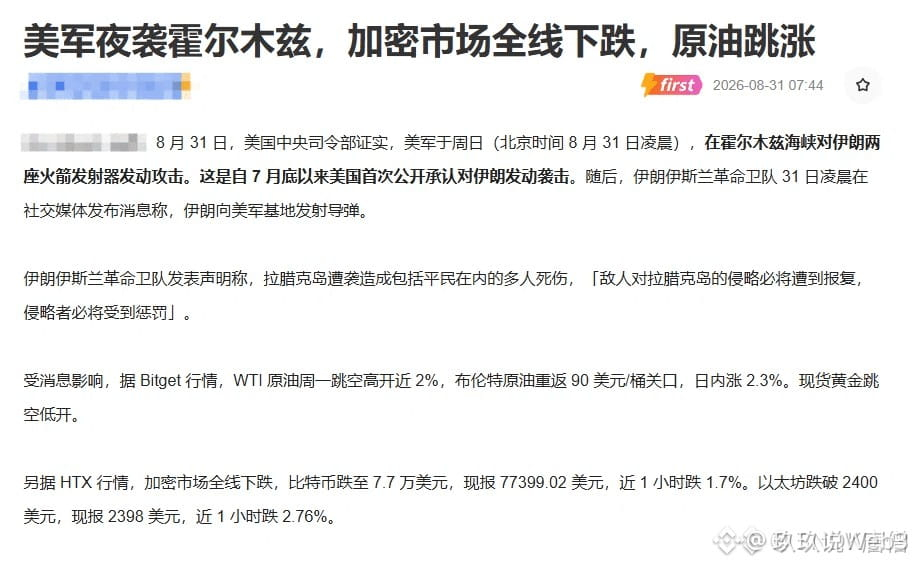
🚨 Will Asia’s regulation be changing? Vietnam officially moves to build a crypto regulatory framework. The market speculates this will ignite a digital-asset boom across all of Southeast Asia—are you still waiting?
Group: 点击进入玖玖的粉丝群
The Vietnamese government is pushing forward a comprehensive crypto-market regulatory system, covering everything from exchange licensing to investor protection. The goal is to drive compliant operations, and supporting details are being rolled out step by step. After the news broke, industry insiders generally believe this is not only Vietnam’s own matter—it may also serve as a model for regulatory trends across Asia.
You know, Vietnam has long ranked among the leaders globally in crypto adoption, with a very high share of retail participation. Its on-chain transfer volume is among the top in Southeast Asia. Once regulation is implemented, it means capital inflows will move from the gray market toward compliance, institutional entry channels will be opened, and stablecoin payments and on-chain liquidity are expected to see a qualitative improvement. The local project financing environment may also improve along with it.
However, the initial phase of regulation typically comes with growing pains. Rising compliance costs may temporarily weigh on some projects, and licensing thresholds will drive out a batch of smaller players. In the short term, sentiment is bound to swing. In the long run, compliance is the inevitable path toward mainstreaming for the industry. The policy “floor” often becomes the market “floor,” but no one can fully avoid the volatility in between. Position management matters more than predicting direction—don’t bet everything on policy.
👀 Which country in Asia will be next to follow with regulation? Do you guess it’s Japan/Korea or Indonesia? Or is it Thailand that moves first? Drop your answer in the comments—Jiujiu is waiting for a god-level fortune-teller!
Click the avatar to watch the livestream, and join the Jiujiu chat group to get daily strategies 🚀
#加密货币 #监管 #越南 #亚洲市场 #Compliance
Group: 点击进入玖玖的粉丝群
The Vietnamese government is pushing forward a comprehensive crypto-market regulatory system, covering everything from exchange licensing to investor protection. The goal is to drive compliant operations, and supporting details are being rolled out step by step. After the news broke, industry insiders generally believe this is not only Vietnam’s own matter—it may also serve as a model for regulatory trends across Asia.
You know, Vietnam has long ranked among the leaders globally in crypto adoption, with a very high share of retail participation. Its on-chain transfer volume is among the top in Southeast Asia. Once regulation is implemented, it means capital inflows will move from the gray market toward compliance, institutional entry channels will be opened, and stablecoin payments and on-chain liquidity are expected to see a qualitative improvement. The local project financing environment may also improve along with it.
However, the initial phase of regulation typically comes with growing pains. Rising compliance costs may temporarily weigh on some projects, and licensing thresholds will drive out a batch of smaller players. In the short term, sentiment is bound to swing. In the long run, compliance is the inevitable path toward mainstreaming for the industry. The policy “floor” often becomes the market “floor,” but no one can fully avoid the volatility in between. Position management matters more than predicting direction—don’t bet everything on policy.
👀 Which country in Asia will be next to follow with regulation? Do you guess it’s Japan/Korea or Indonesia? Or is it Thailand that moves first? Drop your answer in the comments—Jiujiu is waiting for a god-level fortune-teller!
Click the avatar to watch the livestream, and join the Jiujiu chat group to get daily strategies 🚀
#加密货币 #监管 #越南 #亚洲市场 #Compliance

#比特币受阻于81000美元50周均线
CZ moves nearly a million in assets to an education project—"destroyed addresses" were not actually destroyed, and the market over-interpreted it?
👉 CZ转币真相,进群看
CZ transferred approximately $965,000 worth of BNB and Binance commemorative coins to Giggle Academy (his education program) and announced to "stop using this public wallet." After the news broke, the market was flooded with speculation: Was it a liquidation? A transfer? Or was there some kind of signal?
The truth is in the details: CZ's so-called "destroyed address" doesn't actually disappear from the blockchain—so long as the address still exists, others can still send coins to it. This was simply a "wallet cleanup," consolidating scattered assets into the education project, and also bidding farewell to that public address that had been overrun with spam.
Think about it the other way: the market always over-interprets every on-chain move by CZ—sending coins means "he wants to sell," receiving coins means "he wants to pump." But CZ's public wallet has long been filled with all kinds of meme coins. When he cleans it up, it actually shows that "on-chain activity ≠ market signal."
Even more worth关注 is this: by transferring assets to an education project, CZ is using real money to support crypto education—this is far more convincing than any "signal-pushing" or "trading calls." But the market always focuses only on whether "he's going to sell."
CZ sent coins—how do you interpret it? Let’s discuss in the comments👇
Click the profile picture to watch the livestream, and join the Jiujiu chat group to get daily strategies🚀
#比特币受阻于81000美元50周均线 #CZ #BNB #Binance #on-chain data
CZ moves nearly a million in assets to an education project—"destroyed addresses" were not actually destroyed, and the market over-interpreted it?
👉 CZ转币真相,进群看
CZ transferred approximately $965,000 worth of BNB and Binance commemorative coins to Giggle Academy (his education program) and announced to "stop using this public wallet." After the news broke, the market was flooded with speculation: Was it a liquidation? A transfer? Or was there some kind of signal?
The truth is in the details: CZ's so-called "destroyed address" doesn't actually disappear from the blockchain—so long as the address still exists, others can still send coins to it. This was simply a "wallet cleanup," consolidating scattered assets into the education project, and also bidding farewell to that public address that had been overrun with spam.
Think about it the other way: the market always over-interprets every on-chain move by CZ—sending coins means "he wants to sell," receiving coins means "he wants to pump." But CZ's public wallet has long been filled with all kinds of meme coins. When he cleans it up, it actually shows that "on-chain activity ≠ market signal."
Even more worth关注 is this: by transferring assets to an education project, CZ is using real money to support crypto education—this is far more convincing than any "signal-pushing" or "trading calls." But the market always focuses only on whether "he's going to sell."
CZ sent coins—how do you interpret it? Let’s discuss in the comments👇
Click the profile picture to watch the livestream, and join the Jiujiu chat group to get daily strategies🚀
#比特币受阻于81000美元50周均线 #CZ #BNB #Binance #on-chain data
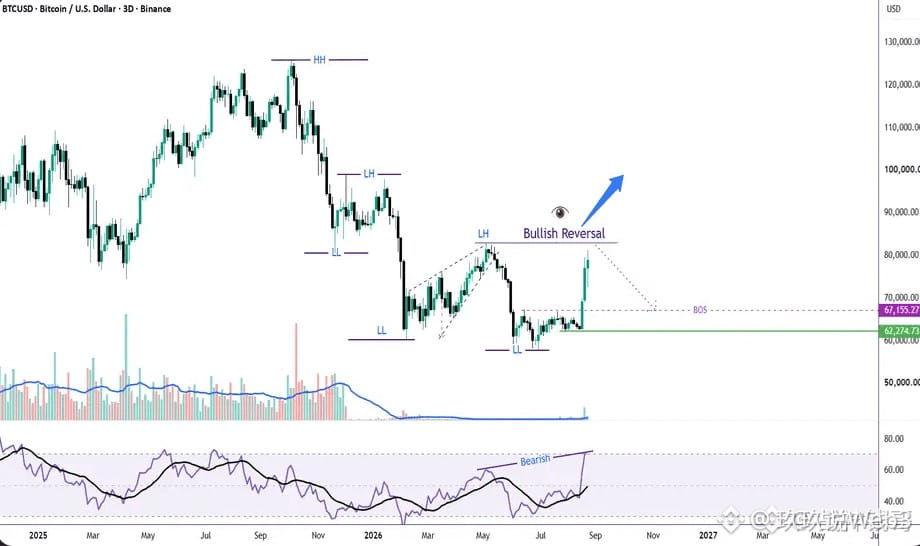
🚨 Another U.S. stock company quietly snaps up crypto! Strive adds 1,800 BTC in one go, jumping straight into the top five for corporate BTC holdings—shares surge 5% on the news. Is an institutional buying wave about to hit?
Group: 点击进入玖玖的粉丝群
Strive just released its latest portfolio moves: in this round, it bought 1,800 Bitcoins, pushing its total holdings past the exchange Bullish, and placing it as the 5th largest corporate holder globally. Based on the current price, this batch of coins is worth over $140 million—one single transaction is enough to match the trading volume of many retail investors over an entire year.
What’s interesting is that this is the third U.S. publicly disclosed company to increase its BTC holdings this month. Earlier, Strategy added 4,603 more, and Metaplanet is also steadily expanding its position. Corporate funds are shifting from watching to aggressively accumulating. The consensus that BTC should be treated as a balance-sheet asset is getting stronger, and even the new wealth-management “darlings” are starting to view Bitcoin as a core reserve.
Institutional buy orders are providing steady support—but don’t forget there are macro variables in September: interest-rate decisions and ETF fund flows will both amplify volatility. Historically, large corporate additions often happen near temporary lows—though nobody can guarantee this time will be the same. Right now, BTC is hovering around the $78,000 range, repeatedly testing up and down. Pushing higher will require momentum to show up.
Don’t deploy your entire position at once. Scaling in is discipline—don’t burn all your ammo in one go; keep room to respond to sudden spikes.
👀 Who do you think will be the next major company to follow? Drop your pick in the comments!
Click the avatar to watch the livestream and join the Jiujiu chat group to get daily strategies 🚀
#比特币 #机构持仓 #BTC #加密市场 #U.S. stocks
Group: 点击进入玖玖的粉丝群
Strive just released its latest portfolio moves: in this round, it bought 1,800 Bitcoins, pushing its total holdings past the exchange Bullish, and placing it as the 5th largest corporate holder globally. Based on the current price, this batch of coins is worth over $140 million—one single transaction is enough to match the trading volume of many retail investors over an entire year.
What’s interesting is that this is the third U.S. publicly disclosed company to increase its BTC holdings this month. Earlier, Strategy added 4,603 more, and Metaplanet is also steadily expanding its position. Corporate funds are shifting from watching to aggressively accumulating. The consensus that BTC should be treated as a balance-sheet asset is getting stronger, and even the new wealth-management “darlings” are starting to view Bitcoin as a core reserve.
Institutional buy orders are providing steady support—but don’t forget there are macro variables in September: interest-rate decisions and ETF fund flows will both amplify volatility. Historically, large corporate additions often happen near temporary lows—though nobody can guarantee this time will be the same. Right now, BTC is hovering around the $78,000 range, repeatedly testing up and down. Pushing higher will require momentum to show up.
Don’t deploy your entire position at once. Scaling in is discipline—don’t burn all your ammo in one go; keep room to respond to sudden spikes.
👀 Who do you think will be the next major company to follow? Drop your pick in the comments!
Click the avatar to watch the livestream and join the Jiujiu chat group to get daily strategies 🚀
#比特币 #机构持仓 #BTC #加密市场 #U.S. stocks
#英国首发加密资产应税收益统计
South Korea’s tax authorities to use “commercial crypto tracking software”—when tax authorities start using hackers’ tools, do retail investors still have privacy?
👉 韩国查链上,进群看
South Korea’s National Tax Service has announced the introduction of commercial crypto tracking software for investigations both at home and abroad. Translate this: tax authorities are about to start using professional tools to link on-chain fund flows with real identities.
The far-reaching impact of this has been seriously underestimated. In the past, the “semi-anonymity” of encrypted transfers made many people think, “They can’t find me.” Now, the tax authorities are directly buying off-the-shelf tracking tools—what this system can do is connect exchange withdrawal records, on-chain activity, and associated addresses. No matter how many times you transferred or how many different coins you swapped, in a professional tool it’s just a clear web.
Think about the other way around: South Korea is one of the markets with the highest levels of crypto penetration worldwide. If it does this, other countries will most likely follow. When “on-chain tracking” becomes a standard feature for tax agencies, the era of “tax compliance” in crypto officially arrives—this isn’t just intimidation, it’s a trend.
A more painful question: if every on-chain transaction can ultimately be reconstructed by the tax system, will you still view crypto as a “tax avoidance tool”? Or is it that crypto’s long-term value should never have been built on the idea of “not being found” in the first place?
If the tax authorities can trace your on-chain transactions, are you panicking? Let’s discuss in the comments below 👇
Click the profile picture to watch the live stream, and join the Jiujiu chat group to get daily strategies 🚀
#英国首发加密资产应税收益统计 #SouthKorea #taxation #onChainTracking #regulation
South Korea’s tax authorities to use “commercial crypto tracking software”—when tax authorities start using hackers’ tools, do retail investors still have privacy?
👉 韩国查链上,进群看
South Korea’s National Tax Service has announced the introduction of commercial crypto tracking software for investigations both at home and abroad. Translate this: tax authorities are about to start using professional tools to link on-chain fund flows with real identities.
The far-reaching impact of this has been seriously underestimated. In the past, the “semi-anonymity” of encrypted transfers made many people think, “They can’t find me.” Now, the tax authorities are directly buying off-the-shelf tracking tools—what this system can do is connect exchange withdrawal records, on-chain activity, and associated addresses. No matter how many times you transferred or how many different coins you swapped, in a professional tool it’s just a clear web.
Think about the other way around: South Korea is one of the markets with the highest levels of crypto penetration worldwide. If it does this, other countries will most likely follow. When “on-chain tracking” becomes a standard feature for tax agencies, the era of “tax compliance” in crypto officially arrives—this isn’t just intimidation, it’s a trend.
A more painful question: if every on-chain transaction can ultimately be reconstructed by the tax system, will you still view crypto as a “tax avoidance tool”? Or is it that crypto’s long-term value should never have been built on the idea of “not being found” in the first place?
If the tax authorities can trace your on-chain transactions, are you panicking? Let’s discuss in the comments below 👇
Click the profile picture to watch the live stream, and join the Jiujiu chat group to get daily strategies 🚀
#英国首发加密资产应税收益统计 #SouthKorea #taxation #onChainTracking #regulation
#比特币24小时跌3.4%至7.74万美元
The stablecoin giants are疯狂ly minting—yet XRP isn’t rising. Is there really a connection between “printing money” and coin prices?
👉 RLUSD增发,进群看真相
In the past few days, the stablecoin market has been full of action: multiple issuers have been minting aggressively on-chain, creating tens of millions of tokens in just a few days. By common sense, more stablecoin issuance should mean more capital inflow—good news for the price. But XRP’s price hasn’t moved at all.
Why? Because stablecoin issuance doesn’t equal someone buying XRP. Stablecoins are used for payments and settlement—not as “fuel” to buy coins. Interpreting “minting” as “price-positive” is forcing two independent things together.
Think the other way around: the real meaning of stablecoin issuance is that issuers are fighting for market share. Besides the two major players, a third force is rising. That’s the long-term narrative: the more players in the stablecoin market, the more credible the “adoption story” of the payment network becomes—each new participant adds a bit more confidence.
But in the short term, issuance doesn’t directly lift the coin price. Anyone expecting “printing money = pump” may be disappointed. What you really need to watch is adoption: is it being used in real payments, or just sitting in wallets?
Stablecoins are being minted like crazy—do you think it’s bullish or just noise? Let’s discuss in the comments 👇
Click the profile picture to watch the livestream and join the Jiujiu chat group to get daily strategies 🚀
#比特币24小时跌3.4%至7.74万美元 #Stablecoin #XRP #Payments #CryptoMarket
The stablecoin giants are疯狂ly minting—yet XRP isn’t rising. Is there really a connection between “printing money” and coin prices?
👉 RLUSD增发,进群看真相
In the past few days, the stablecoin market has been full of action: multiple issuers have been minting aggressively on-chain, creating tens of millions of tokens in just a few days. By common sense, more stablecoin issuance should mean more capital inflow—good news for the price. But XRP’s price hasn’t moved at all.
Why? Because stablecoin issuance doesn’t equal someone buying XRP. Stablecoins are used for payments and settlement—not as “fuel” to buy coins. Interpreting “minting” as “price-positive” is forcing two independent things together.
Think the other way around: the real meaning of stablecoin issuance is that issuers are fighting for market share. Besides the two major players, a third force is rising. That’s the long-term narrative: the more players in the stablecoin market, the more credible the “adoption story” of the payment network becomes—each new participant adds a bit more confidence.
But in the short term, issuance doesn’t directly lift the coin price. Anyone expecting “printing money = pump” may be disappointed. What you really need to watch is adoption: is it being used in real payments, or just sitting in wallets?
Stablecoins are being minted like crazy—do you think it’s bullish or just noise? Let’s discuss in the comments 👇
Click the profile picture to watch the livestream and join the Jiujiu chat group to get daily strategies 🚀
#比特币24小时跌3.4%至7.74万美元 #Stablecoin #XRP #Payments #CryptoMarket
#btc触及80000美元
BTC takes down the strongest August in 9 years—after "the strongest August," what usually comes next in history?
👉 最强8月之后,进群看9月
BTC delivered its strongest August in 9 years, rising more than 20% for the month—from $64,000 to $81,000. The historical numbers look great, but the question is: after the strongest August, how does September typically move?
In the past few cycles, after August surged, September has often pulled back—because profits need to be realized, and September is a traditional off-season (institutional vacations, weaker liquidity). But this time there’s a wildcard: ETF fund flows are unprecedented. Institutional core holdings may be more solid than in any prior cycle.
Think in reverse: if history repeats and September dips into the 75,000–77,000 range, that could actually be a buying/add-on window. But if the ETF flows hold up and absorb the sell pressure, and September breaks above 81,000 directly, then that would mean fully escaping the historical pattern and starting a brand-new cycle. The two scenarios imply completely different strategies.
The more painful question: do you trust the momentum of a "strongest August," or do you trust the rule that "September must pull back"? History won’t repeat itself straightforwardly, but retail traders always fall into the same trap—so which side are you betting on this time?
Will BTC in September pull back or break out? Drop your bet in the comments👇
Click the avatar to watch the livestream, and join the Jiujiu chat group to get daily strategy🚀
#BTC hits $80,000 #Bitcoin #BTC #ETF #September outlook
BTC takes down the strongest August in 9 years—after "the strongest August," what usually comes next in history?
👉 最强8月之后,进群看9月
BTC delivered its strongest August in 9 years, rising more than 20% for the month—from $64,000 to $81,000. The historical numbers look great, but the question is: after the strongest August, how does September typically move?
In the past few cycles, after August surged, September has often pulled back—because profits need to be realized, and September is a traditional off-season (institutional vacations, weaker liquidity). But this time there’s a wildcard: ETF fund flows are unprecedented. Institutional core holdings may be more solid than in any prior cycle.
Think in reverse: if history repeats and September dips into the 75,000–77,000 range, that could actually be a buying/add-on window. But if the ETF flows hold up and absorb the sell pressure, and September breaks above 81,000 directly, then that would mean fully escaping the historical pattern and starting a brand-new cycle. The two scenarios imply completely different strategies.
The more painful question: do you trust the momentum of a "strongest August," or do you trust the rule that "September must pull back"? History won’t repeat itself straightforwardly, but retail traders always fall into the same trap—so which side are you betting on this time?
Will BTC in September pull back or break out? Drop your bet in the comments👇
Click the avatar to watch the livestream, and join the Jiujiu chat group to get daily strategy🚀
#BTC hits $80,000 #Bitcoin #BTC #ETF #September outlook
#布伦特原油涨破90美元
The U.S. attacks Iran, oil prices break 90—yet BTC doesn’t blink. But the words “safe haven” may be the most dangerous label of all.
👉 BTC战争免疫,进群看
The U.S. has taken action against Iran. Brent crude oil has broken through 90, and markets worldwide are tense—only BTC remains unmoved. It’s the best-performing asset in August, seemingly “immune” to war.
On the surface, this looks like a win for BTC’s “digital gold” narrative: traditional assets tremble in the face of war, while BTC stays rock-solid. But think carefully—can this “immunity” really be relied on?
Before World War I, gold was also considered the “ultimate safe haven,” only for it to be sold off and turned into cash once the war began. Today’s “war immunity” for BTC exists because the market still hasn’t fully treated it as a real safe-haven asset—it just happens not to have fallen. If the conflict escalates to the point that it impacts global liquidity, BTC’s “risk asset” characteristics could instantly outweigh its “safe haven” traits.
More importantly: oil breaking 90 → inflation expectations heat up → the Fed dares not cut rates → liquidity tightens → all risk assets come under pressure. BTC’s “immunity” is built on the assumption that the conflict won’t last too long. Once that assumption is broken, a catch-up drop could be harsher than anyone else’s.
Is BTC’s war immunity a case of attribute awakening—or an illusion? Let’s talk in the comments 👇
Click the profile to watch the livestream, and join the Jiujiu chat group to get daily strategy 🚀
#布伦特原油涨破90美元 #BTC #geopolitics #safe haven #crude oil
The U.S. attacks Iran, oil prices break 90—yet BTC doesn’t blink. But the words “safe haven” may be the most dangerous label of all.
👉 BTC战争免疫,进群看
The U.S. has taken action against Iran. Brent crude oil has broken through 90, and markets worldwide are tense—only BTC remains unmoved. It’s the best-performing asset in August, seemingly “immune” to war.
On the surface, this looks like a win for BTC’s “digital gold” narrative: traditional assets tremble in the face of war, while BTC stays rock-solid. But think carefully—can this “immunity” really be relied on?
Before World War I, gold was also considered the “ultimate safe haven,” only for it to be sold off and turned into cash once the war began. Today’s “war immunity” for BTC exists because the market still hasn’t fully treated it as a real safe-haven asset—it just happens not to have fallen. If the conflict escalates to the point that it impacts global liquidity, BTC’s “risk asset” characteristics could instantly outweigh its “safe haven” traits.
More importantly: oil breaking 90 → inflation expectations heat up → the Fed dares not cut rates → liquidity tightens → all risk assets come under pressure. BTC’s “immunity” is built on the assumption that the conflict won’t last too long. Once that assumption is broken, a catch-up drop could be harsher than anyone else’s.
Is BTC’s war immunity a case of attribute awakening—or an illusion? Let’s talk in the comments 👇
Click the profile to watch the livestream, and join the Jiujiu chat group to get daily strategy 🚀
#布伦特原油涨破90美元 #BTC #geopolitics #safe haven #crude oil

🚨 Intercontinental Exchange (ICE), the parent company of the New York Stock Exchange, steps in personally: Invests in tZERO and secures licenses for 103 blockchain patent items—Is the endgame for putting stocks on-chain finally here?
Group: 点击进入玖玖的粉丝群
This signal is extremely strong: ICE, the parent company of the New York Stock Exchange, has just announced an investment in tZERO’s latest funding round—and also obtained usage licenses for 23 patent families, totaling 103 patents. The purpose is to build its own digital trading platform tied to its NYSE network. The full stack infrastructure—transfer agent services, broker systems, and on-chain settlement—is outsourced directly to crypto veterans.
tZERO—who is it? A long-established player that has spent ten years in compliance tokenized securities. This time, it has been “absorbed” as a technology partner by one of the world’s largest exchange groups—and also plans to apply to become the platform’s digital transfer agent. This isn’t a concept collaboration; it’s a direct infrastructure project with signatures and formal commitments.
Cross-check: DTCC’s multi-chain platform, the tokenized-stock scale on the BNB Chain nearing $500 million, and ICE’s hundred-plus patents—three Wall Street giants all betting on the same track in the same month. Traditional finance isn’t waiting around; they’re sprinting ahead. Once stocks and bonds are put on-chain, 24-hour trading and instant settlement will reshape the entire market structure.
Risk warning: Implementation still needs regulatory approvals, and the timeline isn’t set. Don’t use short-term price action to bet on a long-term narrative.
👀 When Apple’s stock goes on-chain, do you think it will first rise or first fall? Traditional finance’s ticket to onboard is on-chain—only then will we see the outcome. Remember to follow Jiujiu so you don’t get lost!
Click the profile picture to watch the live stream, and join the Jiujiu chat group to get daily strategies 🚀
#ICE #tZERO #代币化证券 #NYSE #Bitcoin
Group: 点击进入玖玖的粉丝群
This signal is extremely strong: ICE, the parent company of the New York Stock Exchange, has just announced an investment in tZERO’s latest funding round—and also obtained usage licenses for 23 patent families, totaling 103 patents. The purpose is to build its own digital trading platform tied to its NYSE network. The full stack infrastructure—transfer agent services, broker systems, and on-chain settlement—is outsourced directly to crypto veterans.
tZERO—who is it? A long-established player that has spent ten years in compliance tokenized securities. This time, it has been “absorbed” as a technology partner by one of the world’s largest exchange groups—and also plans to apply to become the platform’s digital transfer agent. This isn’t a concept collaboration; it’s a direct infrastructure project with signatures and formal commitments.
Cross-check: DTCC’s multi-chain platform, the tokenized-stock scale on the BNB Chain nearing $500 million, and ICE’s hundred-plus patents—three Wall Street giants all betting on the same track in the same month. Traditional finance isn’t waiting around; they’re sprinting ahead. Once stocks and bonds are put on-chain, 24-hour trading and instant settlement will reshape the entire market structure.
Risk warning: Implementation still needs regulatory approvals, and the timeline isn’t set. Don’t use short-term price action to bet on a long-term narrative.
👀 When Apple’s stock goes on-chain, do you think it will first rise or first fall? Traditional finance’s ticket to onboard is on-chain—only then will we see the outcome. Remember to follow Jiujiu so you don’t get lost!
Click the profile picture to watch the live stream, and join the Jiujiu chat group to get daily strategies 🚀
#ICE #tZERO #代币化证券 #NYSE #Bitcoin

🚨 Tether CEO publicly challenges “tokenized bank deposits”: Stablecoins and bank tokens are fundamentally not the same—did you understand the difference?
Group: 点击进入玖玖的粉丝群
Paolo Ardoino himself stepped in to draw a clear line between the stablecoin model and tokenized bank deposits: stablecoins are native digital dollars on-chain, redeemable within 24 hours and transferable globally, and they don’t rely on the balance sheet of any single bank. Meanwhile, tokenized bank deposits are still fundamentally the bank’s liabilities; if the bank runs into trouble, the token goes to zero as well.
The context behind this debate is that central banks and commercial banks in various countries are rolling out pilot programs for tokenized deposits, aiming to push stablecoins out of the payments space and capture the future “money” gateway. Ardoino calls it out directly: tokenized deposits don’t solve banks’ credit risk—they just move the ledger onto the blockchain. It’s a one-sentence distinction at the core: stablecoins are tested by reserves, while bank tokens are tested by the bank itself.
Cross-check: the market value of stablecoins keeps setting new highs, and USDT remains the absolute leader in payments. On the other side, giants like DTCC and ICE are also pushing tokenized infrastructure. The two systems are competing head-on—whoever gets compliance and liquidity working first wins the payments gateway. Behind this is a market battle worth trillions.
Risk warning: regulators may tighten stablecoin issuance at any time—keep a close watch on compliance changes, and don’t treat any single token as a faith.
👀 Stablecoins vs. tokenized bank deposits—who are you more optimistic about? Take a side in the comments!
Click the avatar to watch the livestream, and join the Nine Nine chat group to get daily strategies 🚀
#稳定币 #USDT #Tether #RWA #payments
Group: 点击进入玖玖的粉丝群
Paolo Ardoino himself stepped in to draw a clear line between the stablecoin model and tokenized bank deposits: stablecoins are native digital dollars on-chain, redeemable within 24 hours and transferable globally, and they don’t rely on the balance sheet of any single bank. Meanwhile, tokenized bank deposits are still fundamentally the bank’s liabilities; if the bank runs into trouble, the token goes to zero as well.
The context behind this debate is that central banks and commercial banks in various countries are rolling out pilot programs for tokenized deposits, aiming to push stablecoins out of the payments space and capture the future “money” gateway. Ardoino calls it out directly: tokenized deposits don’t solve banks’ credit risk—they just move the ledger onto the blockchain. It’s a one-sentence distinction at the core: stablecoins are tested by reserves, while bank tokens are tested by the bank itself.
Cross-check: the market value of stablecoins keeps setting new highs, and USDT remains the absolute leader in payments. On the other side, giants like DTCC and ICE are also pushing tokenized infrastructure. The two systems are competing head-on—whoever gets compliance and liquidity working first wins the payments gateway. Behind this is a market battle worth trillions.
Risk warning: regulators may tighten stablecoin issuance at any time—keep a close watch on compliance changes, and don’t treat any single token as a faith.
👀 Stablecoins vs. tokenized bank deposits—who are you more optimistic about? Take a side in the comments!
Click the avatar to watch the livestream, and join the Nine Nine chat group to get daily strategies 🚀
#稳定币 #USDT #Tether #RWA #payments
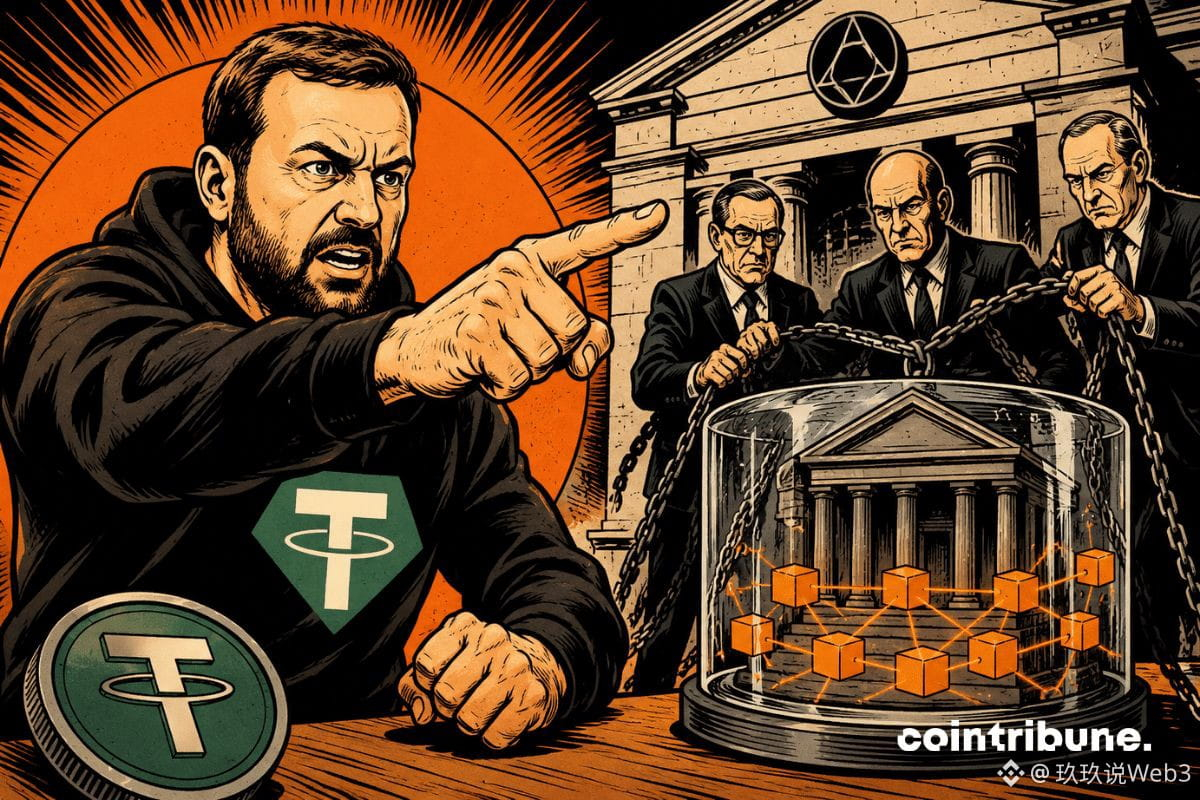
#波场主网激活tvm布拉格大阪兼容
Launched just two months ago, Robinhood Chain’s revenue beats Ethereum—yet 88% comes from meme coins. How long can this last?
👉 Robinhood Chain逆袭,进群聊
Robinhood Chain has only been live for two months. Its app made $2.66 million in daily revenue, surpassing Ethereum’s $1.27 million and Hyperliquid’s $1.70 million. The numbers look great, but if you break them down: Gmgn (a meme-coin trading terminal) contributed $1.11 million alone. Add Pons and Uniswap, and together they account for 88%.
In other words, this chain’s revenue is almost entirely driven by meme-coin trading. What’s the nature of meme coins? They come fast and go just as fast. Today, Gmgn accounts for 42%. Next month, if the meme craze fades, revenue could be cut by half immediately.
Think of it another way: Robinhood Chain’s real ace isn’t revenue—it’s the “traffic entry point.” Tens of millions of retail users can get on-chain and trade without having to learn wallets. This is exactly what Ethereum lacks most. Revenue is meme-driven, but user stickiness is real.
So the question isn’t “Can Robinhood Chain surpass Ethereum?” It’s “When the meme tide goes out, will its users stay?” If they stay, a new king of L2 emerges; if they don’t, it’s just another fireworks show.
Can Robinhood Chain really threaten Ethereum? Let’s discuss in the comments 👇
Click the profile picture to watch the live stream, and join the Jiujiu chat group to get daily strategies 🚀
#MainnetActivationofTronTVM #BlaGraThisCompatibility #Robinhood #L2 #Ethereum #memeCoin
Launched just two months ago, Robinhood Chain’s revenue beats Ethereum—yet 88% comes from meme coins. How long can this last?
👉 Robinhood Chain逆袭,进群聊
Robinhood Chain has only been live for two months. Its app made $2.66 million in daily revenue, surpassing Ethereum’s $1.27 million and Hyperliquid’s $1.70 million. The numbers look great, but if you break them down: Gmgn (a meme-coin trading terminal) contributed $1.11 million alone. Add Pons and Uniswap, and together they account for 88%.
In other words, this chain’s revenue is almost entirely driven by meme-coin trading. What’s the nature of meme coins? They come fast and go just as fast. Today, Gmgn accounts for 42%. Next month, if the meme craze fades, revenue could be cut by half immediately.
Think of it another way: Robinhood Chain’s real ace isn’t revenue—it’s the “traffic entry point.” Tens of millions of retail users can get on-chain and trade without having to learn wallets. This is exactly what Ethereum lacks most. Revenue is meme-driven, but user stickiness is real.
So the question isn’t “Can Robinhood Chain surpass Ethereum?” It’s “When the meme tide goes out, will its users stay?” If they stay, a new king of L2 emerges; if they don’t, it’s just another fireworks show.
Can Robinhood Chain really threaten Ethereum? Let’s discuss in the comments 👇
Click the profile picture to watch the live stream, and join the Jiujiu chat group to get daily strategies 🚀
#MainnetActivationofTronTVM #BlaGraThisCompatibility #Robinhood #L2 #Ethereum #memeCoin

🚨 U.S. clearing giant DTCC that settles tens of trillions of dollars’ worth of securities every day officially announces: a multi-chain tokenization platform is coming. Canton and Besu are going live, and Ripple Prime also joins the plan—will Wall Street really move stocks onto the blockchain?
Group: 点击进入玖玖的粉丝群
You may not be familiar with the name DTCC, but every trade settlement in the U.S. stock market depends on it. This time, it has launched a multi-blockchain tokenization platform, calling out two major technology backbones—Canton Network and Besu—essentially laying a national-level “highway” for tokenized assets.
Details matter: Ripple Prime joins the DTCC plan, but there is no obligation to use XRP—this is just “piggybacking on infrastructure,” not “chasing coins.” It shows that the logic behind traditional finance choosing chains is: “use whichever chain works best,” not simply equating institutional moves with coin prices. Previously, DTCC has already completed production-grade tokenized securities trading, and the market value of RWA tokenization is nearing $4 billion—clearly accelerating.
Cross-check: ICE, the parent company of the NYSE, has also just stepped in to invest in tokenized infrastructure, with ETF funds continuing to flow in. On-chain assets are a major direction—institutions are voting with real money. Prices may not move in the short term, but once the infrastructure is built, it becomes the foundation for the next decade.
Risk warning: The rollout cycle for tokenization is long—don’t chase infrastructure updates with the mindset of trading hype coins.
👀 When do you think on-chain stocks can replace traditional exchanges? Share your take!
Click the profile picture to watch the live stream and join the Jiujiu chat group to get daily strategies 🚀
#DTCC #代币化 #RWA #Ripple #Wall Street
Group: 点击进入玖玖的粉丝群
You may not be familiar with the name DTCC, but every trade settlement in the U.S. stock market depends on it. This time, it has launched a multi-blockchain tokenization platform, calling out two major technology backbones—Canton Network and Besu—essentially laying a national-level “highway” for tokenized assets.
Details matter: Ripple Prime joins the DTCC plan, but there is no obligation to use XRP—this is just “piggybacking on infrastructure,” not “chasing coins.” It shows that the logic behind traditional finance choosing chains is: “use whichever chain works best,” not simply equating institutional moves with coin prices. Previously, DTCC has already completed production-grade tokenized securities trading, and the market value of RWA tokenization is nearing $4 billion—clearly accelerating.
Cross-check: ICE, the parent company of the NYSE, has also just stepped in to invest in tokenized infrastructure, with ETF funds continuing to flow in. On-chain assets are a major direction—institutions are voting with real money. Prices may not move in the short term, but once the infrastructure is built, it becomes the foundation for the next decade.
Risk warning: The rollout cycle for tokenization is long—don’t chase infrastructure updates with the mindset of trading hype coins.
👀 When do you think on-chain stocks can replace traditional exchanges? Share your take!
Click the profile picture to watch the live stream and join the Jiujiu chat group to get daily strategies 🚀
#DTCC #代币化 #RWA #Ripple #Wall Street
🚨 The U.S. clearing giant DTCC that settles tens of trillions of dollars in securities every day officially announces: a multi-chain tokenization platform is coming. Canton and Besu are live—Ripple Prime also joins the move. Is Wall Street really about to move stocks onto the blockchain?
Group: 点击进入玖玖的粉丝群
You may not recognize the name DTCC, but every single trade in the U.S. stock market inevitably goes through it for settlement. This time, it has launched a multi-blockchain tokenization platform, explicitly naming Canton Network and Besu as two major technical foundations—effectively laying a state-level highway for tokenized assets.
Details matter: Ripple Prime has joined the DTCC plan, but there’s no obligation to use XRP—this is just riding on the infrastructure, not chasing the coin. This shows that the logic behind traditional finance selecting chains is "use whichever chain is more usable," and you shouldn’t simply equate institutional moves with token price. Previously, DTCC had already completed production-grade tokenized securities trading. The market value of RWA tokenization is nearing $4 billion, and the pace is clearly accelerating.
Cross-check: The NYSE’s parent company, ICE, has also just stepped in to invest in tokenization infrastructure, while ETF capital continues to flow in. On-chain assets as a big direction—institutions are voting with real money. Prices may not move in the short term, but once the infrastructure is built, it becomes the foundation for the next decade.
Risk warning: Tokenization deployment takes time—don’t chase infrastructure news with a meme-coin trading mindset.
👀 When do you think on-chain stocks could replace traditional exchanges? Share your take!
Click the profile to watch the live broadcast and join the Jiujiu chat group to get daily strategy 🚀
#DTCC #代币化 #RWA #Ripple #WallStreet
Group: 点击进入玖玖的粉丝群
You may not recognize the name DTCC, but every single trade in the U.S. stock market inevitably goes through it for settlement. This time, it has launched a multi-blockchain tokenization platform, explicitly naming Canton Network and Besu as two major technical foundations—effectively laying a state-level highway for tokenized assets.
Details matter: Ripple Prime has joined the DTCC plan, but there’s no obligation to use XRP—this is just riding on the infrastructure, not chasing the coin. This shows that the logic behind traditional finance selecting chains is "use whichever chain is more usable," and you shouldn’t simply equate institutional moves with token price. Previously, DTCC had already completed production-grade tokenized securities trading. The market value of RWA tokenization is nearing $4 billion, and the pace is clearly accelerating.
Cross-check: The NYSE’s parent company, ICE, has also just stepped in to invest in tokenization infrastructure, while ETF capital continues to flow in. On-chain assets as a big direction—institutions are voting with real money. Prices may not move in the short term, but once the infrastructure is built, it becomes the foundation for the next decade.
Risk warning: Tokenization deployment takes time—don’t chase infrastructure news with a meme-coin trading mindset.
👀 When do you think on-chain stocks could replace traditional exchanges? Share your take!
Click the profile to watch the live broadcast and join the Jiujiu chat group to get daily strategy 🚀
#DTCC #代币化 #RWA #Ripple #WallStreet
Verified
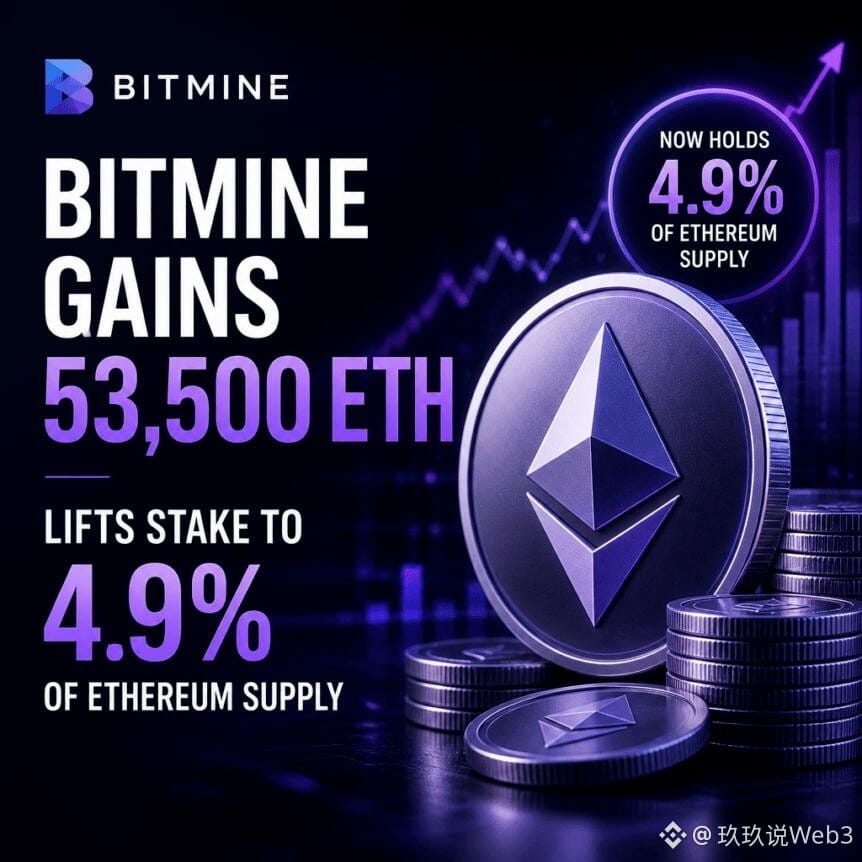
🚨 A mining company has been buying ETH for 65 straight weeks—adding another 53,500 ETH in the latest week to raise its holdings to about 4.9% of Ethereum’s total supply. What exactly have they been seeing?
Group: 点击进入玖玖的粉丝群
Bitmine Immersion Technologies, a Bitcoin mining company, bought another 53,500 ETH in the most recent week, pushing its holdings to roughly 4.9% of Ethereum’s total supply. And this rhythm has not been broken for 65 consecutive weeks. Week after week—no deviations. It’s more mechanical than DCA; even ETH price pullbacks haven’t shaken their hand.
Let’s make the numbers concrete: Ethereum’s total supply is about 120 million ETH. 4.9% is nearly 6 million ETH. At current prices, that’s a position in the tens of billions of dollars. Instead of selling, the mining firm keeps replenishing—suggesting it treats ETH as a long-term core asset to hoard, not something to trade for short-term swings. This “only buy, never sell” accumulation pattern is clearly visible in on-chain data.
Cross-check: Strategy’s BTC holdings are also continuously increasing. Institutional-grade “buy only, never sell” is becoming a mainstream narrative. Miners and listed companies hoarding coins at the same time means more supply keeps getting locked away—an often-typical sign of a cycle bottom. When the smart money is quietly accumulating while retail investors still hesitate, history often flips in just this way.
Risk warning: Continuous buying doesn’t mean the price will rise immediately. Institutions can get trapped too. Don’t blindly follow—position management always comes first.
👀 Adding to ETH for 65 straight weeks—do you think this is smart DCA or just stubborn holding? See you in the comments!
Click the profile to watch the livestream and join the Jiujiu chat group to get daily strategy 🚀
#以太坊 #ETH #机构持仓 #矿业公司 #Bitcoin
Group: 点击进入玖玖的粉丝群
Bitmine Immersion Technologies, a Bitcoin mining company, bought another 53,500 ETH in the most recent week, pushing its holdings to roughly 4.9% of Ethereum’s total supply. And this rhythm has not been broken for 65 consecutive weeks. Week after week—no deviations. It’s more mechanical than DCA; even ETH price pullbacks haven’t shaken their hand.
Let’s make the numbers concrete: Ethereum’s total supply is about 120 million ETH. 4.9% is nearly 6 million ETH. At current prices, that’s a position in the tens of billions of dollars. Instead of selling, the mining firm keeps replenishing—suggesting it treats ETH as a long-term core asset to hoard, not something to trade for short-term swings. This “only buy, never sell” accumulation pattern is clearly visible in on-chain data.
Cross-check: Strategy’s BTC holdings are also continuously increasing. Institutional-grade “buy only, never sell” is becoming a mainstream narrative. Miners and listed companies hoarding coins at the same time means more supply keeps getting locked away—an often-typical sign of a cycle bottom. When the smart money is quietly accumulating while retail investors still hesitate, history often flips in just this way.
Risk warning: Continuous buying doesn’t mean the price will rise immediately. Institutions can get trapped too. Don’t blindly follow—position management always comes first.
👀 Adding to ETH for 65 straight weeks—do you think this is smart DCA or just stubborn holding? See you in the comments!
Click the profile to watch the livestream and join the Jiujiu chat group to get daily strategy 🚀
#以太坊 #ETH #机构持仓 #矿业公司 #Bitcoin
#btc触及80000美元
A hamburger chain that calls itself a "Bitcoin company"—as soon as it starts selling burgers, it tells stories with BTC. Is this hype, or a signal?
👉 汉堡店讲BTC故事,进群聊
A well-known hamburger chain now calls itself a "Bitcoin company." Selling burgers while embracing Bitcoin sounds like a hot-topic grab—but think carefully: why now?
If it were just marketing, they could have done this long ago. Picking this timing suggests that BTC's "adoption narrative" has entered a new phase—not merely a toy for crypto geeks, but a tag that consumer brands are willing to attach themselves to. Brand attachment = more entry points for everyday users to encounter BTC.
Consider the other side: does a brand jumping on BTC hype help or hurt Bitcoin? The upside is that "adoption narrative" gets reinforced; the downside is that once BTC experiences big price swings, the brand will cut ties immediately—"Bitcoin company" is a label that could be removed at any moment.
What’s truly worth watching is the trend: when "Bitcoin company" spreads from public companies like MicroStrategy to hamburger chains, it shows that BTC is moving from an "asset" to a "cultural symbol." The value of a cultural symbol lies in helping more ordinary people learn about it—but knowing ≠ holding.
If a burger shop can use BTC to tell a story, can your holdings make money from "the story"? Let’s discuss in the comments below 👇
Click the avatar to watch the livestream and join the Jiujiu chat group to get daily strategies 🚀
#BTCtouches80000dollars #Bitcoin #BTC #adoption #brand
A hamburger chain that calls itself a "Bitcoin company"—as soon as it starts selling burgers, it tells stories with BTC. Is this hype, or a signal?
👉 汉堡店讲BTC故事,进群聊
A well-known hamburger chain now calls itself a "Bitcoin company." Selling burgers while embracing Bitcoin sounds like a hot-topic grab—but think carefully: why now?
If it were just marketing, they could have done this long ago. Picking this timing suggests that BTC's "adoption narrative" has entered a new phase—not merely a toy for crypto geeks, but a tag that consumer brands are willing to attach themselves to. Brand attachment = more entry points for everyday users to encounter BTC.
Consider the other side: does a brand jumping on BTC hype help or hurt Bitcoin? The upside is that "adoption narrative" gets reinforced; the downside is that once BTC experiences big price swings, the brand will cut ties immediately—"Bitcoin company" is a label that could be removed at any moment.
What’s truly worth watching is the trend: when "Bitcoin company" spreads from public companies like MicroStrategy to hamburger chains, it shows that BTC is moving from an "asset" to a "cultural symbol." The value of a cultural symbol lies in helping more ordinary people learn about it—but knowing ≠ holding.
If a burger shop can use BTC to tell a story, can your holdings make money from "the story"? Let’s discuss in the comments below 👇
Click the avatar to watch the livestream and join the Jiujiu chat group to get daily strategies 🚀
#BTCtouches80000dollars #Bitcoin #BTC #adoption #brand

🚨 DTCC Officially Announces: A Multichain Tokenization Platform Is Coming to Settle Trillions of US Stock Trades Every Day. Canton and Besu Go Live, and Ripple Prime Joins the Move—Is Wall Street Really Going to Put Stocks on-Chain?
Group: 点击进入玖玖的粉丝群
You may not be familiar with the name DTCC, but every trade settlement in the US stock market inevitably winds up with it—handling clearing volumes in the trillions every day. This time, it is rolling out a multi-blockchain tokenization platform, specifically naming Canton Network and Besu as two key technology backbones. In effect, it’s building a national-level expressway for tokenized assets—whoever gets on that road first will grab tickets to the next round of infrastructure.
Details matter: Ripple Prime joins the DTCC plan, but there is no obligation to use XRP—this is infrastructure participation, not a coin-promotion play. The logic of traditional finance choosing a chain is very practical: use whichever chain works best, and don’t equate institutional moves directly with simple price action. Previously, DTCC has already completed production-grade transaction tests for tokenized securities. In the RWA track, market value continues to expand, and the pace is clearly accelerating.
Cross-check: ICE—the parent company of the NYSE—has already stepped in and invested in tokenized infrastructure. ETF capital has kept flowing in, and stablecoin giants are also competing for payment gateways. On-chain assets: institutions are voting with real money. Short-term prices may not respond immediately, but once the infrastructure is built, it becomes the foundation for the next decade. Ordinary people may not be able to understand it now, and later they may not be able to reach it.
Risk warning: Tokenization rollouts take a long time, and regulatory approvals are the biggest variable. Don’t chase infrastructure news with the mindset of trading coins.
👀 When do you think on-chain stocks can replace traditional exchanges? Let’s discuss in the comments!
Click the avatar to watch the live stream, and join the Jiujiu chat group to get daily strategies 🚀
#DTCC #代币化 #RWA #Ripple #WallStreet
Group: 点击进入玖玖的粉丝群
You may not be familiar with the name DTCC, but every trade settlement in the US stock market inevitably winds up with it—handling clearing volumes in the trillions every day. This time, it is rolling out a multi-blockchain tokenization platform, specifically naming Canton Network and Besu as two key technology backbones. In effect, it’s building a national-level expressway for tokenized assets—whoever gets on that road first will grab tickets to the next round of infrastructure.
Details matter: Ripple Prime joins the DTCC plan, but there is no obligation to use XRP—this is infrastructure participation, not a coin-promotion play. The logic of traditional finance choosing a chain is very practical: use whichever chain works best, and don’t equate institutional moves directly with simple price action. Previously, DTCC has already completed production-grade transaction tests for tokenized securities. In the RWA track, market value continues to expand, and the pace is clearly accelerating.
Cross-check: ICE—the parent company of the NYSE—has already stepped in and invested in tokenized infrastructure. ETF capital has kept flowing in, and stablecoin giants are also competing for payment gateways. On-chain assets: institutions are voting with real money. Short-term prices may not respond immediately, but once the infrastructure is built, it becomes the foundation for the next decade. Ordinary people may not be able to understand it now, and later they may not be able to reach it.
Risk warning: Tokenization rollouts take a long time, and regulatory approvals are the biggest variable. Don’t chase infrastructure news with the mindset of trading coins.
👀 When do you think on-chain stocks can replace traditional exchanges? Let’s discuss in the comments!
Click the avatar to watch the live stream, and join the Jiujiu chat group to get daily strategies 🚀
#DTCC #代币化 #RWA #Ripple #WallStreet
Log in to explore more content