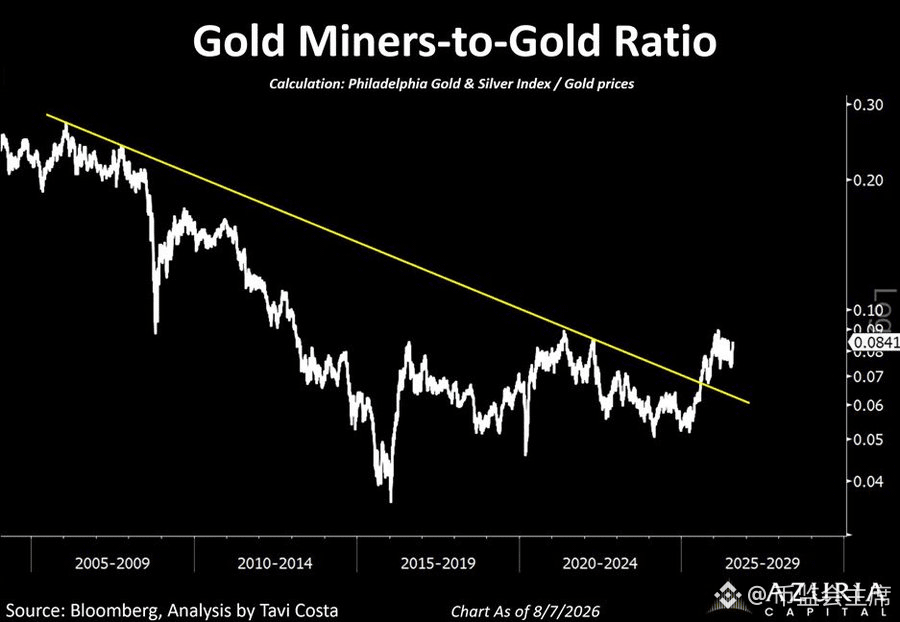
Seeing this chart, the ratio between gold mining stocks and the gold price has finally broken through a downward trend line that has lasted for more than ten years. The current ratio is roughly around 0.084.
Over the past nearly 20 years, the overall performance of gold mining stocks has failed to beat gold itself. The reason is also quite simple: as the gold price rises, costs rise as well; share dilution, environmental protection, and geopolitical risk come in waves one after another, causing the stocks’ sensitivity to weaken over time. But when the ratio breaks the trend line, it implies that capital is starting to re-price “equity that can produce gold” again, beyond just “physical gold.”
I think this has reference value for crypto assets. Many people compare BTC to digital gold, and mining stocks to mining company stocks. But BTC itself does not have the problem of expanding extraction costs, nor does it face resource risk tied to a single country. So, in the “scarcity narrative,” BTC is cleaner than gold mining stocks, but in terms of “discounted cash flow,” it’s not as good as mature mining companies that pay dividends.
In other words, BTC and gold mining stocks are two variants of the gold narrative: one locks in scarcity through protocol rules, and the other amplifies the gold price through corporate earnings. A breakout in the ratio suggests the market is shifting from “buying only gold” to “buying gold-related assets,” with risk appetite moving up one notch.
My own approach is to treat it as an indirect signal: when traditional markets are willing to pay a premium for higher-risk gold-related assets, high-beta positions in the crypto market typically benefit as well. But I don’t chase when it’s already at a high level—I use it only as a reference for position sizing.
Tag $COTI #黄金 #资产配置 #cryptocurrency
Over the past nearly 20 years, the overall performance of gold mining stocks has failed to beat gold itself. The reason is also quite simple: as the gold price rises, costs rise as well; share dilution, environmental protection, and geopolitical risk come in waves one after another, causing the stocks’ sensitivity to weaken over time. But when the ratio breaks the trend line, it implies that capital is starting to re-price “equity that can produce gold” again, beyond just “physical gold.”
I think this has reference value for crypto assets. Many people compare BTC to digital gold, and mining stocks to mining company stocks. But BTC itself does not have the problem of expanding extraction costs, nor does it face resource risk tied to a single country. So, in the “scarcity narrative,” BTC is cleaner than gold mining stocks, but in terms of “discounted cash flow,” it’s not as good as mature mining companies that pay dividends.
In other words, BTC and gold mining stocks are two variants of the gold narrative: one locks in scarcity through protocol rules, and the other amplifies the gold price through corporate earnings. A breakout in the ratio suggests the market is shifting from “buying only gold” to “buying gold-related assets,” with risk appetite moving up one notch.
My own approach is to treat it as an indirect signal: when traditional markets are willing to pay a premium for higher-risk gold-related assets, high-beta positions in the crypto market typically benefit as well. But I don’t chase when it’s already at a high level—I use it only as a reference for position sizing.
Tag $COTI #黄金 #资产配置 #cryptocurrency