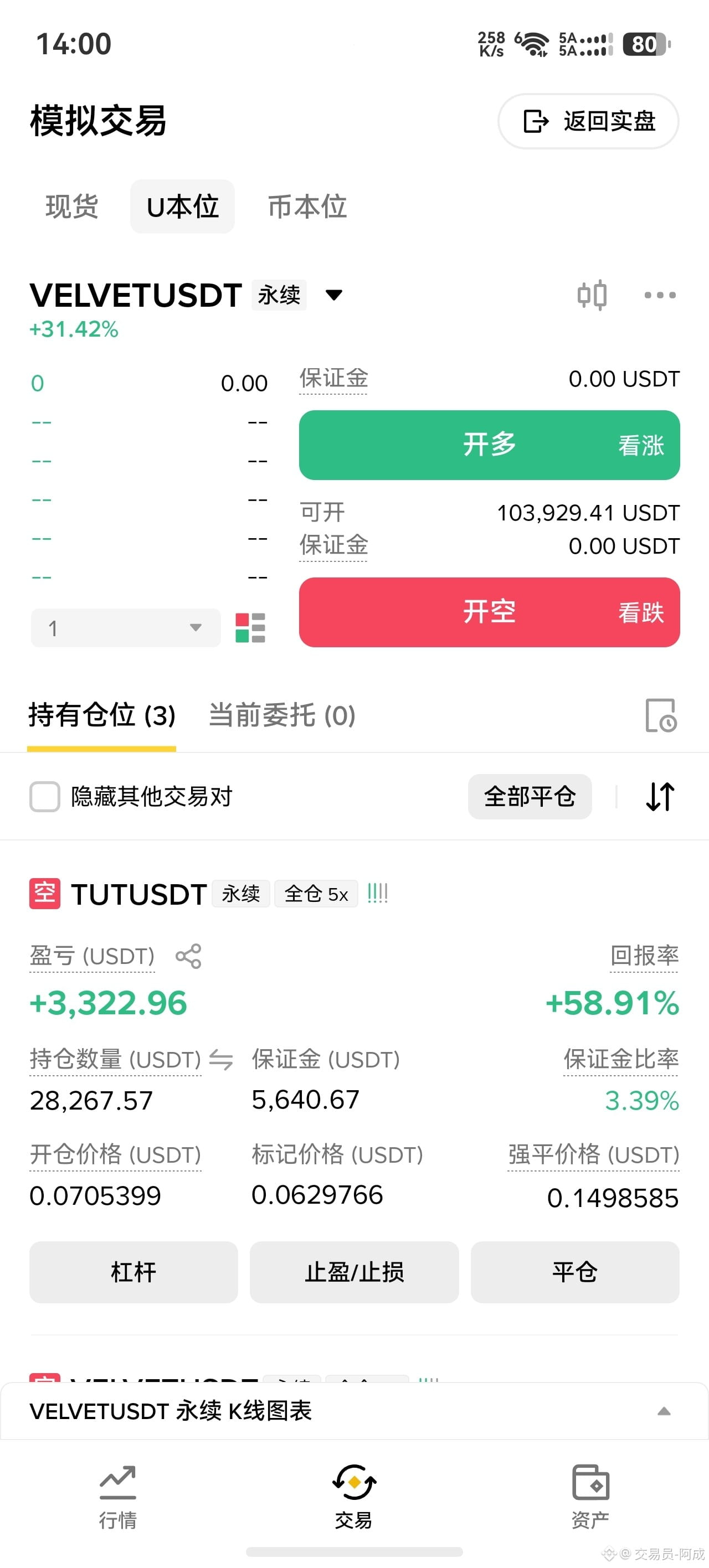
In 2018, I stepped into the crypto world with 5,000U. Back then, everywhere I looked was the “get-rich-quick myth.” I also witnessed too many friends go from full positions to liquidation—from full confidence to pledging their properties. $TAKE
But my account steadily climbed up and to the right. Over five years, the maximum drawdown of my principal never exceeded 8%. $VELVET
I don’t rely on insider information, and I don’t believe in chart-magic. I only trust three things: math, discipline, and execution. $TUT
In this game, the one who always wins is the person who controls the rhythm.
First move: lock in profits with compounding.
For every trade, I set both take-profit and stop-loss at the same time. When profits reach 10% of the principal, I withdraw half immediately into a cold wallet, and the other half keeps rolling into the next trades. If the market goes in my favor, I roll out a snowball; if it doesn’t, I only give back half the profits. Over five years, I’ve taken profits 37 times, with the highest weekly withdrawal reaching 180,000U. That wasn’t luck—it was the power of compounding.
Second move: staggered entries (misalignment in timing).
I use a “three-timeframe linked” approach: daily charts to judge trend, four-hour charts to define the range, and the 15-minute chart to find the entry.
On the same coin, I open two positions: for trade A, I chase long on a breakout; for trade B, I place a short order at a high level. The risk on each trade never exceeds 1.5% of the principal. Take-profit is set to at least 5 times the risk. While others are getting liquidated frequently, I’m eating on both sides. On the day LUNA blew up, with dual stop-takes on both long and short, my account jumped 42% in a single day.
Third move: stop-loss is profit.
I’m never afraid of stop-loss—instead, I proactively embrace it. Loss per trade never exceeds 1.5%. My win rate is only 38%, but the risk-reward ratio is 4.8:1. Over the long run, the mathematical expectation is positive. For every 1U of risk I take, I average 1.9U in profit.
Finally, three iron rules:
1) Divide capital into 10 parts; use at most 1 part to open positions;
2) If you lose two trades in a row, stop trading immediately to rest;
3) If your account doubles, withdraw 20% to lock in a safety cushion.
After five years, I’ve become even more convinced: the market doesn’t fear you might be wrong—it fears you might get liquidated.
Trading crypto isn’t a bet on your life; it’s business management. If you can survive long enough, you’ll eventually make the market work for you.
If you’re still lost, you’re welcome to chat. I’m always here—if you want to improve, I’ll walk with you and move forward together.
But my account steadily climbed up and to the right. Over five years, the maximum drawdown of my principal never exceeded 8%. $VELVET
I don’t rely on insider information, and I don’t believe in chart-magic. I only trust three things: math, discipline, and execution. $TUT
In this game, the one who always wins is the person who controls the rhythm.
First move: lock in profits with compounding.
For every trade, I set both take-profit and stop-loss at the same time. When profits reach 10% of the principal, I withdraw half immediately into a cold wallet, and the other half keeps rolling into the next trades. If the market goes in my favor, I roll out a snowball; if it doesn’t, I only give back half the profits. Over five years, I’ve taken profits 37 times, with the highest weekly withdrawal reaching 180,000U. That wasn’t luck—it was the power of compounding.
Second move: staggered entries (misalignment in timing).
I use a “three-timeframe linked” approach: daily charts to judge trend, four-hour charts to define the range, and the 15-minute chart to find the entry.
On the same coin, I open two positions: for trade A, I chase long on a breakout; for trade B, I place a short order at a high level. The risk on each trade never exceeds 1.5% of the principal. Take-profit is set to at least 5 times the risk. While others are getting liquidated frequently, I’m eating on both sides. On the day LUNA blew up, with dual stop-takes on both long and short, my account jumped 42% in a single day.
Third move: stop-loss is profit.
I’m never afraid of stop-loss—instead, I proactively embrace it. Loss per trade never exceeds 1.5%. My win rate is only 38%, but the risk-reward ratio is 4.8:1. Over the long run, the mathematical expectation is positive. For every 1U of risk I take, I average 1.9U in profit.
Finally, three iron rules:
1) Divide capital into 10 parts; use at most 1 part to open positions;
2) If you lose two trades in a row, stop trading immediately to rest;
3) If your account doubles, withdraw 20% to lock in a safety cushion.
After five years, I’ve become even more convinced: the market doesn’t fear you might be wrong—it fears you might get liquidated.
Trading crypto isn’t a bet on your life; it’s business management. If you can survive long enough, you’ll eventually make the market work for you.
If you’re still lost, you’re welcome to chat. I’m always here—if you want to improve, I’ll walk with you and move forward together.