

Original title: (Twenty Years of the Chinese Internet, and This Summer of Office Agents)
Original author: Observing Beating
There are two office buildings in Hangzhou facing each other across the street. On the roof of one, a red-and-gold Sun Wukong was newly erected before the 2026 Spring Festival, right next to the DingTalk lightning-bolt logo. On the roof of the other, there is the Feishu logo. The day Sun Wukong went up, photos spread quickly on social media, and many people joked that this is the most straightforward kind of business battle—the implied message from DingTalk is probably to be a bit higher than Feishu.
These two companies have been fighting for ten years already. They fought from trying to see who had read whose messages, to sparring over documents, spreadsheets, and client lists—until the fight finally reached the rooftops.
But the two hands of that monkey on the rooftop were empty—no baton. What it was supposed to take out was revealed at a press conference more than a month later.
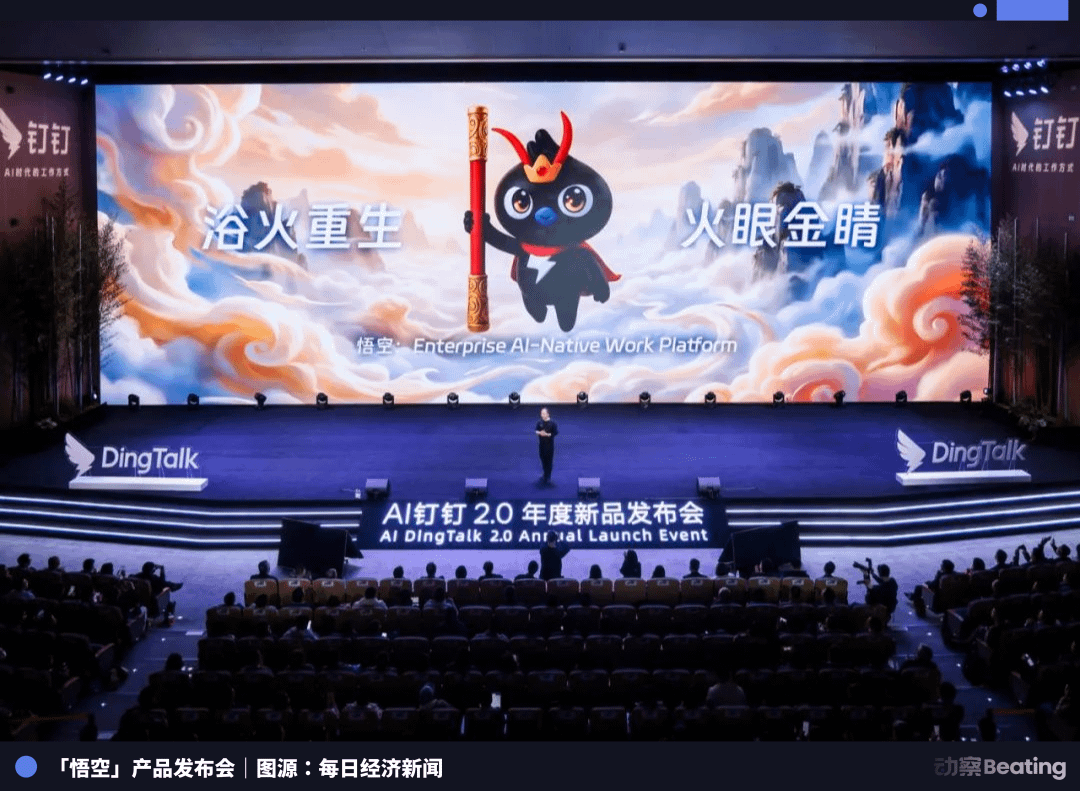
March 17, Xixi, Hangzhou. Dingding’s founder Wuwu stood on the stage at the press conference. In 2015, he built Dingding; in 2021, he left; and in 2025, he was invited back. On this day, he would release a new set of AI assistants, named Wukong, and the logo used was precisely the monkey on top of the building.
Alibaba CEO Wu Yongming sat in the audience. Wuwu said he wanted to shatter Dingding and re-smelt it with AI. In the past, humans used Dingding; going forward, AI would use Dingding.
When talking about the emblem, he removed the golden headband from the monkey’s head, saying that because it had already become the Fighting Buddha.
Applause from below the stage.
The monkey from Havoc in Heaven didn’t reach Ling Mountain. Pinned under the Five Phases Mountain for five hundred years, when it finally came out it had an extra headband on its head. Along the way it was cursed into rolling on the ground, and its temper was gradually cleaned up. The monkey that truly reached Ling Mountain was already another monkey, no longer thinking about being king.
The Fighting Buddha, is the new name Sun Wukong got after the Great Sage of Qitian finished that road. To get there, first you have to deal with the monkey from back then.
This story is about Wukong—it’s also about Dingding.
On the surface, this press conference was unveiling an AI product. But what it really wanted to move was Dingding itself. Dingding rewrote more than a thousand underlying capabilities into instructions that AI can call directly. In the past, employees had to drill down layer by layer in approvals, schedules, and business systems on the screen. With Wukong, this layer could be bypassed: it could read data directly, call tools, and then carry on with the tasks.
What Wuwu had to hand over wasn’t just an entrance, but also the company’s inner organs that grew over ten years.
But just 86 days later, on June 11, he left Dingding. The incident is a bit dramatic, but put back into the past twenty years of China’s internet, it isn’t exactly new.
Companies that truly lived through one cycle after another have almost all done the same thing: while the old business is still making money and the old products are still standing at the top, they hand the next blade to their own people with their own hands.
In China’s internet world over these twenty years, no one has survived to today by guarding the self they used to be.
If you want to live, you must first kill the you that used to be.
Kill the self at the top
This craft—big internet companies practiced it for a long time.
October 2010, Shenzhen. Zhang Xiaolong wrote a letter to Ma Huateng, saying QQ belongs on computers, and Tencent needs a communication tool that is born on mobile phones. Tencent didn’t hand it directly to the QQ team to do. Internally, three groups started working in parallel: QQ, QQ Contacts, and QQ Mail. Whoever made it first would win.
That year, QQ was at the highest point.
January 21, 2011, Guangzhou. The team that built QQ Mail launched WeChat 1.0.
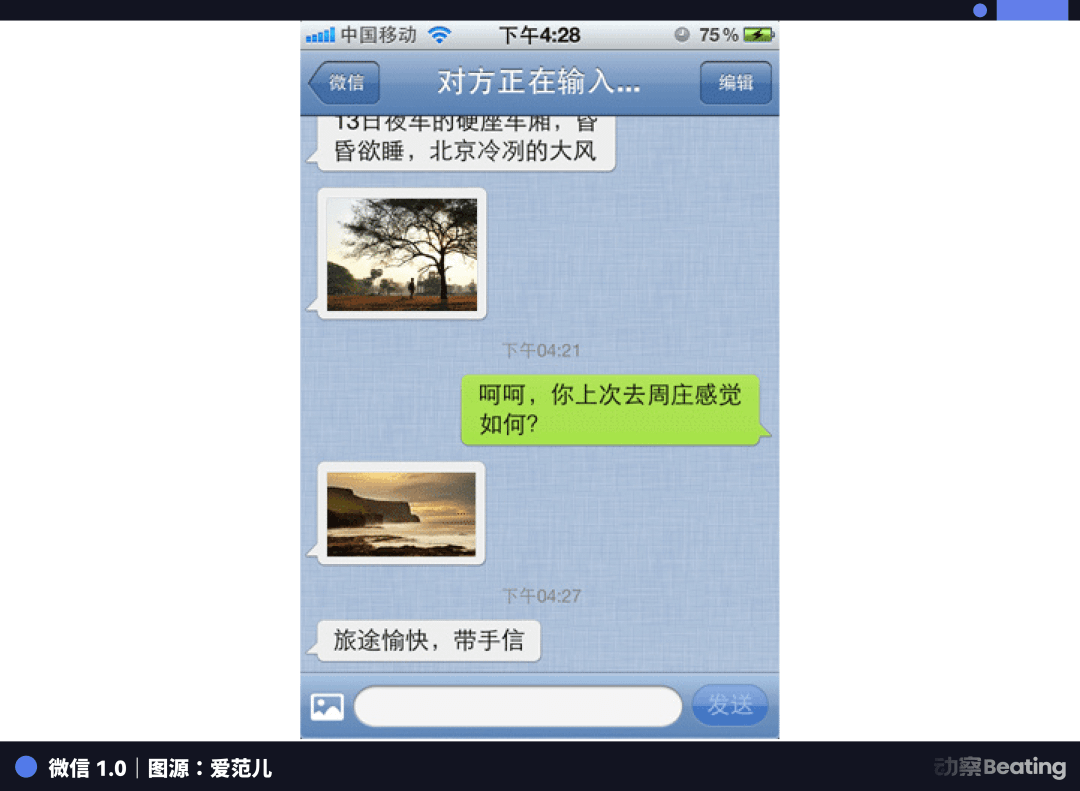
Tencent struck first. Two years later, something almost the same happened in Hangzhou too.
In 2013, Jack Ma said the duty of Alibaba Wireless’s team was to destroy Taobao.
That year, Taobao stood at the center of the stage.
Two years later, mobile Taobao became the main battlefield for Double 11. The words “Taobao” were kept, but the screen where people buy things had already changed. Very few people still sit at a computer to open the Taobao web page.
Five years from now, it will be Beijing’s turn.
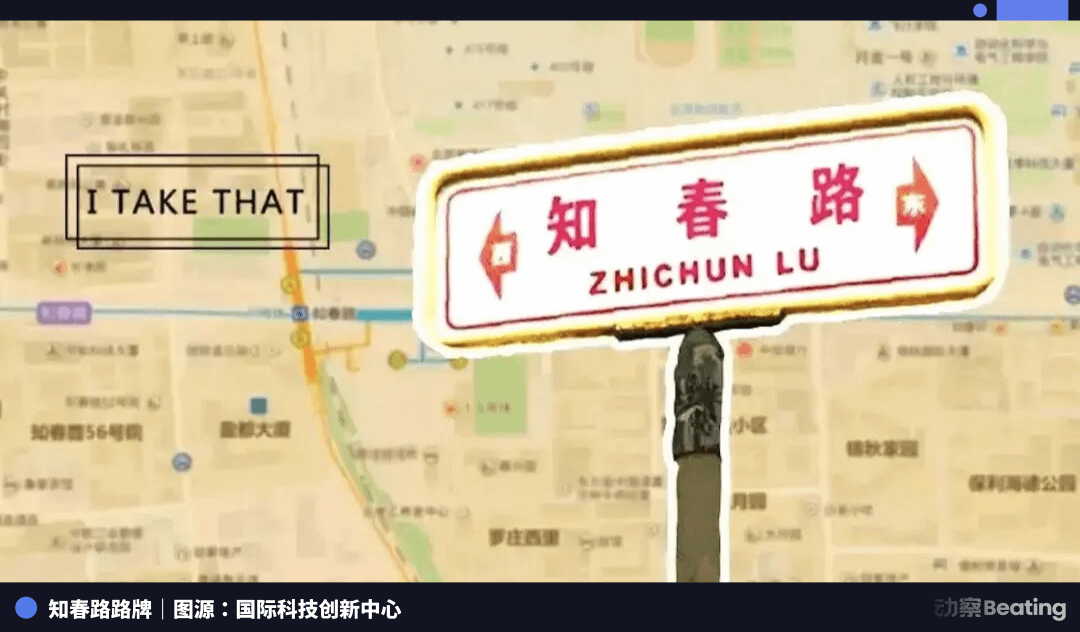
In August 2018, Zhichun Road. The Aviation Building took down the four characters “Toutiao Today,” replacing them with “ByteDance.” Toutiao Today could still be opened, still updating, with users and ads.
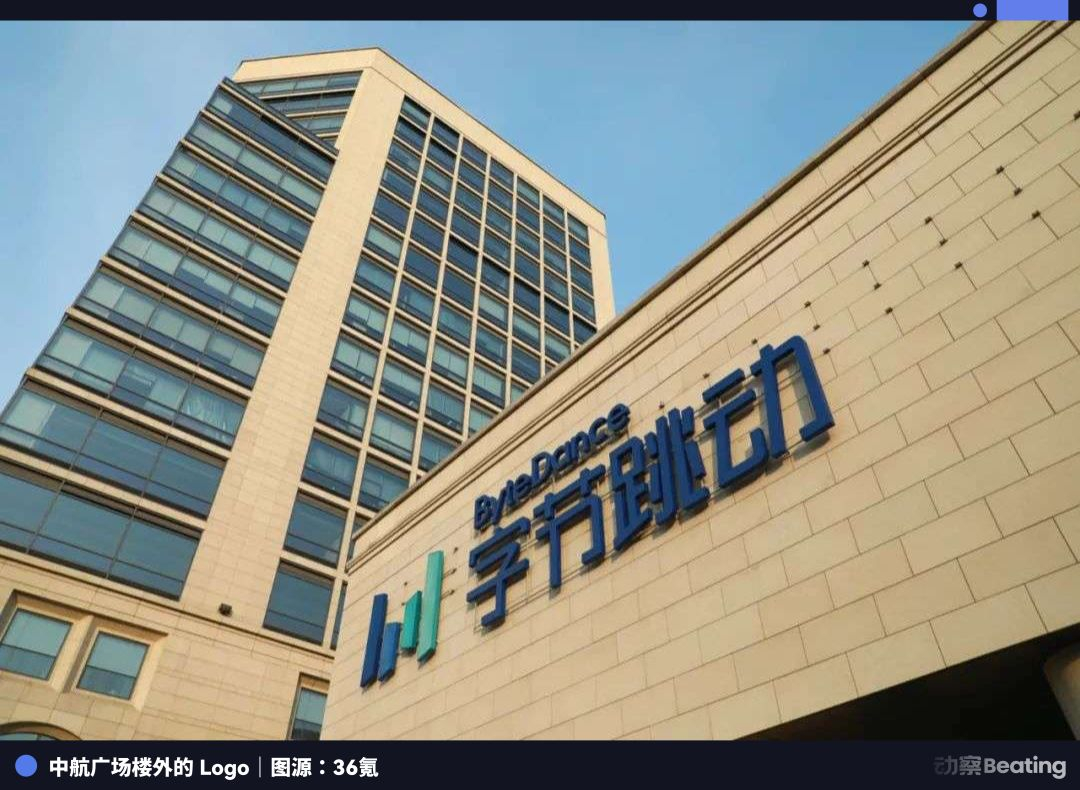
That year, Toutiao Today was still a national-level application.
It’s just that Douyin has already surpassed it. Three months later, Chen Lin became CEO of Toutiao Today, and Zhang Yiming’s official title changed from “Founder and CEO of Toutiao Today” to “Founder and CEO of ByteDance.”
It was the same every time—three times.
What needed to be cut was making money and drawing everyone’s attention—it looked like the one place in the whole company that shouldn’t be touched. But if you let it age on its own, the company will age with it too. So you have to act while it’s still strong—hand the next blade to your own people, let the new grow from within, then eat away the old bit by bit.
Army of losers'
But Dingding wasn’t built by standing at the very top back then.
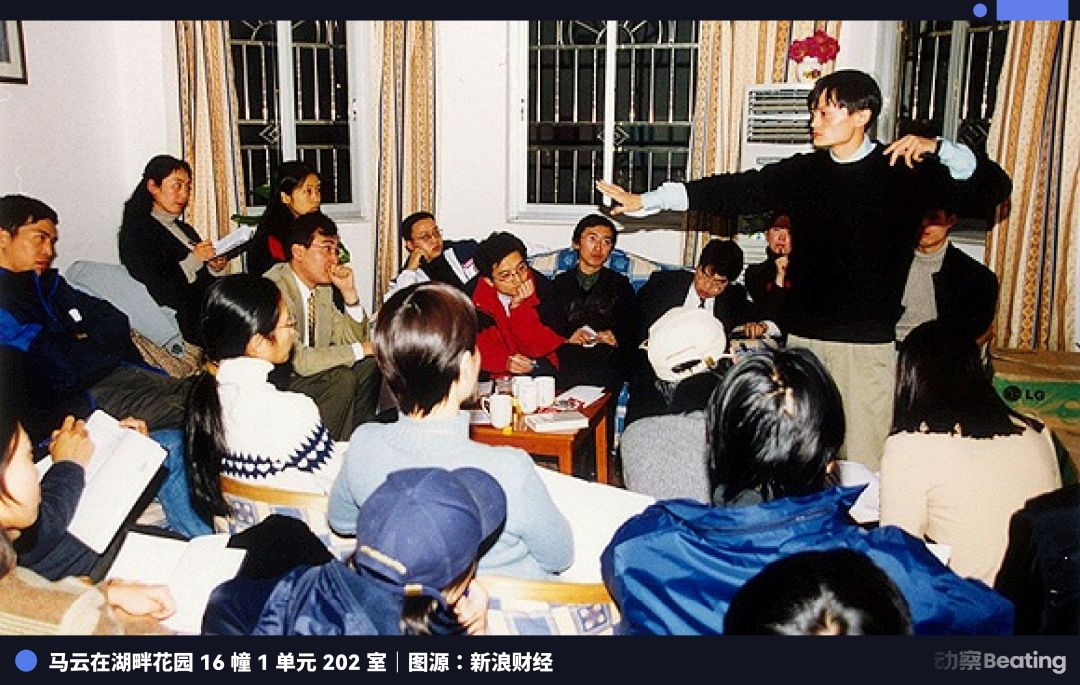
In 2014, Hangzhou, No. 176 Wenyi West Road. In an old apartment in the Lakeview Garden, six people from Alibaba gathered around a table for a weekly meeting. They had just been pulled back from Laiwang. Laiwang was Alibaba’s social product designed to fight WeChat; the company had spent a fortune on it and required every employee to recruit 100 external users each month. Jack Ma personally came to the stage, and Liu Chuanzhi, Shi Yuzhu, and Jet Li were also invited to set up accounts. In those days, in many people’s phones there was a Laiwang app—install it, use it for two days, and then never open it again.
That apartment they retreated to could almost be called a ancestral house within Alibaba.
In 1999, Jack Ma and seventeen others gathered together there to put together 500,000 yuan and Alibaba opened for business. Later, when the Xixi Park was built, they even specifically recreated the interior layout of the room.

It’s just that this time, the new direction growing out of an apartment wasn’t something decided by the strategy meeting.
Qiaoqiao wanted to snatch ordinary people out of WeChat but couldn’t. So Wuwu changed direction—going after the most basic anxieties of Chinese bosses. For example: whether anyone would actually see what I say; whether the tasks I assign would actually move forward.
Dingding, read receipts (read/not read), the corporate address book, attendance, approvals—those things that later drove countless employees crazy. Back then, they precisely hit the thorn in the managers’ hearts.
Dingding was later always described as something made for bosses. But back then, it was precisely those people who were truly willing to pay for a management software. China has tens of millions of small companies—bosses run business themselves, pay salaries themselves, and chase schedules themselves. Before Dingding appeared, in his hands there was almost nothing except a WeChat group.
January 2015, Dingding launched. In the first year, users exceeded 100 million; in three years, more than 300 million.
A defeated army that was never meant to return was able to forge a weapon that suited it perfectly.
Later, this weapon cut down many people—including the one who made it.
Come back and dismantle what you built
Wuwu left Dingding in 2021.
That year, Alibaba rolled out “One Cloud, One Dingding,” tying Dingding to Alibaba Cloud to sell to enterprise clients and do tailored projects—while Wuwu insisted on standardized products and serving small and midsize businesses. The disagreement was written on paper as routes, but in real life it meant endless review meetings where they couldn’t come to terms. After leaving, he founded two hydrogen, one oxygen, building cross-border products and small smart hardware.
Four years later, the wind direction completely changed.
In February 2025, Alibaba announced that over the next three years it would invest 380 billion yuan to build AI infrastructure. Wu Yongming referred to Dingding as one of Alibaba’s most important enterprise AI applications. On March 31, Alibaba acquired shares held by the investors in two hydrogen, one oxygen, and Wuwu sat back in the CEO seat of Dingding for the second time.
Ten years ago, he created Dingding out of a losing situation at Laiwang. This time, inviting him back was to make him personally dismantle what he had built.
In the first week after Wuwu returned, he didn’t completely adopt the customer list prepared by the business departments. Instead, he personally led the team to visit Beijing, Guangdong, and East China. After returning, he also reviewed Dingding’s product managers one by one: ten minutes each. He randomly picked a feature and asked the other person to explain why it was designed this way.
Ten minutes is very short—so short there’s little room for laying groundwork. The moment you open your mouth, you know whether this function was seriously thought through. Public reports said very few people passed this random inspection. In the end, Wuwu’s judgment was that Dingding had already built many AI features, yet it hadn’t defined the future.
Next came “Down-to-earth operations.” The product, engineering, and operations teams rotated to handle customer service for two hours each day.
Before this, the backend data always looked great. The rate of connecting to a human agent was only 15%, and every rating was five stars. But when people really picked up the phone, you heard an entirely different kind of content. Some said the replies were off-topic; others said requests had been sitting for a year with no movement; and some couldn’t even find the entry to reach a human agent at all.
After recalculation, customer satisfaction was only 30%. A few months later, the figure was raised to 80%, and costs dropped by 90%.
Wuwu really did fix some things. He could see through the data a big company fabricated for itself at a glance. He would force product managers to listen when customers cursed them. And he truly pulled the 30% up to 80%.
The problem was that the set of methods he used to fix products was soon used to fix people too.
Then the screws on the whole machine kept tightening. Clock in at 9. Every day there are morning and evening meetings. After the midday break ends, at 13:15 you have to enter work mode. People in management positions were required to learn Python, while the technical team was asked to audit the amount of code. Product managers must visit three companies each week. For external communication, standardized lines even appeared: “Sorry, I only have Dingding.” Reports said that at 10 p.m., he walks the building, giving likes to people still working overtime.
That’s when Teng Yaxin entered Dingding.
She was a product manager, with the nickname You Su. During her interview, Wuwu focused on a user-acquisition task, asking her father first, then her mother, and then her maternal grandparents. In the end, he kept pressing: were they really short of six family members who could come onto Dingding?
Compete
On her first day at work, You Su was assigned to a confidential project, code-named O. Later she learned that O stood for ONE.
In the second week of the project, the design lead left. In the fourth week, the senior who recommended her was transferred elsewhere. In the whole team, only three product managers had stayed at ONE for full three months—she was one of them. People were always changing. New hires had to catch up from scratch, yet no release date was ever delayed.
On August 25, 2025, at Dingding’s 10th anniversary press conference, Wuwu released five products in one go. DingTalk A1 is a 3.8-millimeter-thick audio-recording card that can stick to the back of a phone. AI transcription supports 72 languages. AI spreadsheets and AI search-and-ask were unveiled as well.
ONE sat right in the center. It was supposed to reorder messages, schedules, meetings, approvals, and documents—so that “people find tasks” would become “tasks find people.” But the first thing it collided with was Dingding itself.
A staff member brought a case study from Country Garden and reported it, hoping to use ONE’s cards to assign tasks to the security guards and cleaners based on their updates. According to You Su’s records, Wuwu didn’t approve this direction. He wanted ONE to serve bosses and managers, just like Dingding does.
The wavering direction soon landed on data.
ONE’s daily active users once stabilized at around 3 million, but retention then sharply dropped. The team turned it from an information-organizing tool into a foundation that could hold all kinds of agents. A row of icons was piled along the bottom of the screen. Both internal teams and customers started to question the product. Once the grand ambitions were pulled back, the product returned to being simple: the home page was empty, signaling that you had already handled all urgent matters. In You Su’s recorded data, next-day retention rose from a little over 10% to nearly 30%. Before handing over the entrance, the peak once exceeded 45%.
It was moved away when it was first learning to walk. In early 2026, ONE was split up and demoted to the -1 screen of Dingding, and Wukong became the main entrance.
The entrance changed, but Dingding’s anxiety didn’t disappear. Soon it gained a new reference point—right across the street.
More than two months later, on the night of April 2, Dingding’s senior managers and the product director received a notice: no one was allowed to clock out before midnight. Not for a meeting, not for releasing versions. They had to check what time the building next door, Feishu, went dark.
This sparring duel wasn’t just about whose lights stayed on later.
A year earlier, Feishu CEO Xie Xin talked about attendance software at a public event. He said: if an office tool only collected clock-in data every day, and in one year it accumulated ten million clock-ins, then the AI could only predict which employees would be late tomorrow. He didn’t name names, but the audience knew who he was pointing at. In another interview, he said Feishu’s spreadsheet product was ahead by at least twelve months.
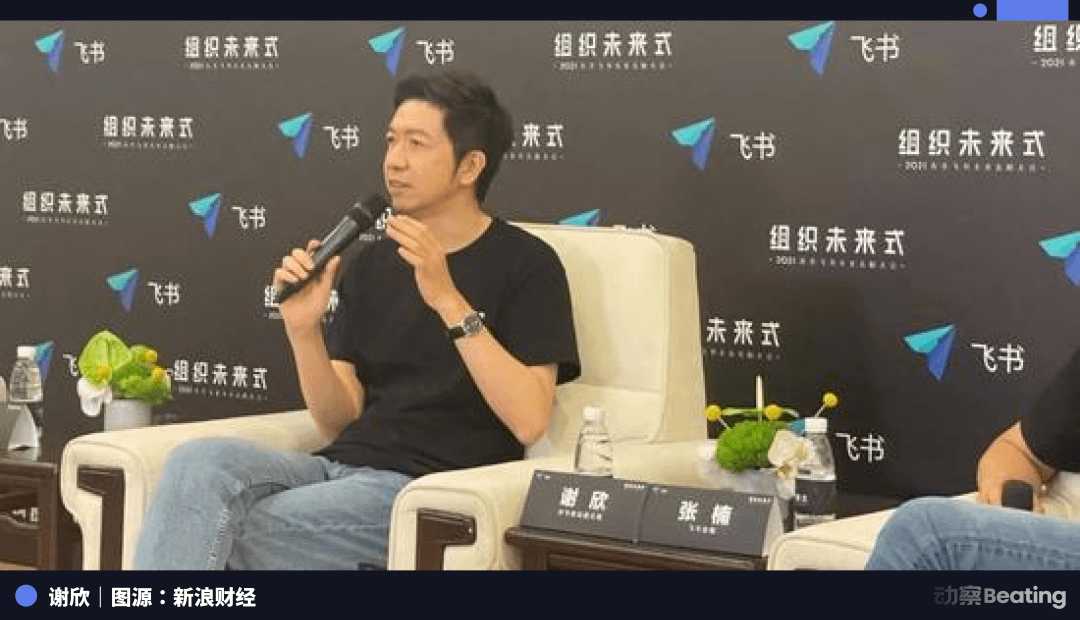
One company takes management to the extreme; another takes collaboration to the extreme. These are two solutions to the same problem—and both sides answer seriously. Dingding asks who hasn’t executed it. Feishu wants to leave in documents how a decision happens, so that new hires who join three months later can open the files and know why it was decided back then.
Over those days when You Su found herself in the middle of it all, she wrote everything down bit by bit.
June 4. She posted on Alibaba’s internal network (putting herself inside Dingding), 75,000 words, 105 pages, divided into eight chapters: her intent in product building, positioning, design, users, agility, order, military contest, and long-term strategy.
Change the signboard
June 8, Hangzhou. Former Dingding deputy president Wang Jiamin wrote a post on the internal network of Dingding (putting herself inside Dingding). She said she hoped Wuwu would bring Dingding back to its glory, but the cost shouldn’t be for everyone to trade their working hours for an exhaustion that leaves them with nothing to give.
June 10, Hangzhou. Alibaba’s partner committee posted a message on the internal network, criticizing Dingding’s management style and saying this was not the kind of look Alibaba culture should have.
June 11, Hangzhou. Wuwu stepped down. This was his second time taking charge of Dingding—437 days in total.
When he came back, it was to get rid of the old Dingding. In the end, he was dealt with by the same set of methods—including himself.
But the surgery on that occasion with Dingding didn't stop.
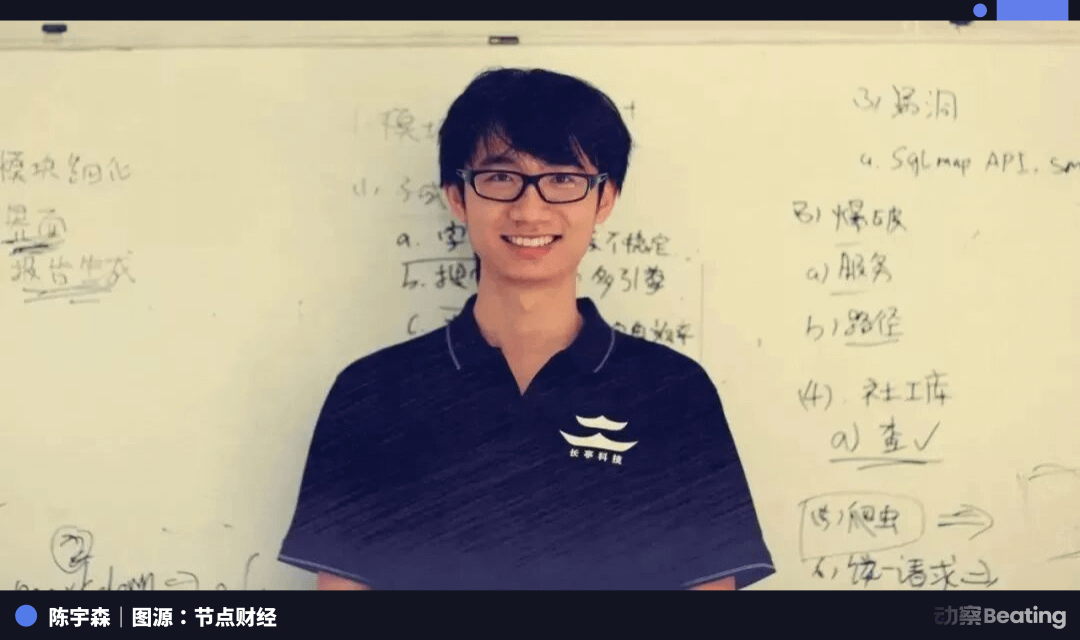
Twenty-one days later, Wukong, QoderWork, and MuleRun were handed over to the successor, Chen Yusen, for integration. QoderWork handles desktop execution; MuleRun grows out from within Alibaba Cloud; and Wukong is the one personally released by Wuwu. On August 3, Qianwen Office, bundled with these three, entered public beta.
From removing the golden headband to putting it into Qianwen—139 days. That monkey was still standing on the rooftop. The person who named it had already left; it had become the path of arrival for another name.
Around the same time, the company across the street also started moving.
July 30, Beijing. ByteDance split Feishu into two parts. The product team moved in parallel with Doubao—ByteDance’s own AI assistant. Xie Xin reported to Zhao Qi, the head of Doubao. The sales, marketing, and customer service teams entered Volcano Engine—that’s ByteDance’s cloud business, led by Tan Dai. The notice said Feishu’s existing products and services remain unchanged.
“Keep unchanged.”
Eight years ago, when the Aviation Building changed its signboard, Toutiao Today didn’t disappear either. It could still be opened, still had users and ads. The real change was the power behind the name: Toutiao Today moved back from being a company to becoming a product, and ByteDance stood on top of it.
Now, similar things have fallen on Feishu again.
It’s just that this time Feishu was a bit different. Its revenue was still rising, and customers were still renewing fees, with Xie Xin still responsible for the product. (Finance) The data obtained says that in 2025, Feishu revenue exceeded 3 billion yuan; in Q2 of 2026, year-over-year growth exceeded 100%. In the same period, more than 90% of new customers purchased Feishu’s AI products.
When Feishu was passively being cut, it was still winning.
This actually resembles those real turning points from the past twenty years. Once a business has already lost, moving it usually only leaves you tidying up the mess. The truly difficult part is when it’s still making money, still growing—then you hand the next layer of power over first.
August 6, Beijing. ByteDance held its second all-hands meeting of the year. Liang RuoBo listed Douyin and Doubao as two thick main trunks, with Zhao Qi and Tan Dai both in attendance. Xie Xin, who joined ByteDance in 2014 and had served as the first head of HR, changed from reporting directly to founder Liang Ruobo to reporting to Zhao Qi.
By here, Feishu’s changes are no longer just a shift in reporting lines. ByteDance is deciding again: which entrance will stand at the top in the next stage.
Tencent was also doing a similar consolidation.
At the start of the year, multiple agent products grew inside the company at the same time. Besides WorkBuddy, there were QClaw and Marvis. Outside, this internal competition was called the “Hundred Shrimp War.” By July, the related business of QClaw and parts of the team were assigned into the department where WorkBuddy was.
Multiple people inside Tencent told the media that Ma Huateng frequently attends WorkBuddy product meetings. When the team applies for computing power, technical resources, and market resources, it’s smooth all the way. Word inside says it may become the third strategic-level product after QQ and WeChat. On August 8, advertisements for WorkBuddy spread from Zhichun Road in Beijing to Shenzhen High-Tech Park. From subway corridors and office elevator lobbies, they tracked all the way into phone information feeds—still lit up at night.
Zhichun Road. Eight years ago, Toutiao Today removed its own signboard on that road.
This summer, similar adjustments kept spreading outward.
Baidu merged the research staff and resources of its assistant dodo, used internally for years, with the office agent “Dazi.” Previously, Wenku and Netdisk had also already been grouped into the same business unit to provide content and users for GenFlow. Meituan connected its in-house LongCat model into CatPaw, starting to enter code, fulfillment, and enterprise business. Among these, fulfillment presses down on the daily scheduling of tens of thousands of couriers and millions of merchants—that’s the company’s heaviest single line.
By this point, it’s already hard to treat these changes as each big company adjusting its own products. The big factories are moving decades of accumulated users, permissions, data, and organizational relationships over to the agent side.
Improvement
Lao She wrote (Teahouse). For a lifetime, Wang Lifa kept “improving.”
Back in the Qing era—when he was in those days—he replaced the square table and long benches with small tables and rattan chairs. Later, he partitioned the apartment to house students; after that, the storytelling talk ran out of steam, and he wanted to add a few female attendants. As the days grew tighter, he changed things more often. He always had a line hanging in his mouth: “I’m the one who improves things.”
The signboard of Yutai never changed, but the tables and chairs inside had been replaced again and again. The note on the wall saying “Don’t talk about state affairs”—each version written bigger than the last.
Wang Lifa was willing to change everything, but he never gave up the way of operating beneath his signboard. In the end, “improvement” didn’t give him a lifeline.
China’s internet giants often strike much harder than “improvement.” They don’t wait for old things to grow old; when it’s truly time to cut, it’s usually when it’s still making money, still growing, and standing at the very top.
This summer, office software was up next. They’ve accumulated organizational relationships, permissions, and customers for ten years—the very “grain” agents need. They’ve spent ten years building product boundaries, which also happens to block the road for agents to move forward.
In China’s internet world—over twenty years—perhaps the most brutal lesson has never been about how to beat others.
The question is: when the one thing that makes the most money—something you know best and can’t bear to move—starts to block your way, would you dare to strike first?
If you want to live, you must first kill the you that used to be.
Original text link