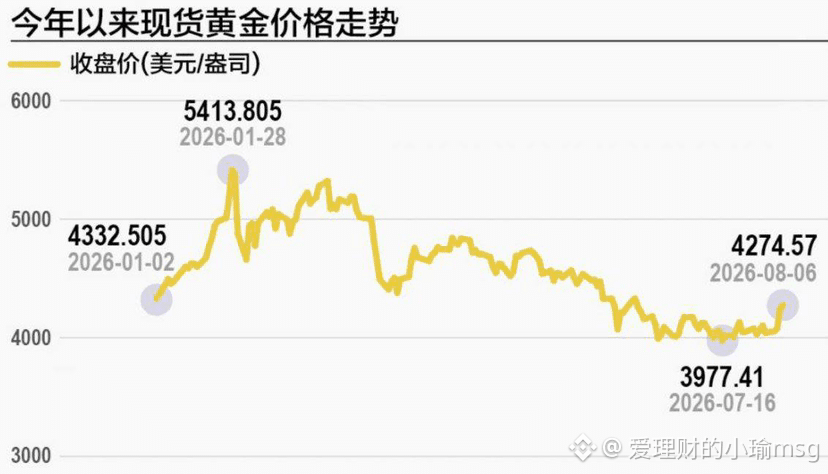
Let’s talk about our view on gold: the short- to mid-term bottom has already emerged, and you can look for opportunities to rebound
In June/July, expectations for the Fed to raise rates surged; at one point the market priced in a 100% chance of a rate hike in September, which pushed gold to its low.
And now, there are two main reasons that have led gold to bottom and rebound:
1️⃣ Rate-cut expectations have rebounded
The non-farm employment data came in weak, increasing the probability of a rate cut in September. The market’s panic-driven rate hikes earlier in the year are no longer factors that can counterbalance gold.
When market expectations for rate hikes are at their peak, gold happened to bottom in July.
2️⃣ Central banks are buying gold again (Chart 2)
Central banks around the world are also buying low and selling high in gold cycles. You can see that global central banks’ gold reserves showed very little increase when gold was at high levels late last year and early this year.
But in June–July, when gold was at low levels, the increment jumped significantly.
So gold prices around $4,000 in June–July are extremely cost-effective.
3️⃣ Analyzing from candlestick charts (Chart 3)
In January–February this year, gold saw daily declines of more than 20%, creating a very clear “pin” (wick).
The level of this pin is 4,050, and in the past two months gold has continued to trade in a tight range around 4,050.
In a bull market trend, the low point of a sharp selloff often provides strong support, and since price has consolidated around this level for a long time, its support is even stronger.
So if the best entry point to get into gold is around 4,050.
At present, gold is still mainly a trading (range) play (taking profit at 4,800 is appropriate). I don’t think it can break into new highs. If you chase gold only after it breaks 4,400, the cost-effectiveness drops a lot.
In June/July, expectations for the Fed to raise rates surged; at one point the market priced in a 100% chance of a rate hike in September, which pushed gold to its low.
And now, there are two main reasons that have led gold to bottom and rebound:
1️⃣ Rate-cut expectations have rebounded
The non-farm employment data came in weak, increasing the probability of a rate cut in September. The market’s panic-driven rate hikes earlier in the year are no longer factors that can counterbalance gold.
When market expectations for rate hikes are at their peak, gold happened to bottom in July.
2️⃣ Central banks are buying gold again (Chart 2)
Central banks around the world are also buying low and selling high in gold cycles. You can see that global central banks’ gold reserves showed very little increase when gold was at high levels late last year and early this year.
But in June–July, when gold was at low levels, the increment jumped significantly.
So gold prices around $4,000 in June–July are extremely cost-effective.
3️⃣ Analyzing from candlestick charts (Chart 3)
In January–February this year, gold saw daily declines of more than 20%, creating a very clear “pin” (wick).
The level of this pin is 4,050, and in the past two months gold has continued to trade in a tight range around 4,050.
In a bull market trend, the low point of a sharp selloff often provides strong support, and since price has consolidated around this level for a long time, its support is even stronger.
So if the best entry point to get into gold is around 4,050.
At present, gold is still mainly a trading (range) play (taking profit at 4,800 is appropriate). I don’t think it can break into new highs. If you chase gold only after it breaks 4,400, the cost-effectiveness drops a lot.