
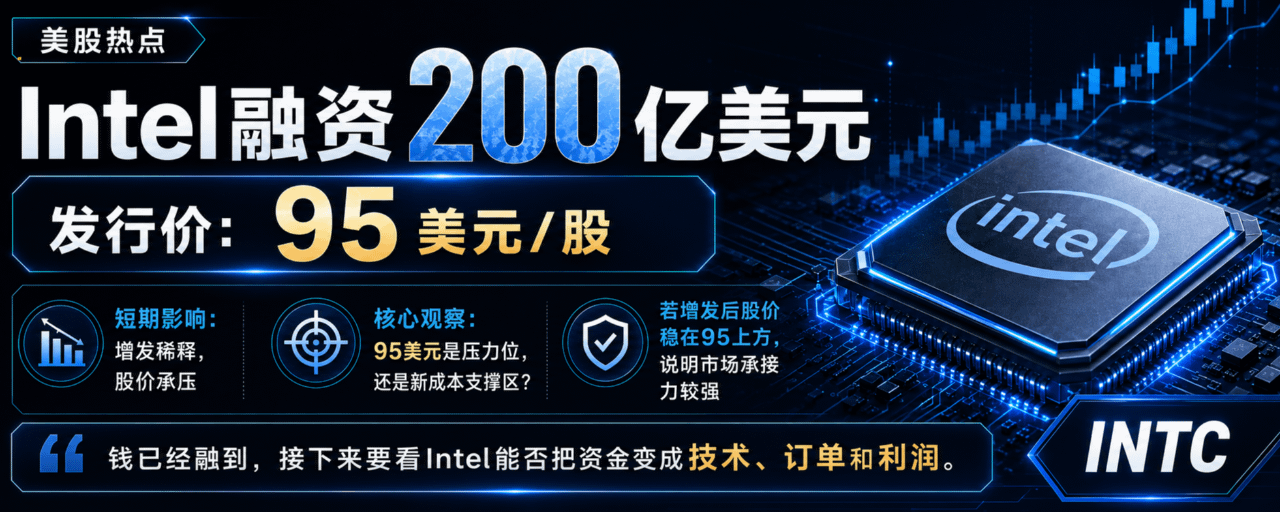

Intel suddenly raised $20 billion— is this bad news for INTC, or a new starting point?
Intel expanded its originally planned financing of about $15 billion further to $20 billion.
The market’s first reaction is very straightforward:
Offering more shares = equity dilution = near-term pressure on the stock price.
So if you only look at the short term, then this certainly doesn’t count as good news.
But I actually think that what’s truly worth looking at isn’t “Intel raised an additional $20 billion,” but rather:
Why is Intel suddenly so short on cash?
The answer is simple—this move also wants to return to the most central table in the global semiconductor industry.
wafer fabs, advanced process technology, advanced packaging, AI servers, and foundry outsourcing—none of these businesses are money-burning free.
Especially now that the AI arms race is still ongoing—TSMC, NVIDIA, and AMD are all pushing forward. If Intel wants to turn itself around by relying on advanced process technology and foundry business, it must keep investing massive capital.
So for this round of financing, I’ll look at it in two stages.
Short term: moderately bearish.
$20 billion isn’t a small amount; equity dilution is an objective reality, and the market needs time to digest it.
Medium to long term: the real exam is only just beginning.
If Intel can turn this money into:
Big customers for advanced process technology, more AI server orders, foundry revenue, and ultimately profits,
But today’s capital increase may instead become a key turning point in Intel’s recovery process.
However, if the money runs out and the technology hasn’t caught up, the customers haven’t delivered, and the foundry business is still continuously loss-making,
Then this $20 billion is just continuing to keep expensive transformation going.
So going forward, I won’t just watch whether INTC goes up or down—I care about three questions:
1. How many truly big customers can Intel’s advanced process actually win?
2. Can the AI server business keep growing?
3. When will the foundry be able to shift from a “money-burning story” to real profit?
My view is simple:
This $20 billion financing, in the short term it’s dilution; in the long term, it’s a high-stakes gamble.
Intel already has the money now.
Next, the market only needs to see one thing:
Can it actually turn the money into technology, orders, and profits?
If anything, INTC’s story is far from over.
If not, no matter how much money there is, it would only extend the length of the race. I think I’m willing to be friends with time.