
Cloudflare is already worth over a trillion dollars, but it’s not a stock that people often bring up in the market. What brought this company to my attention wasn’t that it surged over 20% in the past month, nor was it that any figure in its recent earnings report stood out.
Instead, it was when I was building my website a while back—right from building and running to the GEO design—that I almost never left Cloudflare as my platform.
That’s when I first gained a fairly complete understanding of what Cloudflare is actually doing. After learning about it during this period, I believe its business and future market space will be thoroughly reshaped with the boost of AI.
In the past, many people’s most intuitive understanding of Cloudflare—represented by “$NET.US ”—was still essentially “a CDN + network security company.” But in the present and future, it is truly becoming an intermediary layer in the interaction between AI and websites.
The original business still has a large market, but it’s not “sexy.” The market size can be estimated, but the latter is growing exponentially, and you basically can’t see where the peak might be.
This piece is my personal research log, and I hope that through this perspective alone, it can help you think dialectically and understand Cloudflare’s current and future business and its main strategic thread.
I. First, let’s talk about the current business
So we can simply imagine a scenario like this:
When a company or an individual connects its website domain and network traffic to Cloudflare and enables the corresponding proxy services, thereafter, when requests are made by users or AI Agents, they no longer go directly to the company’s own servers. Instead, they first arrive at Cloudflare nodes closer to the request origin;
After the request enters, Cloudflare can first identify who the visitor is and determine whether there is an attack risk. Then it checks whether nearby nodes have already cached the needed content;
If the cache already has the results, Cloudflare can return them directly. If the request requires new data or business logic, it forwards to the customer’s origin, gets the result, and then returns it to the user.
The role Cloudflare plays here is: customer → Cloudflare → origin server/app ← Cloudflare ← external user or Agent requests—the intermediary layer.
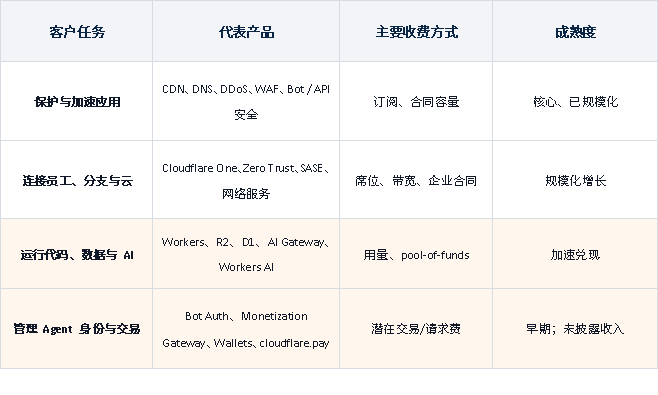
The key to understanding Cloudflare isn’t only knowing that it sits in the “middle.” More importantly, you need to understand that in this middle layer, it can map different needs to different products and perform different jobs.
All of this is happening along the same path I mentioned above. Its future strategy is also built on that path—adding an additional layer of services.
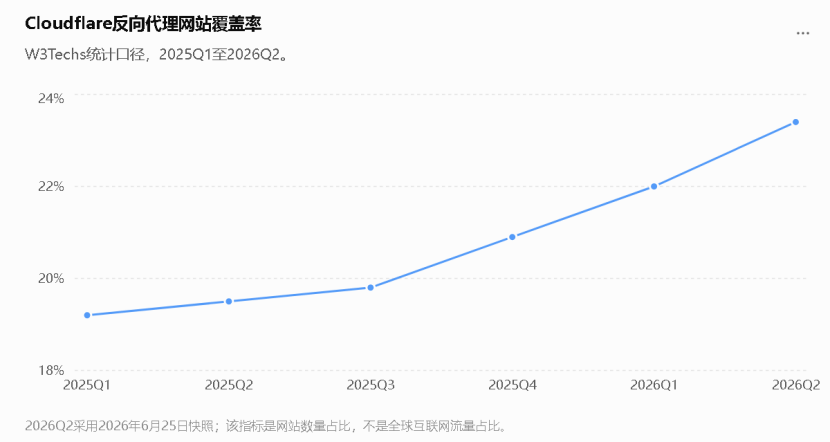
As of Q2 2026, W3Techs statistics show that roughly 23% of websites globally use Cloudflare as a reverse proxy
II. Platformization and latest data verification
Being at the traffic entry point doesn’t mean this traffic can automatically convert into revenue.
So it still needs to be combined with last week’s disclosed quarterly data: after a customer connects its website and network to Cloudflare, can Cloudflare keep selling more services around the same request path—and get the customer to invest more money into this network?
If you push back seven quarters of data, this is already happening:
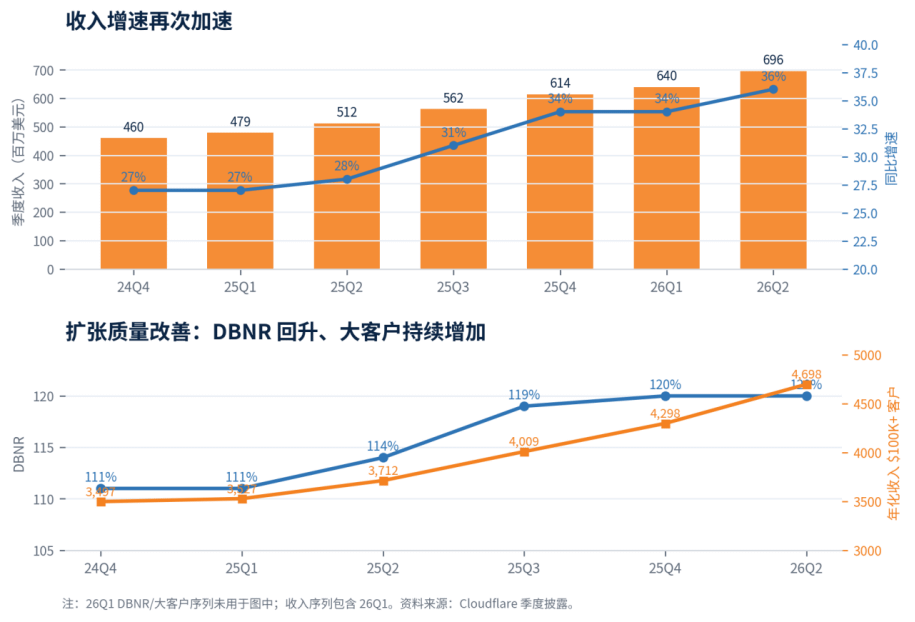
From Q4 2024 to Q2 2026, Cloudflare’s quarterly revenue grew from $460 million to $696 million. The year-over-year growth rate gradually increased from 27% to 36%. Meanwhile, DBNR—which measures expansion among existing customers—rebounded from 111% to 120%.
This means that the same cohort of customers that had already been using Cloudflare a year ago—after accounting for customer churn and spending contractions—still contributes about 20% more annualized revenue than a year ago.
In the same period, the number of large customers with annualized revenue exceeding $100,000 increased from 3,497 to 4,698—an accumulated growth of over 34%.
Put these three sets of data together, and you can see that Cloudflare’s growth this round isn’t only because more personal websites and small customers are connecting.
Currently Cloudflare hasn’t disclosed independent revenue for different products, so we still can’t directly assert that all of these growth figures come from cross-product sales. But revenue acceleration, DBNR rebound, and continued growth of large customers are happening at the same time—at least consistent with the judgment that platformization is deepening.
If what Cloudflare provides is still only traditional CDN, then the additional spending room customers can increase is actually limited. That’s also why I said at the beginning that this isn’t “sexy.”
But the combination of multiple products turns Cloudflare into a multi-demand supply platform built around a single path.
These products (Figure 1 above) may look like they belong to different markets, but at the underlying level they reuse the same global network, the same set of traffic data, and the same transmission path.
So what’s truly great about Cloudflare’s platform strategy isn’t just that the number of products keeps increasing. I think it’s the continuous development along this path that keeps further diluting the overall marginal cost.
III. The future: from “carrying the internet” to “carrying the internet empowered by AI”
In the AI era, the way we obtain content and access websites has been changing rapidly.
Speaking for myself: in the past, when I wanted to find an SEC-listed company’s earnings reports, I could only check an earnings calendar on an American stock information website to see which reports were coming this week and which ones to watch next week. But now I have AI automatically scrape that for me, so I’m opening data sites far less often.
It used to be: I had a need → open a website → the website gives me the data;
Now it’s: I have a need → ask the AI → AI accesses the website/API → scrape the data → organize it → return it to me.
Further into the future, it will most likely even eliminate the need for final human confirmation—Agents will find information on their own, call APIs, execute tasks, and then interact with another Agent.
Our way of interacting has been quietly changed. You may still be in a ramp-up phase and people may not feel it clearly yet. But if you put this scenario back into the time two years ago when most models didn’t support联网, you’ll notice a very obvious contrast.
Combining the Cloudflare business transmission paths I explained in the first two sections, everyone should be clear about what Cloudflare’s main future strategy is: it will remain on the original path, layering in new business scenarios. Even more terrifying is that these scenarios will be extremely high-frequency.
Put this change back into the Cloudflare business path introduced earlier, and the new request chain becomes: customer → Cloudflare → origin server/app ← Cloudflare ← Agent requests/AI model ← external users
Why, in my view, this is a narrative with a lot of imagination:
Because one person can’t continuously open a dozen websites at the same time, repeatedly call dozens of APIs, and execute tasks around the clock. But that is exactly the kind of behavior that AI can do—and can do well.
The frequency at which humans use the internet is limited by time and attention. But the frequency at which machines use the internet can grow alongside compute capacity, the number of Agents, and task complexity.
In Cloudflare CEO’s earnings call, he clearly stated that in 2026 Q2, for the first time, more than 50% of Cloudflare network traffic will not be generated by humans, and AI Agent requests are still growing.
Note: Not all of this traffic is AI Agents; it also includes traditional scrapers, automation tools, and malicious bots.
At the same time, in the earnings call, Cloudflare described the future mode very directly: in the future, it may charge extremely small fees for Agent requests that pass through websites.
This fee per transaction is small, but the volume is huge. Cloudflare hasn’t yet disclosed its pricing standards and take-rate, and the product is still on a waitlist stage;
A few days ago I went and claimed a wallet username—my suggestion is that anyone deploying a website on it should go claim one first

I personally feel this deeply when building a site. To reach people in the public domain, the online courses I’ve been looking for aren’t just staying at SEO anymore—they’re becoming GEO. This is a very clear, and very urgent, trend, and Cloudflare is capturing it and embedding the business steps into it.
Its future is to turn the act of “machine/AI accessing the internet” itself into something identifiable, controllable, and tradable. The imagination space here is qualitatively different from today’s existing business—separating two eras.
IV. From traffic entry points to the birth place of applications
If the Agent traffic mentioned earlier represents that the demand side of the internet is changing, then the growth in the number of developers validates whether the supply side is also migrating to Cloudflare.
In the Q2 earnings call, a somewhat scary growth statistic was disclosed:
In 2026 Q2, Cloudflare added nearly 2 million new developers in a single quarter, whereas for the entire previous year it added only about 1.5 million developers. That means: the developers attracted in just Q2 are more than the total for the whole prior year.
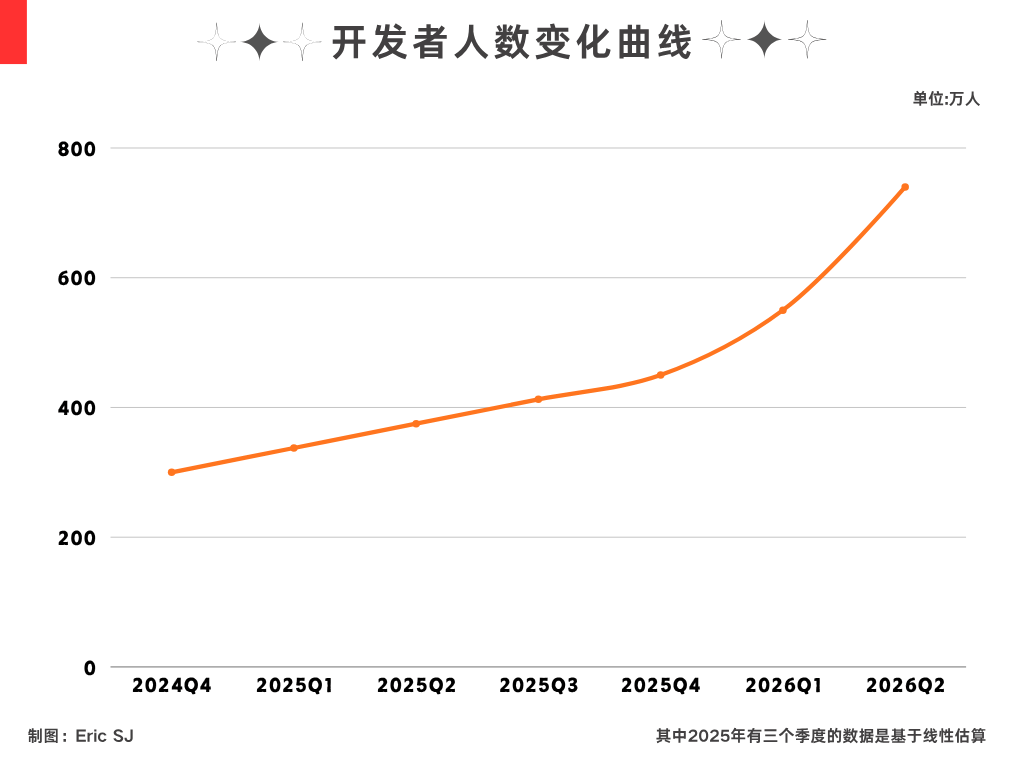
In the earlier period, more than 50% of non-human traffic can only prove that more and more machines are “passing through Cloudflare,” or put another way, it validates the potential trend of machines scraping websites.
But the explosion in the number of developers proves that more and more people are starting to “build things on Cloudflare.” To some extent, the future growth of the two can even be said to be positively correlated—because once these applications are running, they continue consuming Cloudflare’s compute, databases, object storage, AI inference, network transmission, and security products, among a whole set of other products.
Its transmission path is roughly:
More developers → more apps and Agents are created → more compute and network requests are generated → more Cloudflare product calls → more usage and revenue.
In Cloudflare’s Q2 official earnings report, while it didn’t break out independent revenue for the developer platform, management explicitly put the record-breaking growth of developers on par with this quarter’s performance, and described its future positioning as the infrastructure, control layer, developer tools, and payment rails for [proxy internet].
If you think back to the past, Cloudflare was basically waiting for websites to be built first, then letting customers bring traffic in.
For that future Cloudflare wants to apply the idea that deployments begin on Cloudflare from the moment of “birth,” and then—naturally, as traffic and features grow—gradually expand usage of other products as well.
The more developers there are, the more applications there are. The more applications there are, the more requests and data there are. The greater the usage, the more infrastructure and products Cloudflare can invest in. And the more complete the platform capability, the more developers it attracts.
Therefore, the number of developers can be viewed as a leading indicator of Cloudflare’s future revenue—not revenue itself.
Cloudflare has a very large free tier, and many developers may just be trialing products, deploying personal projects, and in the end won’t become paid customers. Take my personal site as an example: when I first built my website, I deployed it on Cloudflare. It has been running for almost a month now, and I still haven’t paid a cent.
And even if it converts into paid users, the revenue generated by different developers could differ by several orders of magnitude.
At the moment, Cloudflare hasn’t disclosed independent revenue for its developer platform, the paid developer proportion, or average revenue per developer. Therefore, we still can’t estimate how much future revenue this portion could generate from the 7.4 million developers alone.
Developer growth proves the direction, not the final outcome of commercialization. That’s why the most challenging part of the current valuation is precisely that the market has already purchased this outcome to what extent in advance.
V. If you buy Cloudflare now, is it worth it?
Finally, going back to the Q2 earnings report itself, looking only at the financial figures, multiple key metrics are improving in parallel:
Revenue grew 36% year over year; the number of large customers continued to rise; DBNR returned to 120%; Current RPO maintained 35% year-over-year growth; and free cash flow grew about 69% year over year.
Placing these data in a company that already has such a massive scale, you could say it’s a quite high-quality earnings report.
The stock price has performed pretty well in the last quarter, and I also don’t think you can simply attribute the rally to earnings beating expectations.
Its current market cap fluctuates in the range of $100–110 billion, while Cloudflare’s latest full-year 2026 revenue guidance is $2.864–$2.870 billion. Using the midpoint, the current market cap is roughly about 35–38x of its 2026 revenue.
This isn’t cheap—this is Cloudflare’s biggest problem at its current share price: great company ≠ something you can buy right now.
Based on profit calculations at the moment, the result is easy to make people纠结. If you buy now, it’s not only a bet that the company can keep growing in the future, but also a bet that the market is willing to maintain a high valuation for the long term.
The more contradictory part is that the company’s growth rate is also being amplified rather than stagnating and then relying on storytelling alone to support the stock price. Otherwise, I wouldn’t have spent so much effort above laying it out.
In my view, its network entry points, platformization capabilities, and strategy for entering the Agent layer are definitely worth long-term attention—and are also very “sexy.”
So it’s hard for me to conclude and tell you whether this price is too high and how much risk there is in buying. But I can tell you this: if you agree with what I said above about its strategic value and how “sexy” it is, then you’ll know that a $100 billion valuation may not be the endpoint. As a more prudent approach, you can consider building the position in batches.
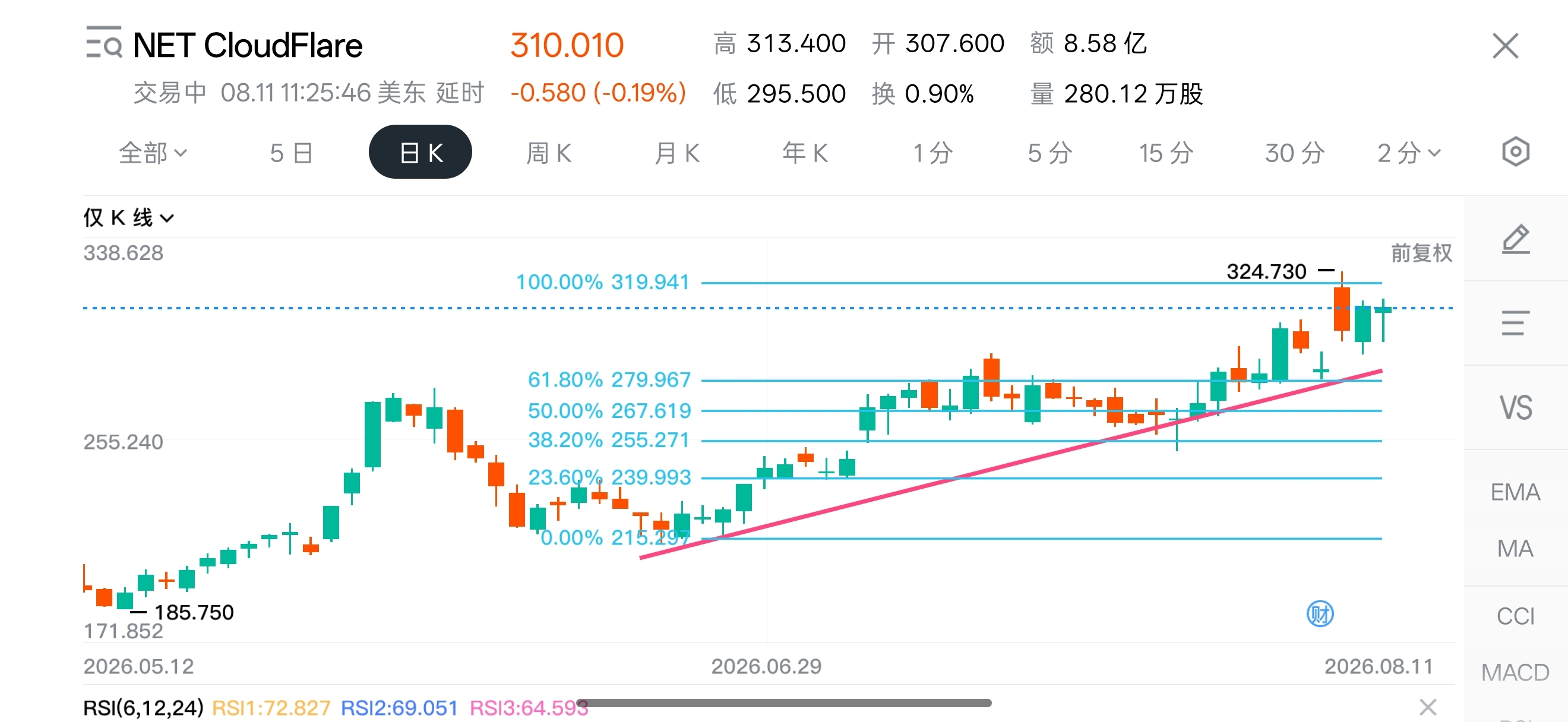
So coming back to the stock chart, I can tell you a bit further: roughly what support price range might be suitable to enter at:
The three support levels in order are: 280–260–225