


Today we continue to discuss the 6th issue of the 26-year investment research journey - ADA. This project was discussed on March 10, 2023. At that time, my judgment was that the innovation was not enough to cover its flaws, and the drawbacks were very obvious. The public chain that came out in 2015 has developed for 8 years, and there are no outstanding applications on-chain, and the TVL is also insufficient. It's basically very difficult to rise, and the only innovation is in the consensus mechanism. Although it surpasses Bitcoin in speed, compared to today's high-speed public chains, 300 TPS really cannot compete.
Therefore, I believe the entire ADA project does not conform to the logic of 'value investment', and there isn't even an opportunity for speculation since there is no new narrative. So, I would like to discuss with all of you, should we continue to talk about projects without value in the upcoming investment research journey? There are 2 options: one is to go through all the top 100 by market cap as promised before, and the second is to filter out the garbage projects and only select those with opportunities and potential! Please give me your opinions in the comments section!
This issue will first provide a popular science introduction to ADA!
1. Introduction
ADA-Cardano is a public chain established in 2015, founded by Ethereum co-founder Charles Hoskinson. The biggest innovation of ADA is the innovation of the consensus mechanism, which is Ouroboros, a PoS (Proof of Stake) that has undergone rigorous academic peer review and can be mathematically proven to be secure.
Charles's core judgment is: if the consensus mechanism lacks mathematical proof, then it is essentially just an 'engineering assumption.' Therefore, his goal in creating Cardano was to first prove 'absolute security' before discussing scalability and ecology. However, after so many years of development, this judgment is clearly wrong!
2. The Core Design Philosophy of Ouroboros
1. Time Fragmentation: Epoch + Slot
Ouroboros divides time into Epochs, with each Epoch divided into multiple Slots. In each Slot, the system randomly selects a Slot Leader responsible for block production.
Election Basis: The amount of ADA held and staked. The more staked, the higher the probability of being selected! The VRF random function is used for the selection function!
This compares to the old problems of PoS: bribery attacks, block producer prediction attacks, and centralization game issues. As long as more than 51% of the stake is held by honest nodes, the protocol can guarantee mathematically verifiable security and effectively resist 51% attacks.
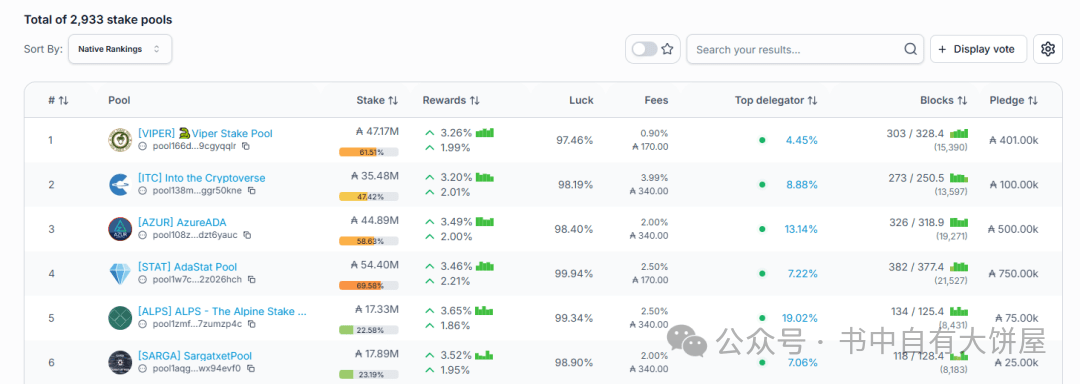
Currently, in terms of decentralization, Cardano is doing well, with the on-chain browser showing 2933 staking pools!
3. The Defects of ADA
1. Account Model - eUTXO Model (similar to Bitcoin)
Cardano's account model uses a UTXO model similar to Bitcoin. It is unclear why Ethereum's core founder would choose the outdated UTXO account model instead of Ethereum's wallet address account model. UTXO has many problems; although it is good in terms of security, it significantly increases the complexity of smart contract development and is severely disconnected from the EVM ecosystem!
Moreover, its smart contract language is Haskell / Plutus, which has a very high learning curve and low development efficiency, so new projects are more inclined towards EVM / Solana! At this stage in 2026, the reasons for developers to choose Cardano are becoming fewer.
2. Dapp & DeFi Ecosystem Cannot Rise
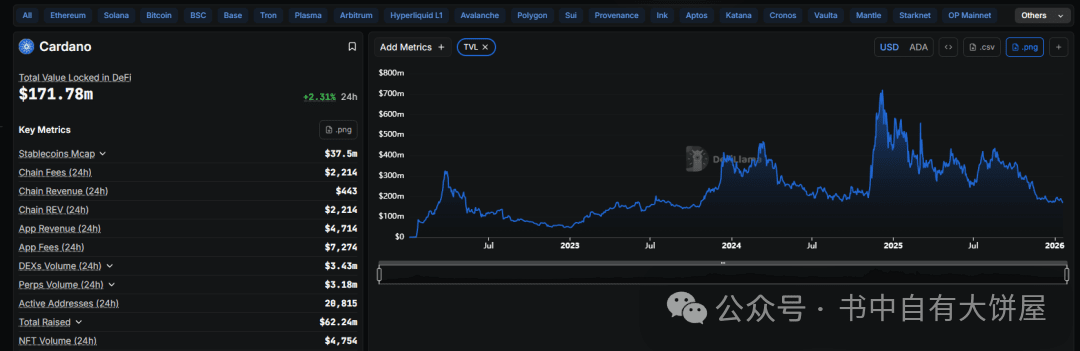
It is precisely because the above account model was chosen that the difficulty of developing DeFi apps has sharply increased. Currently, there are no standout applications on the chain, and it has been said before that the soul of a public chain is applications! Currently, Cardano's TVL has dropped to 170 million, while three years ago it was still 300 million, which is severely inconsistent with its market value of 16 billion!
4. Token Data
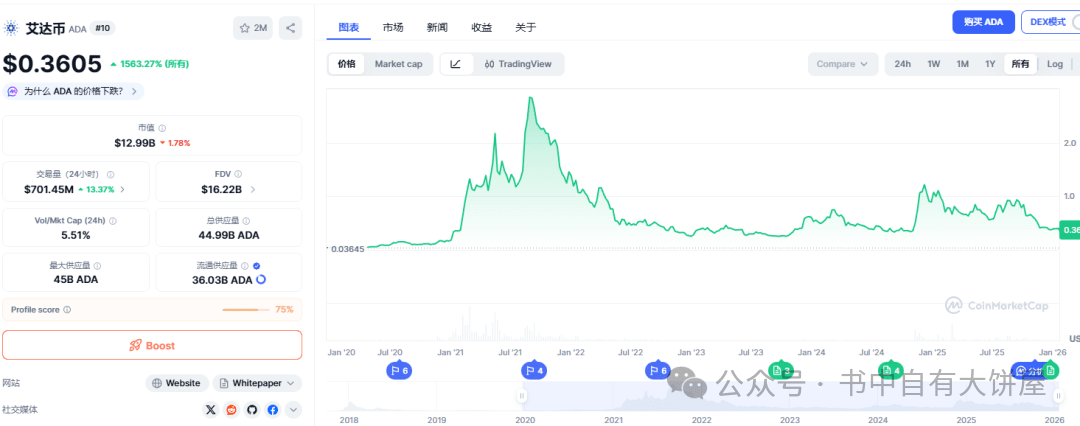
The total supply of tokens is 45 billion, with 36 billion currently in circulation. Since it is PoS, the yield rate of the stake pool is about 3%, and there is currently a downward trend!
Currently, the coin price is 0.36, the highest point in 2024 is 1.2, and the highest point in 2021 is 3. So this round has also not broken the previous high, and the maximum increase in this round in 2024 is 4.8 times (lowest 0.25, highest 1.2), and the growth multiple has not exceeded Bitcoin, so the performance this round is relatively poor. In 2024, Trump still promoted ADA, otherwise, the performance might have been worse!
In conclusion, the project's development progress is actually very slow. After so many years, there have been no major innovations, and the commercialization path is also very slow. The demand conversion for tokens is very weak, and no buybacks or burns have been initiated, providing almost no stimulus for ADA tokens. Although there is innovation in the consensus mechanism, it is already significantly lagging behind the current high-speed public chains. In the future competition among public chains, it is expected to be difficult to stand out! So will Trump continue to promote it? I think it is highly unlikely, after all, Trump hasn't even promoted his own project! $ADA