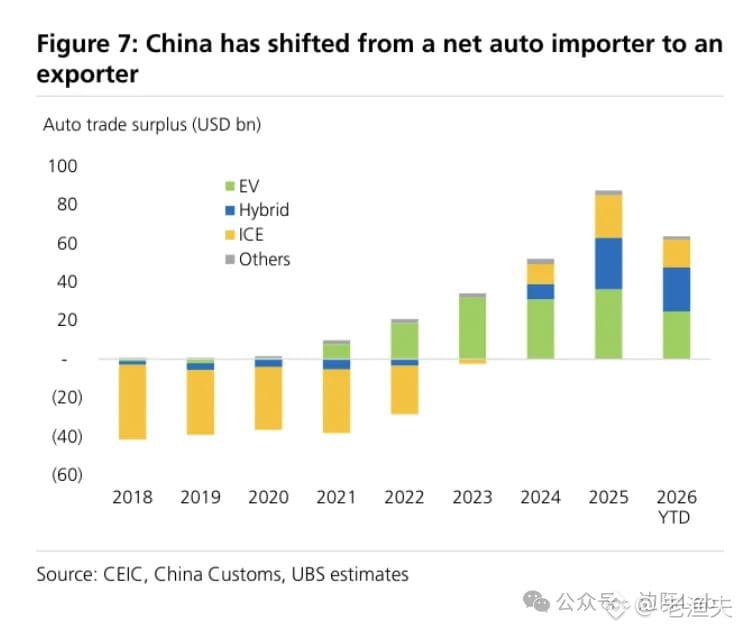
China’s automakers’ latest push to expand overseas is moving faster than expected. In the first half of 2026, exports are up year-on-year by +60%; hybrids +115% and pure electric vehicles +57%. This isn’t just a matter of subsidy-driven volume. Behind it are excess manufacturing capacity spillover, supply-chain integration, and structural demand for electrification fueled by growing global energy-security concerns.
After China became a net exporter in 2023, its trade surplus has continued to widen—much like the path taken by Japanese and South Korean automakers in the 1990s: first use cost performance to open up emerging markets, then gradually penetrate developed markets’ mid-to-low end segments. UBS estimates that by 2030, Chinese automakers could account for one-third of global market share. That figure isn’t overly aggressive—assuming trade barriers in the U.S. and Europe don’t escalate significantly.
But several risks should be kept in mind:
1) Geopolitical headwinds: EU anti-subsidy investigations and the U.S. IRA Act are squeezing the space for Chinese automakers in key markets
2) Pressure to localize production: in the future, they may be forced to build factories overseas, which will change the cost structure
3) Brand-premium ceiling: cost performance can open markets, but sustaining profit margins depends on technology moats and brand strength
In the near term, export data looks impressive; in the longer term, success will hinge on whether Chinese automakers can truly establish a foothold in the global value chain. This isn’t simply “Made in China 2.0”—it’s a comprehensive contest involving industrial chains, capital, technology, and branding.
After China became a net exporter in 2023, its trade surplus has continued to widen—much like the path taken by Japanese and South Korean automakers in the 1990s: first use cost performance to open up emerging markets, then gradually penetrate developed markets’ mid-to-low end segments. UBS estimates that by 2030, Chinese automakers could account for one-third of global market share. That figure isn’t overly aggressive—assuming trade barriers in the U.S. and Europe don’t escalate significantly.
But several risks should be kept in mind:
1) Geopolitical headwinds: EU anti-subsidy investigations and the U.S. IRA Act are squeezing the space for Chinese automakers in key markets
2) Pressure to localize production: in the future, they may be forced to build factories overseas, which will change the cost structure
3) Brand-premium ceiling: cost performance can open markets, but sustaining profit margins depends on technology moats and brand strength
In the near term, export data looks impressive; in the longer term, success will hinge on whether Chinese automakers can truly establish a foothold in the global value chain. This isn’t simply “Made in China 2.0”—it’s a comprehensive contest involving industrial chains, capital, technology, and branding.