The biggest feature of last night’s U.S. stock market was that clear differentiation began to emerge.
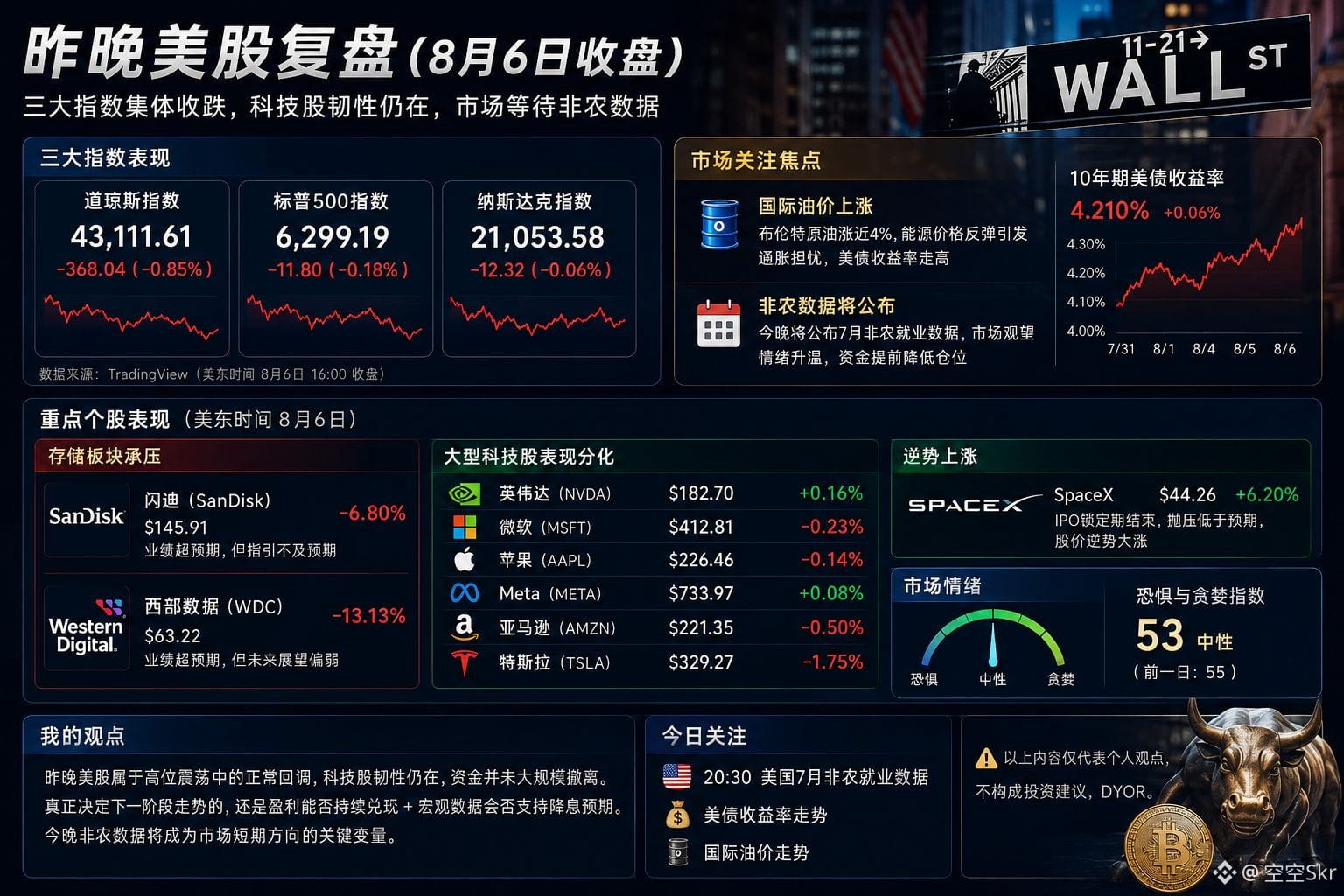
All three major indexes closed lower together: the Dow fell 0.85%, the S&P 500 declined 0.18%, and the Nasdaq only slipped 0.06%. The indexes looked somewhat weak, but tech stocks did not show panic selling. The market felt more like a normal rotation at elevated levels.
What truly drove market sentiment were two things.
First, international oil prices rose again. Uncertainty in the Middle East pushed crude oil higher. U.S. Treasury yields moved up in tandem, and the market started pricing in inflation risk once more.
Second, ahead of the release of the Nonfarm Payrolls report, capital clearly became more cautious. After consecutive gains, many institutions chose to lock in some profits first, then wait for new macro data to provide direction.
At the individual stock level, the divergence was even more pronounced last night.
The AI theme is still far from extinguished, but the market has become more selective.
The storage sector faced the most pressure. SanDisk fell by about 6.8% intraday, while Western Digital dropped more than 13%. Although the two companies’ overall performance isn’t bad, the market was not satisfied with their forward guidance. This suggests that capital is no longer only looking at whether there is growth—it now demands that growth continues to beat expectations.
By contrast, large-cap tech names such as Nvidia, Microsoft, Apple, and Meta saw relatively limited overall movement. They did not experience a clear wave of catch-up declines despite the index pullback. This indicates that institutional funds still treat AI as a core allocation direction, but they have shifted from chasing valuations to screening for companies that can truly deliver results.
Another thing worth watching is that SpaceX actually rose against the trend, up more than 6%. Earlier, the market worried that the end of the IPO lock-up period would bring substantial selling pressure, but in reality the selling pressure was lower than expected. Funds chose to flow back in, which also suggests that high-momentum growth stocks still have strong ability to attract demand.
For the crypto market, this isn’t necessarily a bad thing.
As long as the AI tech main theme isn’t damaged, overall risk appetite for Bitcoin and the broader crypto market will still have support. But in the short term, what will truly determine the direction is still the U.S. macro data that is about to be released.
What the market is trading now isn’t yesterday—it’s the future.
The above is for informational purposes only and does not constitute investment advice. Do your own research (DYOR).
All three major indexes closed lower together: the Dow fell 0.85%, the S&P 500 declined 0.18%, and the Nasdaq only slipped 0.06%. The indexes looked somewhat weak, but tech stocks did not show panic selling. The market felt more like a normal rotation at elevated levels.
What truly drove market sentiment were two things.
First, international oil prices rose again. Uncertainty in the Middle East pushed crude oil higher. U.S. Treasury yields moved up in tandem, and the market started pricing in inflation risk once more.
Second, ahead of the release of the Nonfarm Payrolls report, capital clearly became more cautious. After consecutive gains, many institutions chose to lock in some profits first, then wait for new macro data to provide direction.
At the individual stock level, the divergence was even more pronounced last night.
The AI theme is still far from extinguished, but the market has become more selective.
The storage sector faced the most pressure. SanDisk fell by about 6.8% intraday, while Western Digital dropped more than 13%. Although the two companies’ overall performance isn’t bad, the market was not satisfied with their forward guidance. This suggests that capital is no longer only looking at whether there is growth—it now demands that growth continues to beat expectations.
By contrast, large-cap tech names such as Nvidia, Microsoft, Apple, and Meta saw relatively limited overall movement. They did not experience a clear wave of catch-up declines despite the index pullback. This indicates that institutional funds still treat AI as a core allocation direction, but they have shifted from chasing valuations to screening for companies that can truly deliver results.
Another thing worth watching is that SpaceX actually rose against the trend, up more than 6%. Earlier, the market worried that the end of the IPO lock-up period would bring substantial selling pressure, but in reality the selling pressure was lower than expected. Funds chose to flow back in, which also suggests that high-momentum growth stocks still have strong ability to attract demand.
For the crypto market, this isn’t necessarily a bad thing.
As long as the AI tech main theme isn’t damaged, overall risk appetite for Bitcoin and the broader crypto market will still have support. But in the short term, what will truly determine the direction is still the U.S. macro data that is about to be released.
What the market is trading now isn’t yesterday—it’s the future.
The above is for informational purposes only and does not constitute investment advice. Do your own research (DYOR).