


China Trust Bank and Boston Consulting Group (BCG) jointly released the 2026 Taiwan Ultra High Net Worth Customer Wealth Insight Report, which primarily studies high net worth customers with net assets exceeding NT$100 million in Taiwan and abroad. The report reveals that high net worth users are still primarily from the wealth creation generation, and it also discloses that over 30% of ultra-high net worth users have invested in cryptocurrencies, far exceeding the proportion of cryptocurrency holders in Taiwan.
Evolution of customer demographics: High net worth users are still mainly from the wealth creation generation
The current wealth core is still dominated by entrepreneurs aged 55 to 64 (the wealth creation generation), accounting for about 30%. The second and third generations (the new wealthy generation) account for about 25%. The report indicates that Taiwan's family wealth structure is gradually entering a new stage of generational co-governance.
The report indicates that the ultra high-net-worth client group with assets over NT$ 1 billion grows by 7% annually.
Taiwan's total personal wealth is expected to reach NT$ 279 trillion by 2029. While wealth is steadily growing, cross-border asset allocation has shifted from being a hedging option to a fundamental strategy, and client demand is evolving from simple personal finance to institutional family governance.
The report indicates that thanks to the strong performance of the semiconductor and AI supply chains, the scale of Taiwan's high-net-worth population continues to expand. The number of users with wealth exceeding NT$ 100 million increased by 4% from 2021 to 2025, while those with wealth in the NT$ 10 billion range grew by 7% during the same period.
It is expected that by 2029, the number of 'high-net-worth clients' with assets exceeding NT$ 100 million will grow to 155,000. Notably, the growth momentum of the 'ultra high-net-worth clients' with assets exceeding NT$ 1 billion is even more significant, with the number expected to grow at an annual rate of 7%, outpacing the overall average, and their total personal wealth is expected to reach NT$ 59 trillion.
Over 50% of high-net-worth users have allocated their assets overseas, generally reducing their holdings in the Chinese market.
In the face of external uncertainties, geopolitical issues are seen as the biggest external risk by high-net-worth clients. The survey shows that as many as 74% of respondents already hold offshore assets. Among them, 15% of clients have allocated more than half of their assets overseas.
In terms of market preferences, Singapore has become the financial center with the strongest momentum for increasing holdings in the Asia-Pacific region due to its stable political and economic environment and tax advantages; the United States and Japan are also favored by investors. In contrast, high-net-worth clients generally hold a conservative wait-and-see attitude towards assets in mainland China, even showing a trend of reduction in holdings.
Main reasons for high-net-worth users adjusting asset allocations: geopolitical issues
The report points out that the core driving factors for high-net-worth clients adjusting their asset allocation have clearly shifted from single market performance to 'external uncertainties', with geopolitical risk being the most concerning. As many as 48% of respondents indicated that they adjusted their asset allocation due to increased uncertainty in U.S. policies and escalating geopolitical conflicts, the highest among various factors; followed by asset price volatility (44%), reflecting the market's sensitivity to short-term severe fluctuations. Other factors include the global shift in monetary policy (38%) and AI development (31%).
In terms of actual response strategies, high-net-worth groups have the clearest action direction focusing on 'outflow' and 'diversification.' 33% of respondents chose to increase overseas asset allocation in their Taiwan accounts, while 32% directly transferred assets overseas to reduce regional risks; at the same time, 29% increased their asset weight in major markets like the U.S., Japan, and Europe, and 25% increased their investments in stocks and equity products, indicating that diversifying markets and asset types remains the mainstream defensive strategy.
In contrast, the proportion of those adjusting single market allocations, who have not yet taken action, or who make minor adjustments through structured products, private equity, real estate, and alternative assets tends to hover around 10%. Overall, high-net-worth clients, facing a highly uncertain external environment, are no longer solely relying on tactical operations but are systematically reducing geopolitical and policy risks through cross-market, cross-currency, and cross-asset allocations.
The report reveals that high-net-worth users have a much higher proportion of investment in cryptocurrencies compared to the average in Taiwan.
Fidelity International (2025 Asia-Pacific Investor Survey) shows that 24% of Taiwanese investors indicate they hold digital assets, although the proportion is not high, it has doubled compared to 2024 (12%). However, this survey is targeted at investors; if the denominator is expanded to the total population, it is rumored that the number of cryptocurrency holders is around 5%.
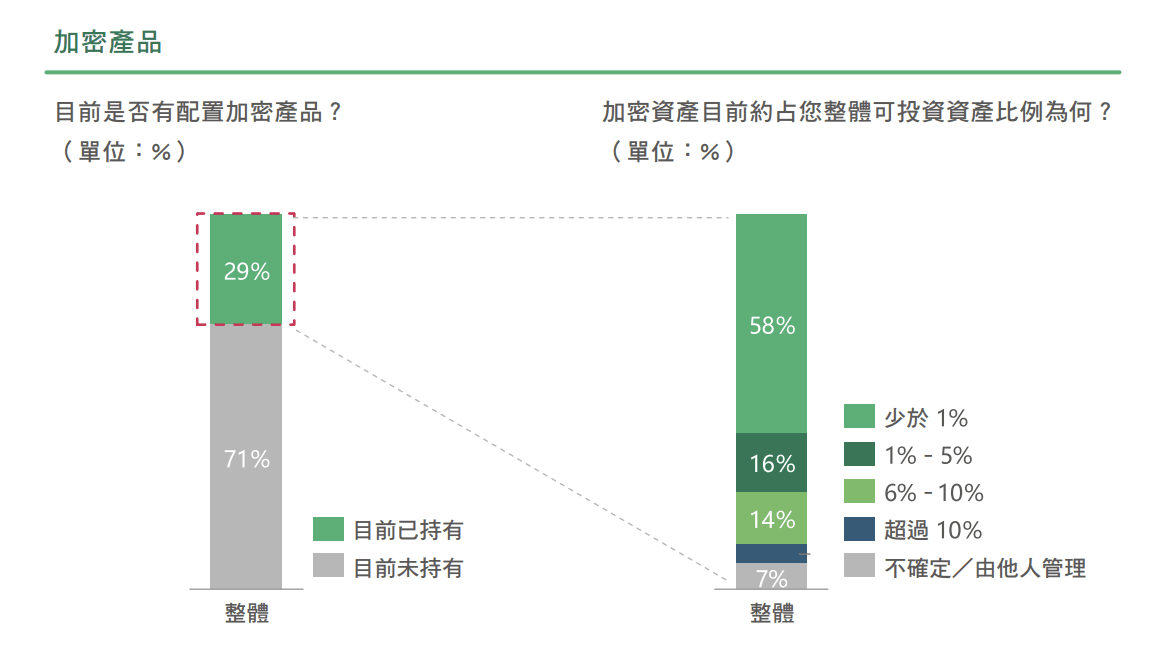 Source: 2026 Taiwan Ultra High Net Worth Client Wealth Insight Report
In comparison, as many as 29% of high-net-worth users hold cryptocurrencies. However, about 58% of them hold it only as an experimental allocation, with their holdings accounting for less than 1% of total assets. 5% of high-net-worth users have a cryptocurrency allocation exceeding 10%, 14% have an allocation of about 6-10%, and 16% have an allocation between 1-5%.
This article is authorized for reprint from: (Chain News)
Original title: (China Trust 2026 Ultra High Net Worth Client Report: Over 30% of Taiwan's billionaires allocate cryptocurrencies, far exceeding the average)
Original author: Neo
The article 'China Trust 2026 Billionaire Report: Over 30% of Taiwan's billionaires allocate cryptocurrencies, far exceeding the average' was first published in 'Crypto City'