


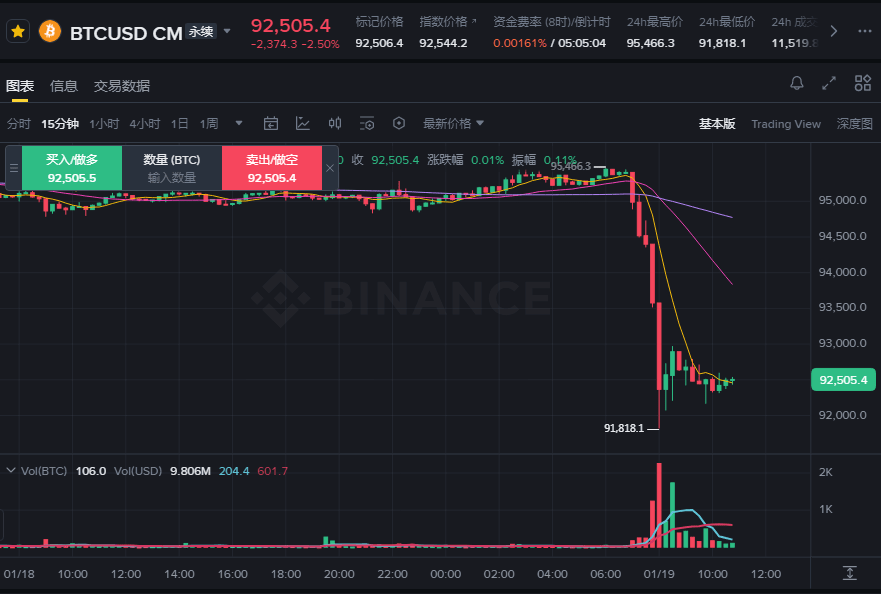
On the morning of January 19, 2026, around 7 a.m., the cryptocurrency market experienced a sudden crash, with mainstream coins collectively plummeting significantly, and the short-term volatility exceeding the market's recent expectations. BTC rapidly fell from $95,531 to a low of $91,910; ETH also weakened in tandem, with its price dropping from $3,350 to $3,177; SOL was not spared either, falling from $143 to $130. Smaller coins saw even more significant declines, with some altcoins like SUI, XPL, and ASTER experiencing drops of over 10% within 24 hours.
The rapid price drop directly triggered a large-scale liquidation. According to Coinglass data, the total amount of liquidations across the network reached $830 million in the past 12 hours, with long positions accounting for the absolute majority, totaling $764 million. In the past 24 hours, the largest single liquidation occurred on the Hyperliquid exchange, involving a perpetual contract worth $25.8337 million for BTC-USDT, forcing a large amount of leveraged funds to be liquidated, further amplifying price volatility. The current fear and greed index in the cryptocurrency market has fallen to 45, with market sentiment shifting from a previously neutral range towards caution.
In stark contrast to the severe situation in the crypto market, traditional safe-haven assets have simultaneously experienced a strong rally, setting a historical high against the trend. Spot gold successfully crossed the $4690 per ounce mark, with a daily increase exceeding 2%; spot silver performed even stronger, breaking through $94 per ounce, with a daily increase exceeding 4%, clearly reflecting a preference for safe-haven assets.
U.S. stocks have not reacted directly today due to the market closure, but U.S. stock futures have already come under pressure. The S&P 500 futures opened down 0.71%, while NASDAQ futures saw a decline that once expanded to 1.1%; the dollar index also weakened, dropping 0.26% to 99.14. The bond market showed safe-haven characteristics, with both 10-year and 30-year U.S. Treasury futures rising by 5 points, reflecting a comprehensive response to geopolitical and macro-level uncertainties.
This flash crash is by no means an isolated incident; the core driving force comes from the dual intertwining of geopolitical tensions and macro factors. Trump has once again unleashed tariff measures, becoming the key trigger for market sentiment. The direct cause of last year's crypto market "1011 crash" was Trump's waving of the tariff stick against China, and now a similar scenario is playing out again.
On January 18, Trump posted a statement on Truth Social, announcing that due to the Greenland issue, starting from February 1, he would impose a 10% tariff on all goods exported to the U.S. from Denmark, Norway, Sweden, France, Germany, the UK, the Netherlands, and Finland, and this tariff will be raised to 25% on June 1, until both parties reach an agreement on a "comprehensive and complete purchase of Greenland." In his post, he stated that the aforementioned eight countries have all become involved in Greenland with unclear intentions, posing a serious threat to global security, and this dangerous situation is intolerable and must be quickly ended through strong measures.

This tariff threat immediately triggered a strong backlash from Europe. According to CNBC, several European leaders have made clear statements emphasizing that the sovereignty of Greenland is non-negotiable, while warning that this move will exacerbate transatlantic rifts. European Commission President Ursula von der Leyen and European Council President Antonio Costa pointed out that pressuring allies with tariffs would harm EU-U.S. relations and could trigger a dangerous vicious cycle; EU High Representative for Foreign Affairs and Security Policy Josep Borrell believes that tariffs would hurt mutual prosperity and distract Europe from issues concerning Ukraine, allowing adversaries like Russia and China to take advantage; Spanish Prime Minister Pedro Sánchez also warned that if the U.S. takes more aggressive actions regarding Greenland, it would have a significant impact on NATO. Currently, ambassadors from the 27 EU countries plan to hold an emergency meeting to coordinate a response.
Opposition voices have also emerged within the U.S. According to Bloomberg, Senate Democrats plan to introduce relevant legislation to prevent Trump from imposing tariffs on European countries opposing the U.S. annexation of Greenland. Previously, Senate Minority Leader Chuck Schumer publicly criticized that this move would harm the U.S. economy and damage relationships with allies. The latest data from Polymarket shows that the market bets that Trump will acquire Greenland before 2027 is only 20%, indicating that this geopolitical divergence is likely to persist for a long time.
The risk aversion triggered by geopolitical conflicts has directly pushed funds to flow out of crypto assets into traditional safe-haven products like gold and silver. Coupled with the impact of Federal Reserve policy expectations, the crypto market is further under pressure. According to Polymarket data, the current market bets that the Federal Reserve will maintain its policy unchanged and not cut interest rates in January have risen to 96%, with a high probability of holding steady putting overall pressure on the valuations of risk assets.
In fact, the market had already shown signs of volatility. On the evening of January 18, the crypto trading indicator analysis platform CoinKarma had previously posted a warning that BTC once approached $98,000 on Monday, but there was near that price level the most obvious selling pressure in recent weeks, leading to a slight price pullback. However, at that time, the liquidity between buyers and sellers had not shown obvious imbalance, and key market indicators had not released clear directional signals. The platform suggested that long positions established at relatively low points at the beginning of the year could consider taking profits and opting for full or partial liquidation, waiting for clearer signals before re-entering the market.
Veteran crypto investor Dan Tapiero has provided a long-term perspective. He stated that if $10,000 were invested in crypto assets in 2026, it could be directly allocated to Bitcoin, Ethereum, and Solana, with specific ratios adjustable according to personal preference. In his view, the biggest opportunities in the cryptocurrency field in 2026 lie in the improvement of infrastructure and the proliferation of stablecoins, while he expects Bitcoin to rise to $180,000 in this cycle, driven by the combined push of demand growth and global monetary policy shifts. Lower interest rates and massive government investments in artificial intelligence infrastructure will create strong benefits, and the depreciation of fiat currencies driven by this global push will provide significant support for Bitcoin.
